Біографія митця
A Life Forged by Sea and Canvas
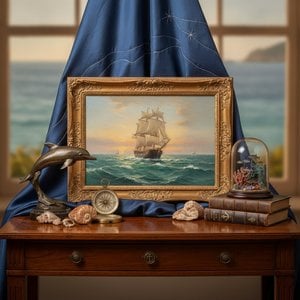
John Wilson Carmichael, a name that resonates powerfully within the annals of 19th-century British marine painting, emerged from the industrious shipbuilding town of Newcastle upon Tyne in 1800. His life’s journey was an extraordinary transformation—a deliberate shift from the tangible world of constructing vessels to the evocative realm of artistic expression. Born into a family deeply rooted in maritime tradition, as the son of a skilled shipwright, Carmichael didn't merely observe the sea; he possessed an innate understanding of its mechanics, its mercurial moods, and the inherent dangers it presented. This intimate familiarity, cultivated through years spent apprenticed to building ships, distinguished him from many of his contemporaries, imbuing his canvases with a realism and authenticity rarely found in those lacking such hands-on experience. Initially following in his father’s footsteps, Carmichael soon discovered an irresistible pull towards art, beginning as a drawing master and honing his skills through the disciplined practice of miniature painting—a foundation that demanded precision, acute observation, and a remarkable ability to capture subtle details. This early training proved invaluable as he expanded his scale and ambition, seamlessly blending technical proficiency with burgeoning artistic talent.
Rising Tide: Early Successes and Establishing a Reputation
Carmichael’s ascent within the art world was marked by both unwavering dedication and fortunate opportunities. His initial works, such as *The Fight Between the Shannon and Chesapeake*, immediately showcased his developing ability to portray dramatic maritime events with compelling narrative force. These paintings weren't simply depictions of naval battles; they were dynamic stories brought vividly to life on canvas, brimming with tension, action, and a palpable sense of historical significance. His talent quickly garnered recognition, leading to prestigious commissions from institutions like Trinity House in Newcastle—a testament to his growing reputation and the demand for his unique artistic vision. Depicting coastal scenes and vital maritime infrastructure solidified his standing within the local art community, establishing him as a respected artist capable of capturing both the beauty and the power of the Northumbrian coastline. *View of Newcastle*, painted in 1827, exemplifies this early success, demonstrating an impressive ability to integrate landscape elements with urban architecture—a skill that would become increasingly prominent throughout his career. The Irwin Lighthouse, Storm Raging (1851), another privately owned piece, showcases his ability to convey the drama and unpredictability of the sea. Of course, *HMS Erebus and Terror in the Antarctic (1847)*, now at the National Maritime Museum, remains a cornerstone of his artistic achievement.
The Crimean War and National Recognition
A pivotal moment arrived with the outbreak of the Crimean War (1853-1856). Carmichael’s exceptional skills were sought after by the *Illustrated London News*, commissioning him to document the conflict, specifically focusing on naval engagements. This assignment transported him to the Baltic Sea, where he witnessed firsthand the dramatic bombardment of Sveaborg (Suomenlinna) in 1855—an event immortalized in one of his most celebrated works, *The Bombardment of Sveaborg*. The painting, a masterful depiction of naval warfare and explosive power, was exhibited at the Royal Academy to widespread acclaim. It now resides within the esteemed collection of the National Maritime Museum, serving as a lasting testament to Carmichael’s artistic prowess and historical significance. His work for the *Illustrated London News* dramatically broadened his audience, transforming him from a respected regional artist into a nationally recognized figure—a testament to his ability to capture complex narratives with visual clarity and emotional resonance.
A Legacy of Technique and Inspiration
Carmichael's artistic style was characterized by an extraordinary realism, meticulous attention to detail, and a remarkable ability to convey both the beauty and raw power of the sea. He wasn’t merely replicating what he saw; he was translating it onto canvas with a deep understanding of light, color, and composition. His paintings often featured dramatic skies, turbulent waters, and meticulously rendered ships—a combination that created a sense of dynamism and immediacy. Beyond his technical skill, Carmichael was also a dedicated teacher, recognizing the importance of sharing his knowledge and expertise. He authored two influential guides on marine painting: *The Art of Marine Painting in Water-Colours* (1859) and *The Art of Marine Painting in Oil-Colours* (1864)—detailed manuals that provided aspiring artists with invaluable insights into his techniques and approaches. These works stand as a lasting legacy, preserving his artistic philosophy and ensuring that his methods would continue to inspire generations of painters.
A Lasting Impression: Key Works and Artistic Significance
Carmichael’s oeuvre is rich with compelling works showcasing his mastery of marine painting. *James Wilson Carmichael and the Arrival of the Royal Squadron (1843)*, held in a private collection, exemplifies his ability to capture the grandeur and excitement of naval ceremonies. *The Bombardment of Sveaborg*, remains a cornerstone of his artistic achievement, while works like Off the Dutch Coast (1858) demonstrate his continued exploration of light, atmosphere, and maritime life. Carmichael’s legacy extends beyond individual paintings; it resides in his ability to capture the very essence of maritime existence—the thrill of naval combat, the tranquility of coastal scenes, and the enduring power of the ocean itself. His work continues to be admired for its technical skill, artistic vision, and historical significance, securing his place as a prominent figure in 19th-century British art. He was also a dedicated father, with his daughter Annie Carmichael Thomas further cementing the family’s place within the artistic landscape through her marriage to William Luson Thomas, the founder of *The Graphic* newspaper—a publication that played a pivotal role in shaping Victorian visual culture.



 Переглянути в інтер'єрі
 Перейти до друку
 Надіслати
 Поділитися
 Деталі
 Посібник

 Завантажити
 Схожі предмети колекціонування
 Рентгенівське дослідження
 Слайд-шоу
 Статистика переглядів
 Читати далі






































 Скляний варіант доступний лише для розмірів до 110 см