Переглянути в інтер'єріПереглянути в інтер'єрі Перегляд в ARПерегляд в AR Перейти до друку Перейти до друкуПерейти до цифрових зображень Перейти до цифрових зображень Надіслати як листівкуНадіслати як листівку
ДетальнішеДетальніше Додати до улюблених Додати до улюблених ЗавантажитиЗавантажити Схожі експонатиСхожі експонати Рентгенівське дослідженняРентгенівське дослідження Слайд-шоуСлайд-шоу СтатистикаСтатистика

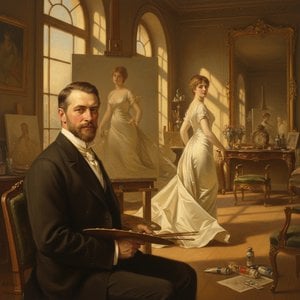
An Interior in Venice

John Singer Sargent's "An Interior in Venice" captures Venetian opulence with meticulous detail – elegant figures illuminated by chandeliers within a richly furnished room, reflecting the artist’s mastery of light and capturing the spirit of Edwardian society.

Джон Сінгер Сержант – американський художник епохи Розкоші, відомий портретами та мальовничими пейзажами. Його роботи – це світ елегантності, світського життя та вражаючої техніки.

Олійная репродукція ручної роботи

Написана вручну олією на полотні у вашому розмірі та рамі, виготовлена на замовлення нашими художниками. (Перейти до друку Перейти до друкуПерейти до цифрових зображень Перейти до цифрових зображень)

P118B $10
P118H $10
P118W $10
P438Z $10
P508JH $12
P508YH $12
P805H $10
P805Z $10
P919BZ $10
P919G $10
P919XJ $10
P959ZH $10
P968JZ $12
W106C $8
W218G $10
W218JH $8
W218Y $10
W307PJ $10
W316G $10
W316PJ $8
W316Y $10
W398PJ $8
W4111J $10
W500HY $15
W500JH $15
W692G $12
W849H $8
W940BG $15
W953PJ $8

Стандартний розмір
індивідуальний
CM
INCH

Обирайте з наших стандартних розмірів, що відповідають оригінальним пропорціям твору мистецтва.

ширина
висота

Ви можете вказати власні розміри, щоб репродукція ідеально підійшла до конкретної рами або інтер'єру. Якщо вибраний вами розмір не відповідає пропорціям оригіналу, ми або обріжемо полотно, або доповнимо картину додатковими елементами, промальованими вручну. Цифровий макет буде надіслано вам на затвердження перед початком виробництва.
Зверніть увагу, що попередній перегляд на екрані не відображає фактичне обрізання або розширення зображення. Тільки макет точно покаже остаточну композицію.
Хоча ми можемо виготовити виріб у нестандартному розмірі, для збереження оригінальних пропорцій рекомендуємо обирати варіанти зі встановленого списку.

Приклади можливих змін: замінити обличчя на фото клієнта; додати домашню тварину (наприклад, замінити кота на собаку); додати приховане повідомлення на фоні; змінити ландшафт або елементи фону.
Після оформлення замовлення команда WahooArt.com зв'яжеться з клієнтом електронною поштою для отримання інструкцій та надасть попередній макет

Доставка по всьому світу () за 3–4 тижні замість стандартних 5 тижнів. (12 Вересень). Без жодних компромісів у якості.

why_choose_icon
Безкоштовна експрес-доставка по всьому світу
why_choose_icon
Високоякісне лляне полотно
why_choose_icon
Повне страхове покриття доставки
why_choose_icon
Гарантія відшкодування митних зборів
why_choose_icon
Гарантія точного відтворення кольорів
why_choose_icon
Політика повернення протягом 100 днів (тільки у разі виявлення дефектів)
why_choose_icon
Гарантія повернення 100% коштів
why_choose_icon
Пропозиція на оптові замовлення

Загальна вартість

$ 272

reproduction

An Interior in Venice

Матеріал репродукції

Розмір репродукції

-

Підсумкова вартість

$ 272

Основна інформація

  • Influences: Impressionism
  • Notable elements or techniques: Chandeliers, Light & Shadow
  • Location: Royal Academy of Arts
  • Movement: Realism
  • Dimensions: 64 x 80 cm
  • Artistic style: Elegant Luxury
  • Artist: John Singer Sargent

A Glimpse Into Venetian Splendor

To step before John Singer Sargent’s An Interior in Venice is to be instantly transported to the twilight of the nineteenth century, where the air is thick with the scent of old grandeur and the soft murmur of aristocratic conversation. Completed in 1899, this masterpiece serves as a breathtaking window into the opulent world of the Edwardian era. Set within the magnificent Palazzo Barbaro, the painting captures a moment of quiet, refined elegance that feels both intimate and monumental. Sargent, an American expatriate who moved through the highest circles of European society with effortless grace, does not merely depict a room; he captures a way of life. The scene features the American expatriates Daniel and Ariana Curtis alongside their son Ralph and his wife Lisa, frozen in a state of timeless sophistication amidst the shimmering light of their Venetian home.

The composition is a masterclass in balance, where the weight of history meets the lightness of a fleeting moment. As your eyes wander through the grand salon, you encounter the delicate interplay of figures and architecture. The presence of a suitcase resting near the floor hints at a recent arrival, adding a subtle narrative layer of movement and transition to an otherwise still scene. This touch of realism prevents the painting from feeling like a static museum piece, instead inviting the viewer to imagine the rustle of silk, the clink of crystal, and the unfolding stories of those gathered under the glow of magnificent chandeliers.

The Alchemy of Light and Impressionistic Mastery

Technically, An Interior in Venice represents a sublime intersection of Impressionist spontaneity and classical discipline. While Sargent was deeply influenced by the Impressionist movement's obsession with light, he eschewed their often fragmented approach in favor of a more structured, tonal brilliance. He employed a sophisticated layering process, applying thin, translucent glazes over thicker underpaintings to achieve a luminous depth that seems to radiate from within the canvas itself. This technique allows for an extraordinary rendering of textures; one can almost feel the velvety weight of the drapery and the cold, sharp brilliance of the chandelier's crystal pendants.

The artist’s use of light is nothing short of transformative. He manipulates illumination to sculpt form, using shadow not merely as an absence of light, but as a tool to create volume and psychological depth. The monochrome-leaning palette, though rich in tonal variation, focuses the viewer's attention on the play of highlights across surfaces—the sheen of a satin gown, the polished wood of a dining table, or the soft glow reflecting off a porcelain surface. For the discerning collector or interior designer, this mastery of light offers a profound sense of atmosphere, making the work an ideal centerpiece for spaces that demand a touch of dramatic, sophisticated luminosity.

A Legacy of Elegance for the Modern Collector

Beyond its technical prowess, the painting resonates with a deep emotional and symbolic resonance. It stands as a tribute to the Belle Époque, a period of peace and unprecedented artistic achievement. The work evokes a sense of nostalgia for a lost era of grace, making it more than just a decorative object; it is an emotional anchor. For those looking to curate a space with character and historical weight, a high-quality reproduction of this Sargent masterpiece provides an unparalleled opportunity to introduce a sense of "old world" luxury into a contemporary setting.

Whether placed in a grand library, a formal dining room, or a curated gallery wall, An Interior in Venice brings with it the prestige of the Royal Academy of Arts. It serves as a conversation piece that bridges the gap between the historical past and modern aesthetic sensibilities. To possess such an image is to invite the spirit of Venice—its light, its mystery, and its enduring elegance—into one's own private sanctuary.


Біографія митця

A Life Immersed in Light and Society

John Singer Sargent, a name synonymous with the Gilded Age and its shimmering portraits of elegance, was an American artist who spent most of his life cultivating his craft within the European art world. Born in Florence, Italy, in 1856 to American expatriate parents, Fitzwilliam and Mary Newbold Sargent, his upbringing was anything but conventional. The family’s nomadic existence – constantly traversing France, Germany, Italy, and Switzerland – instilled in young John a cosmopolitan sensibility and an early exposure to the artistic treasures of Europe. Rather than formal schooling, his education unfolded within museum halls and ancient churches, fostering a visual literacy that would profoundly shape his artistic vision. This itinerant childhood, while lacking traditional structure, provided a rich tapestry of cultural experiences that fueled his developing talent. His father, a surgeon, and his mother, an amateur artist, encouraged his inclinations, recognizing early on the remarkable acuity of his observational skills. It was clear from a young age that John’s path lay not in medicine or conventional pursuits, but within the realm of art.

From Parisian Atelier to Portrait Master

In 1874, at the age of eighteen, Sargent embarked on a pivotal chapter of his artistic development by entering the Paris studio of Carolus-Duran. This mentorship proved transformative. Duran’s emphasis on *direct painting* – a technique eschewing preliminary sketches in favor of immediate application of paint to canvas – honed Sargent's already impressive technical facility and instilled within him an astonishing ability to capture likenesses with speed and precision. It was a revolutionary approach, encouraging boldness and spontaneity, and it became the hallmark of Sargent’s style. He absorbed Duran’s lessons wholeheartedly, mastering the art of capturing not just physical resemblance but also the very essence of his sitters. Simultaneously, he enrolled at the École des Beaux-Arts, further refining his skills in drawing from casts and life models. However, it was the influence of Spanish masters like Velázquez, encountered during a formative trip to Spain in 1879, that truly ignited Sargent’s artistic imagination. He became captivated by Velázquez’s masterful use of light, brushwork, and psychological insight – qualities he would strive to emulate throughout his career. This encounter shifted his focus from purely academic training towards a more expressive and observational approach.

Navigating Fame, Scandal, and Artistic Evolution

Sargent quickly established himself as a sought-after portraitist in Paris, attracting commissions from the city’s elite. His ability to capture not just physical likeness but also the personality and social standing of his subjects made him immensely popular. However, his ascent was not without its challenges. The unveiling of *Madame X* (Portrait of Madame Pierre Gautreau) at the 1884 Salon ignited a scandal that threatened to derail his burgeoning career. The painting’s daring depiction of socialite Virginie Amélie Avegno Gautreau – with her pale complexion, suggestive pose, and fallen strap – was deemed provocative and scandalous by Parisian society. Though Sargent later repainted the strap, the damage was done. Disheartened by the controversy, he relocated to London in 1886, where he found a more receptive audience for his talents. In London, he continued to paint portraits of the wealthy and prominent, capturing the opulence and social dynamics of Edwardian society with unparalleled skill. Yet, Sargent’s artistic ambitions extended beyond the confines of commissioned portraiture. He yearned for greater creative freedom and increasingly devoted himself to landscape painting and plein-air studies, embracing an Impressionistic style characterized by loose brushwork, vibrant colors, and a focus on capturing fleeting moments of light and atmosphere. These landscapes reveal a different side of Sargent – one less concerned with social status and more attuned to the beauty of the natural world. He sought to capture not just the appearance of a scene but also its feeling, its mood, its essence.

Influences and Artistic Kinships

  • Carolus-Duran: His teacher, who instilled in him a direct painting technique and encouraged spontaneity.
  • Diego Velázquez: Sargent deeply admired Velázquez’s mastery of light, brushwork, and psychological insight, particularly evident in his Spanish works. He studied Velázquez's techniques meticulously, attempting to replicate the master's ability to convey emotion through subtle shifts in tone and color.
  • Impressionism: The Impressionists' emphasis on capturing fleeting moments and atmospheric effects profoundly impacted his landscape paintings, leading to a looser, more expressive style. He was particularly influenced by Monet’s use of light and color, incorporating these techniques into his own work.
  • James Abbott McNeill Whistler: Sargent shared with Whistler an interest in aestheticism and the pursuit of “art for art’s sake,” influencing his approach to composition and color. They both sought to elevate painting beyond mere representation, aiming to capture a sense of beauty and atmosphere.

A Lasting Legacy: Beyond Portraiture

While celebrated as “the leading portrait painter of his generation,” John Singer Sargent’s artistic legacy extends far beyond his masterful depictions of society figures. His major works, such as *El Jaleo*, a dynamic portrayal of Spanish flamenco dancers, and *Carnation, Lily, Lily, Rose*, a serene depiction of two young girls in an English garden, demonstrate his versatility and technical brilliance. These pieces showcase a remarkable range of subject matter and stylistic approaches, moving beyond the traditional confines of portraiture. Later in life, he embarked on ambitious mural projects, including the monumental cycle at the Boston Public Library, showcasing his ability to translate his artistic vision onto a grand scale. His influence can be seen in the work of subsequent generations of artists who admired his technical skill, his bold brushwork, and his ability to capture both physical likeness and psychological depth. The rediscovery of his previously overlooked male nudes in the 1980s further broadened our understanding of Sargent’s artistic range and revealed a more complex and nuanced artist than previously recognized. *His paintings continue to captivate audiences worldwide*, offering a fascinating glimpse into a bygone era while simultaneously transcending time through their enduring beauty and technical mastery. He remains, undeniably, one of the most significant American artists of his generation, whose work continues to inspire and provoke admiration.

Джон Сінгер Сержант

Джон Сінгер Сержант

1856 - 1925 , Італія

Короткі факти

  • Artistic Movement Or Style: Імпресіонізм
  • Artists Or Movements Influenced By This Artist: ['Вільям Тёрнер']
  • Artists Who Influenced This Artist:
    • Карлос-Дюран
    • Дієго Веласкес
  • Date Of Birth: 12 січня 1856
  • Date Of Death: 15 квітня 1925
  • Full Name: John Singer Sargent
  • Nationality: Американський
  • Notable Artworks:
    • Мадам X
    • Ель Халео
    • Канартія, Лілі, Лілі, Роза
  • Place Of Birth: Флоренція, Італія
Досліджуйте твори мистецтва, впорядковані за темами, стилями та характеристиками.