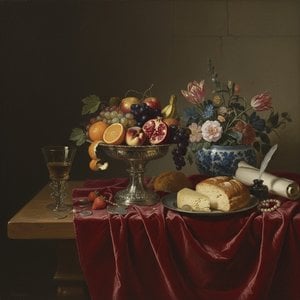
A Moment Frozen in Time: John Brack’s “The Breakfast Table”
John Brack's "The Breakfast Table," painted in 1958, isn’t merely a depiction of a morning meal; it’s a carefully constructed tableau brimming with quiet observation and subtle commentary on Australian domestic life. This iconic work, now residing within the National Gallery of New South Wales, offers a captivating glimpse into a seemingly ordinary scene—a family breakfast—transformed by Brack's masterful use of color, composition, and perspective.
The painting immediately draws the eye with its vibrant palette. Brack eschews the muted tones often associated with still life, opting instead for an almost fluorescent yellow for the tabletop, a hue that feels both startlingly modern and deeply rooted in the Australian landscape – reminiscent of the harsh sunlight reflecting off the red earth. This bold choice contrasts sharply with the deep shadows cast by the objects scattered across the surface, creating a dynamic interplay of light and dark that anchors the composition and imbues it with a sense of immediacy. The careful arrangement of the cutlery, plates, bottles, and cups isn’t haphazard; each element is deliberately positioned to contribute to the overall narrative.
The Language of Domesticity
Brack's genius lies in his ability to convey more than just the visual elements of a breakfast scene. He captures the *feeling* of that moment—the lingering traces of activity, the unspoken interactions between family members, and the subtle sense of routine that defines everyday life. The empty glasses, cups, and plates speak volumes about the recent departure of the occupants, while the scattered crumbs hint at the remnants of a shared meal. Brack’s use of aerial perspective – looking down on the table as if from above – creates an intimate yet slightly detached view, inviting the viewer to become a silent observer within this domestic drama.
The painting's significance extends beyond its immediate subject matter. It emerged during a period of significant social and artistic change in Australia, coinciding with the rise of the Antipodeans group—a collective of artists who sought to capture the unique character of Australian life. Brack’s work, like that of his contemporaries (including Sidney Nolan and Russell Drysdale), challenged traditional European art conventions and embraced a distinctly Australian sensibility. “The Breakfast Table” exemplifies this shift by focusing on familiar subjects – domesticity, family, and everyday routines—and presenting them with a fresh, modern perspective.
Symbolism and Brack’s Vision
While seemingly straightforward, "The Breakfast Table" is rich in symbolic detail. The abundance of tableware suggests a sense of plenty and comfort, while the emptiness hints at a transient moment – a pause before the demands of the day begin. The carefully chosen objects—bottles, spoons, cups—are not merely props but represent the tools and rituals of daily life. Brack’s deliberate arrangement creates a geometric pattern that subtly reinforces the painting's sense of order and control, even as it captures the inherent chaos of a busy household.
Furthermore, Brack was known for his sharp observations of Australian society and his ability to capture its quirks and contradictions. “The Breakfast Table” can be interpreted as a commentary on the changing role of women in post-war Australia—the shift from traditional domestic roles to more independent lifestyles. The painting’s focus on the mundane details of everyday life suggests a quiet celebration of the ordinary, while also hinting at the unspoken tensions and complexities that lie beneath the surface.
A Timeless Masterpiece
"The Breakfast Table" remains one of John Brack's most celebrated works, admired for its striking visual impact, its insightful commentary on Australian culture, and its enduring emotional resonance. It’s a painting that invites repeated viewing, revealing new layers of meaning with each encounter. Whether you are an art enthusiast, a collector seeking to add a significant piece to your collection, or simply someone looking for inspiration, “The Breakfast Table” offers a captivating glimpse into the heart of Australian life and the genius of one of its most important artists.
Запитання та відповіді
Яка яскравість твору «The breakfast table» Джон Брек?
«The breakfast table» Джон Брек має рівень яскравості Bright Balance. Яскравість описує, скільки світла відбивають кольори.
Хто створив "The breakfast table"?
Автором твору «The breakfast table» є Джон Брек. Робота внесена до каталогу під іменем Джон Брек.
Яке місце посідає "The breakfast table" серед постійних тем Джон Брек?
Серед зафіксованих тем Джон Брек — antipodean realism, urban life, post-war australian domesticity, sharp observation, social commentary, group style, brack's iconography, domestic scenes — «The breakfast table» приділяє особливу увагу breakfast table, australian art, domestic scene, john brack, 1958, family life, composition, still life.
У якому році було створено «The breakfast table» Джон Брек?
«The breakfast table» Джон Брек було створено у 1958 році.
Як «The breakfast table» вписується в тематику та стиль Джон Брек?
У творчості Джон Брек твір "The breakfast table" витриманий у стилі Contemporary Realism, що перегукується з темами antipodean realism, urban life, post-war australian domesticity, sharp observation, social commentary, group style, brack's iconography, domestic scenes.
Чи залишився твір «The breakfast table» у батьківщині свого автора?
Ні — твір зберігається за кордоном. Творець народився в Australia; оригінальний твір знаходиться в Австралія.
У якому віці Джон Брек створив(ла) "The breakfast table"?
Джон Брек створив(ла) «The breakfast table» у віці 38 років. Митець народився(лася) у 1920, а дата створення твору — 1958.



 Переглянути в інтер'єрі
 Купити картину ручної роботи
 Надіслати
 Поділитися
 Деталі
 Посібник

 Завантажити
 Схожі предмети колекціонування
 Рентгенівське дослідження
 Слайд-шоу
 Статистика переглядів


 Читати далі






































 Скляний варіант доступний лише для розмірів до 110 см