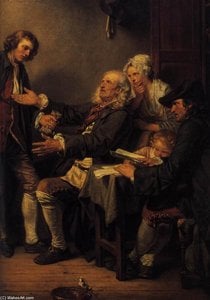
A Life Etched in Sentiment: The World of Jean-Baptiste Greuze
Jean-Baptiste Greuze, a name synonymous with the intimate and emotionally charged world of 18th-century French painting, was born in Tournus, a small Burgundian town steeped in history, on August 21st, 1725. His early life, far from the grand salons and aristocratic circles that defined much of the art world, was marked by a modest upbringing – his father a roofer, shaping his young mind with practical realities rather than artistic aspirations. Yet, within this seemingly ordinary existence, a spark ignited: a profound sensitivity to human emotion and an innate ability to capture it on canvas. This talent wasn’t immediately nurtured; initially discouraged from pursuing art by his father, young Greuze found encouragement in the guidance of Grandon, a Lyonnese artist who recognized the nascent potential within him. This early mentorship proved pivotal, laying the foundation for a career that would ultimately redefine the boundaries of genre painting.
The Rise of a Genre Painter
Greuze’s artistic breakthrough arrived in 1755 with *Le Père de famille expliquant la Bible à ses enfants* (The Father Explaining the Bible to His Children). This wasn't merely a depiction of domestic life; it was an embodiment of Enlightenment ideals, a carefully constructed tableau that resonated deeply with the sensibilities of the era. The painting’s power lay not in grand historical narrative or mythological grandeur, but in its intimate portrayal of familial piety and moral instruction – a reflection of the burgeoning bourgeois virtue that was gaining prominence within French society. The work quickly garnered attention, culminating in its acquisition by Ange-Laurent de La Live de Jully, a discerning collector who recognized Greuze’s unique talent. This success propelled him to Paris, where he enrolled at the Royal Academy and began to hone his skills under the tutelage of Charles-Joseph Natoire. However, Greuze quickly distinguished himself from the prevailing academic emphasis on historical and mythological subjects, forging his own path towards capturing the nuances of everyday life.
A journey to Italy in 1755, undertaken with Abbé Louis Gougenot, broadened his artistic horizons, exposing him to classical models and influencing his compositional techniques. Yet, despite this exposure, Greuze ultimately found greater inspiration in the realities of French society than in the idealized world of antiquity. His ability to evoke genuine feeling—joy, sorrow, remorse—set him apart from many of his contemporaries and established him as a leading figure in the emerging Rococo style, albeit one with a distinctly moralizing bent. He wasn’t simply painting scenes; he was painting emotions, distilling complex human experiences into accessible and deeply affecting images.
Mastering Emotion and Moral Narrative
Greuze's artistic strength lay in his ability to tell stories through paint. His works are not merely portraits of children or domestic scenes; they are explorations of universal human experiences—loss, innocence, temptation, and the complexities of familial relationships. He possessed an extraordinary talent for capturing subtle nuances of expression, conveying inner turmoil with remarkable sensitivity. His compositions were often carefully staged, utilizing dramatic lighting and expressive gestures to heighten emotional impact. Consider *La Jeune Fille qui pleure son oiseau mort* (The Young Girl Weeping for Her Dead Bird) – the heartbreaking grief etched on the girl’s face, the delicate feathers scattered around her—it's a masterclass in conveying sorrow through visual language. Similarly, *Savoyard with a Dancing Doll* captures the fleeting joy and vulnerability of childhood, showcasing his skill in portraiture while simultaneously hinting at the darker undercurrents beneath the surface.
Denis Diderot, a leading intellectual of the Enlightenment, became a fervent champion of Greuze’s work, praising his ability to depict “morality in paint.” Greuze's paintings weren’t just aesthetically pleasing; they were intended to provoke thought and inspire virtuous behavior – a reflection of the Enlightenment’s emphasis on reason and moral reform. However, this very success created a dilemma for the artist. He aspired to be recognized as a history painter—the most prestigious category within the Academy—and attempted a transition with *Septimius Severus Reproaching Caracalla* (1769). This ambitious work, depicting the Roman emperor’s confrontation with his son, was met with harsh criticism and ultimately failed to secure him acceptance into the Academy as a history painter.
Later Years and Lasting Legacy
The rejection by the Academy marked a turning point in Greuze's career. He withdrew from exhibiting at the Salon for many years, becoming increasingly reclusive and embittered. His later works often explored themes of seduction and moral transgression, sometimes bordering on the overtly sensual. These paintings, while technically proficient, lacked the emotional resonance and moral clarity of his earlier masterpieces. Financial difficulties plagued his final years, a stark contrast to the acclaim he had once enjoyed. He died in poverty within the Louvre itself in 1805, a poignant end for an artist who had once commanded such admiration.
Despite this decline, Jean-Baptiste Greuze’s influence on French art remains significant. He pioneered a new form of genre painting that focused on contemporary life and explored universal human emotions. His work paved the way for later artists who sought to depict the realities of everyday existence with honesty and sensitivity. He left behind a body of work that continues to captivate viewers with its emotional power, technical brilliance, and enduring relevance – a testament to his unique ability to translate the complexities of the human heart onto canvas.
Key Works & Their Significance
- Le Père de famille expliquant la Bible à ses enfants (1755): A cornerstone of his early success, embodying Enlightenment ideals of familial piety.
- La Jeune Fille qui pleure son oiseau mort (c. 1765): Demonstrates Greuze’s mastery of emotional expression and poignant storytelling.
- Savoyard with a Dancing Doll (c. 1763): Captures the spirit and vulnerability of childhood, showcasing his skill in portraiture.
- Septimius Severus Reproaching Caracalla (1769): A failed attempt at historical painting that highlighted his strengths lay elsewhere.
- The Broken Pitcher (c. 1770s): Represents a shift towards more sensual and morally ambiguous themes in his later work.



 Переглянути в інтер'єрі
 Замовити репродукцію ручної роботи
 Надіслати як листівку
 Поділитися
 Детальніше

 Завантажити
 Схожі експонати
 Рентгенівське дослідження
 Слайд-шоу


 Читати далі






































 Скляний варіант доступний лише для розмірів до 110 см