

Отримайте файл, готовий до друку, якість якого значно перевищує якість веб-попереднього перегляду. Кожне цифрове зображення, яке ми продаємо, створене на основі високої роздільної здатності з нашої бази даних — зазвичай від 5 000 до 15 000 пікселів по ширині — тому ви можете впевнено друкувати у великому форматі, робити щільну обрізку або відтворювати найдрібніші деталі.
Жоден файл не залишається в нашій студії без уваги. Експерт із цифрової обробки звіряє кольори з оригінальною картиною та за потреби коригує їх, після чого покращує чіткість і деталізацію за допомогою професійних інструментів ретушування — завжди зберігаючи вірність мазкам пензля та стилю художника. Результатом є зображення, яке виглядає як справжня картина, а не як відскановане фото з накладеними фільтрами.
Ви затверджуєте результат перед завершенням замовлення: протягом 72 годин наш експерт надішле зображення електронною поштою для вашого перегляду. Не задоволені результатом? Ви можете попросити про внесення змін чи виправлень або отримати відшкодування, якщо якість не відповідає вашим очікуванням.
Саме на таку якість покладаються видавництва, дизайн-студії, галереї та друкарні.
Завантажте файл високої роздільної здатності для особистого використання, друку та творчих проєктів. ( Перейти до друку Замовити картину ручної роботи)
Обираючи WahooArt.com, ви отримуєте не просто зображення — ви отримуєте професійно вдосконалений цифровий витвір мистецтва, створений з надзвичайною точністю та підкріплений гарантією задоволення. Ось усе, що автоматично додається до вашого замовлення:
Ваш цифровий файл із зображенням високої роздільної здатності буде надісланий вам електронною поштою протягом 72 годин після оформлення замовлення — він буде готовий до негайного використання.
Ваш витвір мистецтва професійно оптимізовано за допомогою передових інструментів штучного інтелекту та ручної корекції, що забезпечує максимальну деталізацію, чіткість і точність передачі кольорів.
Випадково видалили або втратили файл? Не хвилюйтеся — ми надішлемо його вам повторно в будь-який час безкоштовно.
Насолоджуйтесь вашим витвором мистецтва миттєво без жодних мит, зборів або плати за доставку — цифрові завантаження завжди не оподатковуються.
Ми гарантуємо максимально точне відтворення оригінальних кольорів на вашому цифровому зображенні завдяки використанню професійних інструментів та систем управління кольором.
Якщо ви не задоволені придбаним цифровим зображенням, ми внесемо правки або повернемо 100% вартості протягом 100 днів — без зайвих запитань.
Незадоволені покупкою? Отримайте повне повернення коштів протягом 100 днів після отримання цифрового файлу — без зайвих запитань.
Купуйте 3 зображення — заощаджуйте 10% — Купуйте 5 — заощаджуйте 15% — Купуйте 10+ — заощаджуйте 20%. Чудово підходить для творчих проєктів, галерей та агентств.
The scene unfolds within LA FONTAINE, a work painted by Hubert Robert in 1784. This piece emerges from a specific creative sequence, forming part of a series of paintings centered on the theme of water. The artist captures a moment where the elements of nature and the remnants of human construction meet under a soft, diffused light.
The origins of this work trace back to the patronage of David Etienne Rouillé de l'Etang, who served as the Treasurer General of the Police. He commissioned this vision to decorate the private residence of his estate, the Hôtel de la place Louis XV in Paris. Through his direction, the artist translates the quiet movement of water and the stillness of stone into a visual narrative that feels both expansive and intimate.
A serene pastoral vista unfolds before the eye, dominated by the crumbling ruins of an ancient temple or palazzo. These weathered stone structures lean into the landscape, their decaying forms asserting a monumental scale against the natural world. A solitary figure sits quietly beside a deer, a moment of stillness captured amidst the slow disintegration of the architecture. This central grouping anchors the midground, creating a focal point where humanity and nature meet in quiet companionship.
The composition is carefully structured vertically, drawing the gaze upward through the layers of the landscape. Linear perspective directs the eye away from the immediate ruins, guiding it toward the distant mountains that loom beneath a muted sky. An atmospheric haze settles over these far-off peaks, softening their edges and enhancing the sense of depth. This subtle blurring of the horizon contributes to a melancholic mood, as if the very air is heavy with the weight of passing time.
Oil paints meet canvas in this quiet scene, where the medium allows for a profound sense of atmosphere. The artist works through a meticulous process of layering and blending, building up the surface to achieve a soft, diffused light that seems to hang in the air. This technique creates subtle gradations in tone, allowing the sky to transition seamlessly into the hazy distance and the stone of the ruins to melt into the surrounding greenery. There is a palpable sense of depth achieved through these tonal shifts, drawing the eye toward the mountains that loom in the pale background.
The execution relies on a delicate balance between the seen and the imagined. While the architectural forms of the fountain and the crumbling structures possess a grounded, physical presence, the brushwork avoids harshness. Instead, the colors blend into one another, minimizing visible strokes to favor a smooth, polished finish. This approach allows the textures of the weathered stone and the organic shapes of the foliage to coexist within a unified, atmospheric space. The light does not strike the scene with sharp intensity but rather settles softly over the landscape, as if filtered through a light overcast sky.
The life of this painting begins within the private walls of an hôtel on the place Louis XV in Paris, where it was commissioned by David Etienne Rouillé de l'Etang, the Treasurer General of the Police. It remains part of a series of works centered on the theme of water, intended to decorate the residence of its original patron. From there, the work moves through the hands of a single family across generations. It passes from Rouillé de l'Etang to his niece, the Marquise de Pastoret, and then to her son, Amédée de Pastoret. Eventually, the inheritance reaches his daughter, the Marquise du Plessis-Bellière.
The quiet continuity of family ownership ends following the death of the Marquise du Plessis-Bellière. The painting enters the public sphere during a sale at the Hôtel Drouot in Paris on May 10-11, 1897, appearing as lot number 79. It travels through various collections until 1946, when it arrives at the Musée du Louvre through a manual donation from Victor Lyon. This gift ensures the work remains a permanent part of the museum's collection. In 1971, the painting undergoes restoration at the hands of Lucien Aubert to preserve its appearance.
Формат (Tall) та рекомендоване приміщення (Living Room) — це два ключові параметри розміщення для «LA FONTAINE» роботи Гюбер Робер.
«LA FONTAINE» роботи Гюбер Робер рекомендується для Living Room. Ця пропозиція ґрунтується на сюжеті, кольоровій гамі та настрої твору.
«LA FONTAINE» сповнене Melancholic емоційності в межах стилю Romanticism.

Born in Paris in 1733, Hubert Robert entered a world where his family's social standing was tied to the service of others. His father, Nicolas Robert, held a position within the household of a prominent figure, a connection that would eventually facilitate the young man's movement through the upper echelons of French society. This early stability provided the foundation for a formal education, which he pursued through the structured environment of the Collège de Navarre. By 1751, he had completed his studies under the Jesuits, gaining a disciplined intellectual background before turning his attention to the visual arts.
His initial path was not intended for the canvas. He entered the atelier of the sculptor Michel-Ange Slodtz, where his training focused on the rigorous principles of design and perspective. While the tactile nature of sculpture was his starting point, Slodtz possessed a keen eye for the boy's specific inclinations. Recognizing a different potential, the mentor encouraged him to abandon the chisel in favor of the brush. This shift from the three-dimensional weight of sculpture to the atmospheric possibilities of painting would define the trajectory of his life.
In 1754, Robert left France for Rome, traveling in the entourage of Étienne-François de Choiseul. This move was more than a simple change of scenery; it was a decade-long immersion into the heart of antiquity. During his eleven years in Italy, he resided at the Académie de France, a period that allowed him to absorb the architectural grandeur of the city. He did not merely observe these monuments from a distance; he lived among them, developing a profound connection to the physical remains of the past.
His development was further shaped by his time in the studio of Giovanni Paolo Panini. Through this association, Robert began to refine his ability to interpret the classical world. He moved beyond the simple documentation of existing structures, learning instead to manipulate light and shadow to suggest a sense of history. His presence in the city was so deeply felt that, in 1767, he reportedly carved his name into the walls of the Colosseum, a small, humanizing act of permanence against the very ruins he spent his life studying.
Upon his return to Paris in 1765, Robert found a city eager for the perspectives he had gathered during his years in Italy. His ascent within the French artistic establishment was swift. In 1766, he was received by the Académie royale de peinture et de sculpture, presenting a Roman capriccio that signaled his arrival. This formal recognition opened doors to the highest circles of French society, where his ability to blend architectural precision with imaginative landscapes met a growing public appetite for the picturesque.
His professional life became increasingly intertwined with the French crown. He secured prestigious appointments that reflected the state's trust in his technical skill and aesthetic judgment. He served as the Designer of the King's Gardens and later held the position of Keeper of the King's Pictures. These roles allowed him to influence the visual landscape of the monarchy, moving between the creation of new designs and the stewardship of existing collections. His influence extended into the very institutions that would define French art for the next century.
As the political landscape shifted, his responsibilities grew in weight and complexity. He was appointed Keeper of the Museum and Councilor to the Academy, a position that placed him at the center of the nation's cultural administration. His life was no longer merely that of a painter, but of a guardian of history. Even as the structures of the old regime began to fracture, his presence within the halls of the Louvre remained a constant, marking him as a central figure in the transition of French institutional art.
Robert’s hand was as versatile as the landscapes he sought to capture. He moved with ease between the precision of a draftsman and the fluid touch of a painter, employing a wide array of media. His technical repertoire included etching, pen and ink, black chalk, red chalk, and watercolor, alongside the traditional application of oil on canvas. He often utilized the alla prima technique, applying paint in a direct, spontaneous manner that lent a sense of immediacy to his compositions. This technical breadth allowed him to navigate the complexities of architectural form and the softness of a changing sky with equal facility.
His method relied on a delicate balance between the seen and the imagined. While his works were grounded in meticulous detail and a rigorous understanding of perspective, they were never mere topographical records. Instead, he used atmospheric perspective to soften distant horizons, creating a palpable sense of depth and light. He possessed a particular mastery of illusion, using light and shadow to manipulate the viewer's perception of space. By blending careful observation with a heightened imagination, he constructed scenes where the physical reality of a stone arch or a crumbling column was heightened by a carefully orchestrated, almost theatrical, sense of atmosphere.
The moniker "Robert des Ruines" was more than a mere nickname; it was a recognition of a man who found his most profound expression in the crumbling remains of the past. He moved through the artistic landscape of the late 18th century as a painter in the school of Romanticism, a position that allowed him to look beyond the literal documentation of architecture. Instead of simply recording the state of a building, he sought the poetry within its disintegration. His work often presented semi-fictitious, picturesque depictions of ruins, finding subjects in both the ancient landscapes of Italy and the changing urban fabric of France.
Central to this vision was his mastery of the capriccio. In these compositions, he deliberately juxtaposed disparate elements—ancient monuments, fantastical landscapes, and idealized figures—to create scenes that existed in the tension between reality and imagination. He did not merely paint what was there; he constructed atmospheres of melancholy and wonder. By blending factual architectural details with imagined settings, he created a sense of history that felt both tangible and dreamlike. This approach allowed him to explore the passage of time through the lens of stone and shadow.
The shifting tides of the French Revolution brought sudden and personal peril to Robert. During the Reign of Terror, he faced a period of brief imprisonment, an experience that left its mark on his output through a series of drawings documenting his confinement. Despite the volatility of the era, his professional standing remained significant. He was appointed curator of the newly established Muséum Central des Arts, the institution that would eventually become the Musée du Louvre, where he worked to organize and catalog the nation's growing collection.
His connection to the Louvre was profound and enduring. From 1778 until 1802, he made his home within its walls, living amidst the very halls he had helped to decorate and preserve. This long residency placed him at the center of a changing France, witnessing the transition from the old monarchy to the Napoleonic era. He remained a prolific creator until his health finally failed him. Robert died in Paris from a stroke on 15 April 1808.
The sheer scale of Robert's output reflects a life spent in constant dialogue with the past. His prolific hand produced approximately 1,000 paintings and 10,000 drawings, a volume that allowed him to explore the nuances of light and architectural decay through countless iterations. His early success was anchored by The Port of Rome, a Roman capriccio that established his reputation within the French artistic establishment. This work demonstrated his ability to move beyond mere topographical recording, instead constructing a vision of antiquity that resonated with the sensibilities of his era.
As his career progressed, his subjects shifted from the purely classical to the integration of historical structures within more varied landscapes. In about 1773, he produced The Portico of a Country Mansion, a work that showcased his command of perspective and atmosphere. Later, his interest in the grandeur of ancient engineering was captured in The Pont du Gard, painted about 1787. These works illustrate a technical mastery of both the monumental and the intimate, often utilizing thin glazes to build a sense of tonal depth and luminosity.
His later years saw him documenting the very institutions he helped manage. Around 1795, he produced The Grande Galerie, a work that captured a specific, transformative moment in Parisian history. This period of his life saw him navigating the tension between the preservation of cultural memory and the reality of a changing nation. His ability to render these spaces, whether through oil on canvas or through the precise lines of pen and ink, ensured his place in the history of French landscape painting.
The preservation of Robert’s prolific output is spread across several major international institutions, reflecting the reach of his influence during the late eighteenth century. The most significant concentration of his paintings remains in Paris, where The Louvre holds 43 of his works. Visitors to this collection can encounter his detailed architectural studies and his dramatic depictions of the Grande Galerie, including a view of the hall in ruins and another showing the gallery under restoration about 1798 or 1799.
Beyond France, his presence is felt in several other prominent collections. The Hermitage Museum in Saint Petersburg maintains four of his paintings, such as Inhabited Ruins and Painters. In the United States, the Metropolitan Museum of Art in New York houses three works, including The Portico of a Country Mansion and Wandering Minstrels. His reach extends to Germany and Switzerland as well, with the Staatliche Kunsthalle Karlsruhe in Germany holding three pieces, including a Roman Capriccio.
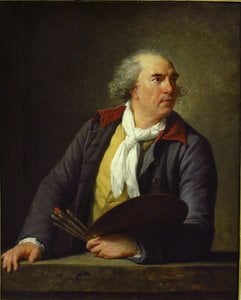
1733 - 1808 , Франція
 Переглянути в інтер'єрі
 Надіслати як листівку
 Поділитися
 Деталі витвору
 Посібник

 Завантажити
 Схожі екземпляри
 Рентгенівське дослідження
 Слайд-шоу
 Питання та відповіді
 Статистика


 Розгорнути текст


