


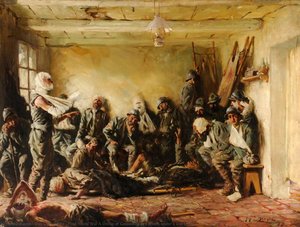
 1917
1917 148.0 x 192.0 cm
Придбайте цифрову копію високої роздільної здатності з покращеною якістю, що значно перевершує онлайн-перегляд.
Кожен файл ретельно підготовлений нашими фахівцями за допомогою сучасних інструментів та професійної ручної ретуші. Ми гарантуємо виняткову чіткість, точну передачу кольору та високу деталізацію кожного зображення.
Фінальний файл надсилається електронною поштою протягом 72 годин і оптимізований для негайного використання у професійних виданнях та друкованих матеріалах. Таку якість обирають провідні дизайнерські студії, видавництва та галереї.
Завантажте файл високої роздільної здатності для особистого використання, друку та творчих проєктів. ( Замовити принт Замовити репродукцію ручної роботи)
Обираючи WahooArt.com, ви отримуєте не просто зображення — ви отримуєте професійно вдосконалений цифровий витвір мистецтва, створений з надзвичайною точністю та підкріплений гарантією задоволення. Ось усе, що автоматично додається до вашого замовлення:

Ваш цифровий файл із зображенням високої роздільної здатності буде надісланий вам електронною поштою протягом 72 годин після оформлення замовлення — він буде готовий до негайного використання.

Ваш витвір мистецтва професійно оптимізовано за допомогою передових інструментів штучного інтелекту та ручної корекції, що забезпечує максимальну деталізацію, чіткість і точність передачі кольорів.

Випадково видалили або втратили файл? Не хвилюйтеся — ми надішлемо його вам повторно в будь-який час безкоштовно.

Насолоджуйтесь вашим витвором мистецтва миттєво без жодних мит, зборів або плати за доставку — цифрові завантаження завжди не оподатковуються.

Ми гарантуємо максимально точне відтворення оригінальних кольорів на вашому цифровому зображенні завдяки використанню професійних інструментів та систем управління кольором.

Якщо ви не задоволені придбаним цифровим зображенням, ми відкоригуємо його або повернемо 100% вартості протягом 100 днів — без жодних запитань.

Не задоволені покупкою? Отримайте повне повернення коштів протягом 100 днів після отримання цифрового файлу — без жодних запитань.

Купуйте 3 зображення — заощаджуйте 10% — Купуйте 5 — заощаджуйте 15% — Купуйте 10+ — заощаджуйте 20%. Чудово підходить для творчих проєктів, галерей та агентств.

Guy Lipscombe (1881 – 1952) remains a captivating figure in the annals of British art, a painter whose brush possessed the rare ability to oscillate between the serene beauty of the natural world and the harrowing realities of human conflict. Born in Teddington, London, on August 22, 1881, Lipscombe’s artistic journey was forged in some of the most prestigious institutions of his era. His meticulous training at Hatherley’s School of Art and the Slade School of Art, further enriched by a coveted scholarship at the Royal Academy Schools, provided him with a formidable technical foundation. This rigorous academic background allowed him to master the nuances of light and form, a skill that would later serve him both in the sun-drenched landscapes of Cornwall and the somber, gas-lit rooms of the Italian Front.
Before he became a chronicler of war and landscape, Lipscombe established himself as a masterful illustrator. In the early years of the twentieth century, his keen eye for movement and mechanical precision found a home in the pages of “The Motor,” a publication founded in 1903. His ability to capture the kinetic energy of early automobiles—most notably seen in his depiction of the 1907 French Grand Prix—solidified his reputation as an artist capable of rendering both speed and intricate detail. This period of his life, characterized by a fascination with the burgeoning age of technology, instilled in him a precision that would later lend a profound sense of realism to his more emotive works.
While his early career was defined by the mechanical, Lipscombe’s heart belonged to the landscape. Influenced heavily by the St Ives School, he embraced the plein air tradition, seeking to capture the ephemeral qualities of light as it danced across the Cornish coastline. His canvases from this period are celebrated for their vibrant palettes and expressive brushwork, reflecting an emotional depth that sought to convey the very soul of the landscape. He did not merely paint scenery; he painted the atmosphere, the salt spray, and the ethereal glow that defines the British coast.
However, the trajectory of his life and art was irrevocably altered by the outbreak of the Great War. Driven by a sense of duty, Lipscombe volunteered as a driver for the British Red Cross Society, serving with the No. 3 British Red Cross Ambulance Unit on the Italian Front. This transition from observer of light to witness of tragedy brought about a profound shift in his creative output. The landscapes of peace were replaced by the stark, often devastating imagery of combat and its aftermath. His experiences in Italy yielded several monumental oil paintings that serve as haunting historical documents, including:
These works, several of which were commissioned by and now reside within the prestigious collection of the Imperial War Museum, stand as powerful testimonies to the era’s anxieties. Through his art, Lipscombe bridged the gap between the aesthetic beauty of the natural world and the visceral, often grim, realities of history. His ability to navigate these two extremes—the tranquil Cornish light and the shadows of the Italian Front—ensures his enduring significance as an artist who captured the full spectrum of the human experience during one of the most transformative periods in modern history.
1881 - 1952

 Переглянути в інтер'єрі
 Надіслати як листівку
 Поділитися
 Детальніше

 Завантажити
 Схожі експонати
 Рентгенівське дослідження
 Слайд-шоу
 Читати далі


