Переглянути в інтер'єрі Примірка в AR Купити картину ручної роботи Перейти до цифрових зображень Надіслати
Деталі Посібник Додати до улюблених Завантажити Схожі предмети колекціонування Рентгенівське дослідження Слайд-шоу Статистика переглядів

Le Chateau de Thoraise

“La Ruisseau de la Breme” by Gustave Courbet is a captivating oil painting depicting a tranquil woodland river scene populated with figures and an animal, embodying the core tenets of Realism. Created in 1865, it’s housed in Besançon's Musée Des Beaux Arts and celebrated for its depiction of everyday life and natural beauty.

Відкрийте для себе Гюстава Курбе – новатора реалізму! Його картини з зображенням повсякденного життя та соціальної критики змінили мистецтво 19 століття. Пориньте у світ правди та спостережливості!

Гікле / Художній принт

Музейна якість друку جيкле або на полотні з оперативним виготовленням та різноманітними варіантами фінішної обробки. ( Купити картину ручної роботи Перейти до цифрових зображень)

P118B $10
P118H $10
P118W $10
P438Z $10
P508JH $12
P508YH $12
P805H $10
P805Z $10
P919BZ $10
P919G $10
P919XJ $10
P959ZH $10
P968JZ $12
W106C $8
W218G $10
W218JH $8
W218Y $10
W307PJ $10
W316G $10
W316PJ $8
W316Y $10
W398PJ $8
W4111J $10
W500HY $15
W500JH $15
W692G $12
W849H $8
W940BG $15
W953PJ $8

Стандартний розмір
на замовлення
CM
INCH

Обирайте з наших стандартних розмірів, що відповідають оригінальним пропорціям твору мистецтва.

ширина
висота

Ви можете вказати власні розміри, щоб репродукція ідеально підійшла до конкретної рами або інтер'єру. Якщо обраний вами розмір не відповідає пропорціям оригіналу, ми або обріжемо полотно, або розширимо зображення за допомогою дзеркального відображення чи суцільної заливки країв. Перед початком виробництва вам буде надіслано цифровий макет для затвердження.
Будь ласка, зверніть увагу, що попередній перегляд на екрані не відображає фактичне обрізання або розширення. Тільки макет точно покаже фінальну композицію.
Хоча можливість замовлення індивідуальних розмірів доступна, ми рекомендуємо обирати формат із попередньо визначеного списку, щоб зберегти оригінальні пропорції.

Доставка по всьому світу () за 2 тижні замість стандартних 4/5 тижнів. (22 Вересень)

why_choose_icon
Безкоштовна експрес-доставка по всьому світу
why_choose_icon
Високоякісне лляне полотно
why_choose_icon
Повне страхове покриття доставки
why_choose_icon
Гарантія повернення митних зборів
why_choose_icon
Гарантія точного відтворення кольорів
why_choose_icon
Політика повернення протягом 100 днів (лише у разі виявлення дефектів)
why_choose_icon
Гарантія повернення 100% коштів
why_choose_icon
Знижка на оптові замовлення

Загальна вартість

$ 68

reproduction

Le Chateau de Thoraise

Гікле / Художній принт

Розмір репродукції

-

Загальна вартість

$ 68

Короткі факти

  • Dimensions: 66 x 86.4 cm.
  • Influences: Old Masters
  • Movement: Realism
  • Title: Le Château de Thoraise
  • Artist: Gustave Courbet
  • Notable elements or techniques: Dark priming; Layered painting
  • Subject or theme: Landscape, Castle

Тест на знання мистецтва

У кожному запитанні лише одна правильна відповідь.

Запитання 1:
What artistic movement is Gustave Courbet’s ‘Le Château de Thoraise’ primarily associated with?
Запитання 2:
Approximately how many centimeters are the dimensions of ‘Le Château de Thoraise’?
Запитання 3:
What is the dominant color scheme employed in ‘Le Château de Thoraise’?
Запитання 4:
The painting depicts a castle overlooking what natural element?
Запитання 5:
What technique did Courbet utilize to create the illusion of light and shadow in ‘Le Château de Thoraise’?

Le Château de Thoraise

Gustave Courbet, a titan of Realism, stands as an emblem of artistic rebellion against the gilded conventions of his era. His oeuvre transcends mere representation; it’s a visceral engagement with the world around him—a conviction that art should mirror life's unfiltered truth. ‘Le Château de Thoraise’ (1865), housed in private collections worldwide, exemplifies this unwavering dedication to authenticity. It's more than just a depiction of stone and mortar; it’s a meditation on landscape, history, and the artist’s own creative process.
  • Artist: Gustave Courbet (1819–1877)
  • Birth Year: 1819
  • Death Year: 1877
  • Birth City: Orléans
  • Birth Country: France
Courbet’s artistic philosophy was rooted in a profound rejection of academic idealism. He famously declared, “I do not paint what I see; I paint what I feel.” This sentiment permeates ‘Le Château de Thoraise’, where he abandons idealized perspectives for a grounded observation of the château perched atop Montferrand Hill overlooking the Rhône River. This deliberate choice reflects Courbet's belief that art should capture not merely appearances but also the emotional resonance of its subject matter.

Artistic Style and Technique

Courbet’s Realist style distinguishes itself through meticulous detail and a masterful command of oil paint on canvas. He eschewed blending techniques favored by Impressionists, opting instead for layering strokes to build up texture and luminosity—a technique honed during his studies at the École des Beaux-Arts in Paris. The château's imposing tower dominates the composition, rendered with careful shading that captures the interplay of light and shadow—a deliberate homage to Old Masters like Rembrandt and Hals. Courbet’s process involved priming the canvas with dark grounds, mirroring the way sunlight illuminates the verdant foliage of a forest, thereby conveying an atmosphere of palpable vitality.

Composition and Elements

The painting's arrangement is strikingly balanced, emphasizing the château’s grandeur against the tranquil backdrop of nature. Two trees—one positioned centrally and another on the right side—serve as visual anchors, guiding the viewer’s gaze across the scene. The muted palette—primarily browns and greens—further enhances the sense of realism, reflecting Courbet's commitment to portraying the world without embellishment. The château itself is depicted with architectural precision, capturing its solidity and permanence against the ephemeral beauty of the riverine landscape.

Historical Context

The Château de Thoraise holds a significant place in Montferrand’s history dating back to the 13th century. Originally constructed by Robert I, Count of Montferrand, it served as a formidable fortification during medieval times—a testament to the region's turbulent past. Records indicate that the château was first mentioned in 1273, marking its emergence as a symbol of noble power and defense. Courbet’s depiction captures this historical legacy, subtly conveying the enduring influence of bygone eras on the present landscape.

Symbolism

Beyond its visual realism, ‘Le Château de Thoraise’ speaks to broader themes of permanence versus change—the château representing stability and tradition against the flowing currents of the Rhône River. Courbet's deliberate use of dark grounds serves as a visual metaphor for confronting darkness and embracing illumination—a reflection of his artistic philosophy and his unwavering belief in capturing the essence of human experience.

Emotional Impact

Courbet’s masterpiece evokes a profound sense of serenity and contemplation, inviting viewers to immerse themselves in the beauty of the natural world. The painting's subdued colors and meticulous detail create an atmosphere of quiet grandeur—a testament to Courbet’s ability to transform observation into artistic expression. For those seeking inspiration or contemplating acquiring a stunning reproduction, Gustave Courbet: Le Chateau de Thoraise at WahooArt offers an unparalleled opportunity to experience the enduring legacy of Realist art. Explore more about Gustave Courbet and his contributions to Realism, refer to Discover the Masterpieces of Musee des Beaux-Arts Besancon, France on WahooArt. For a comprehensive understanding of Courbet’s life and works, visit Musée des Beaux-Arts de Besançon, which houses an impressive collection of his paintings.

Біографія митця

Gustave Courbet (1819-1877): Pioneer of Realism

Jean Désiré Gustave Courbet, born in Orléans, France, on June 10, 1819, stands as a monumental figure in the history of art – a rebel who irrevocably altered the course of nineteenth-century painting. His artistic journey transcends mere pigment and canvas; it’s a chronicle steeped in social critique, unwavering conviction, and an uncompromising dedication to portraying reality exactly as he perceived it: unvarnished, visceral, and profoundly truthful. Growing up within a relatively prosperous bourgeois household, Courbet benefited from his mother's encouragement to pursue his artistic inclinations – a nurturing that would propel him toward a revolution within the art world itself. His formal education commenced at the École des Beaux-Arts in Paris in 1839, yet he swiftly recognized the stifling limitations imposed by academic conventions and Romantic idealism. While acknowledging influences from Eugène Delacroix and Théodore Géricault – artists who wrestled with grand narratives of heroism and emotion – Courbet forged his own path, prioritizing observation over imagination and veracity above tradition.

The Birth of Realism: Challenging Artistic Conventions

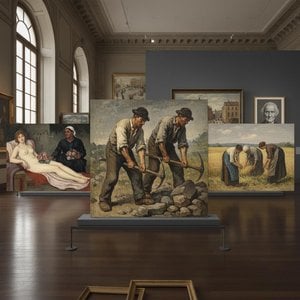
Courbet’s artistic trajectory was defined by a deliberate repudiation of prevailing aesthetic standards. He eschewed mythological tales or heroic allegories; his gaze remained fixed on the everyday lives of ordinary individuals – particularly those engaged in labor and rural existence. This commitment to depicting the world without embellishment—what would soon become known as Realism—encountered initial scorn from critics accustomed to more polished, idealized representations. Early canvases explored landscapes and portraits, but swiftly pivoted toward scenes of working-class life, rendered on a monumental scale traditionally reserved for historical or religious paintings. This purposeful choice wasn’t merely stylistic; it was an assertion about the inherent dignity and importance of subjects often overlooked by artistic discourse. The Stone Breakers (completed in 1849), tragically destroyed during World War II, exemplifies this approach—a stark portrayal of two laborers toiling away under oppressive conditions, their faces obscured by exhaustion and despair. Critics deemed it vulgar and lacking in aesthetic merit, reflecting the prevailing prejudices of the time. Yet, Courbet steadfastly defended his artistic vision, arguing that art should reflect the realities of human experience.

Influences and Artistic Development

Courbet’s formative years were marked by exposure to influential artists like Eugène Delacroix and Théodore Géricault—artists who grappled with grand narratives of heroism and emotion. However, Courbet deliberately distanced himself from Romantic idealism, prioritizing observation over imagination and truth over convention. He recognized the legacy of Caravaggio – particularly his masterful use of chiaroscuro (light and shadow) – as a source of inspiration for dramatic realism. This influence is palpable in his later works, where he skillfully manipulated light to heighten emotional impact and convey psychological depth. His artistic development progressed through meticulous study and experimentation, culminating in a distinctive technique characterized by thick impasto—applying paint thickly onto the canvas—that emphasized the materiality of the medium itself.

Major Works and Artistic Philosophy

Courbet’s oeuvre encompasses a remarkable range of subjects – landscapes, portraits, still lifes, and genre scenes depicting everyday life. Among his most celebrated paintings are A Burial at Ornans (1850-51), a monumental canvas portraying a provincial funeral that provoked considerable controversy upon its exhibition. Its sheer scale—typically reserved for historical canvases—combined with its unflinching realism and absence of sentimental embellishment shocked audiences accustomed to idealized depictions of piety and nobility. Courbet’s artistic philosophy extended beyond subject matter; he championed the notion that art should serve as a conduit for social commentary, mirroring the realities of human existence without resorting to moralizing pronouncements. He famously declared, “I paint what I see.” This uncompromising stance resonated deeply with fellow artists who sought to challenge established norms and explore new avenues of artistic expression.

Legacy and Historical Significance

Gustave Courbet’s impact on subsequent art movements is undeniable. While he acknowledged influences from earlier masters like Caravaggio for their dramatic realism and masterful use of light, his contribution transcended mere imitation. He fundamentally reshaped the landscape of nineteenth-century painting by liberating artists from the constraints of Romantic idealism—encouraging them to embrace observation and strive for truthful representation. His unwavering advocacy for artistic freedom cemented his position as a champion of revolutionary ideas during a period marked by social upheaval. Courbet’s participation in the Salon des Refusés in 1863 – an exhibition showcasing artworks rejected by the official Salon – symbolized defiance against academic dogma and reaffirmed his commitment to artistic integrity. He died peacefully in Paris on December 31, 1877, leaving behind a legacy that continues to inspire artists and scholars alike—a testament to the transformative power of art to confront societal injustices and elevate human experience. His enduring influence can be seen in movements like Impressionism and Post-Impressionism, where artists sought to capture fleeting moments of sensory perception and express subjective emotion with unprecedented boldness.
Гюстав Курбе

Гюстав Курбе

1819 - 1877 , Франція

Довідкова інформація

  • Artistic Movement Or Style: Реалізм
  • Artists Or Movements Influenced By This Artist:
    • Імпресіонізм
    • Пост-імпресіонізм
  • Artists Who Influenced This Artist:
    • Ежен Делакруа
    • Теодор Жерико
    • Караваджо
  • Date Of Birth: 10 червня 1819
  • Date Of Death: 31 грудня 1877
  • Full Name: Gustave Courbet
  • Nationality: Француз
  • Notable Artworks:
    • «Заливна брама в Оптевозі»
    • Гра зі шахівницями
    • Жінка в білих панчохах
  • Place Of Birth: Орланс, Франція
Досліджуйте твори мистецтва, впорядковані за темами, стилями та характеристиками.