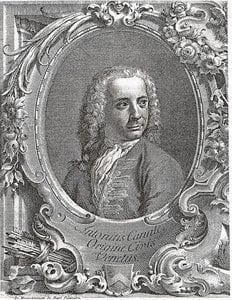
Early Life and Artistic Beginnings
Giovanni Antonio Canal, universally known as Canaletto, was born on October 18, 1697, in the heart of Venice – a city that would forever be the subject of his artistic obsession. His early life unfolded within a family deeply rooted in the world of visual arts; his father, Bernardo Canal, was a respected scene painter for theatrical productions, imbuing young Giovanni with an initial understanding of composition and perspective. Artemisia Barbieri, his mother, further nurtured his creative spirit. Canaletto’s artistic journey began not with grand ambitions, but with the practicalities of assisting his father in crafting backdrops for Venetian stages – a formative experience that instilled within him a keen eye for detail and an appreciation for capturing fleeting moments of everyday life.
Crucially, Canaletto's training extended beyond simply replicating theatrical settings. He honed his skills by working alongside his brother, also a painter, absorbing techniques and developing a foundational understanding of color, light, and shadow. This early apprenticeship laid the groundwork for his later success as a topographical artist – an artist dedicated to meticulously documenting the city he loved.
The Roman Years: Seeds of a New Style
In 1718, Canaletto embarked on a pivotal journey to Rome, a move that profoundly shaped his artistic development. He sought opportunities within the bustling world of Roman theatre scenery, working for renowned composers like Alessandro Scarlatti and Giovanni Porto. This period proved transformative; he was exposed to the vibrant energy of the city, its grand architecture, and the diverse cast of characters that populated its streets. It was here that Canaletto began to develop his signature style – a precise, almost photographic realism combined with an elegant sense of composition.
The influence of Giovanni Paolo Pannini, a celebrated Roman vedutista (a painter specializing in cityscapes), is particularly evident in Canaletto’s early work. Pannini's meticulous attention to detail and his ability to capture the essence of urban life served as a model for Canaletto, inspiring him to translate the dynamism of Rome onto canvas.
Venetian Mastery: Capturing the Spirit of the City
Upon returning to Venice in 1725, Canaletto quickly established himself as one of the city’s most sought-after artists. He shifted his focus from theatrical scenery to painting *vedute* – detailed depictions of Venetian buildings, canals, and public spaces. These weren't merely accurate records; they were carefully constructed compositions designed to evoke a sense of atmosphere and charm. Canaletto’s approach was revolutionary for its time, moving beyond simple documentation to create visually compelling narratives.
His most celebrated works from this period include “The Stonemason’s Yard” (circa 1725), a masterpiece that showcases his early skill in capturing the textures of stone and the bustle of daily life. Other notable paintings, such as "Regatta on the Grand Canal" and "Eton College," demonstrate his ability to depict public ceremonies and grand architectural settings with equal artistry.
Collaboration and Influence: Bellotto and Beyond
Canaletto’s artistic career was inextricably linked to that of his nephew, Bernardo Bellotto. Bellotto became a talented artist in his own right, inheriting Canaletto's style and techniques. The two collaborated extensively on numerous projects, often working together to create large-scale *vedute* of Venice – a testament to their shared vision and artistic partnership.
Furthermore, Canaletto’s influence extended far beyond his immediate circle. His meticulous preparatory drawings, often incorporating the use of a camera obscura (a device that projects an image of the outside world onto a surface), became a model for other artists seeking to achieve greater accuracy and detail in their landscapes. His work profoundly impacted 18th-century art, shaping the development of *vedute* painting across Europe.
A Journey to England: New Perspectives
In 1746, Canaletto embarked on a significant chapter of his career – a journey to England. Invited by the wealthy merchant and connoisseur Joseph “Consul” Smith, he spent nearly two decades documenting London and other English sites. This period marked a shift in his artistic focus, as he began to paint imaginary landscapes alongside his realistic depictions of urban scenes.
Canaletto’s paintings of England, including views of Warwick Castle and Alnwick Castle, were immensely popular with the British public, thanks to Smith's astute business acumen. His work was widely reproduced in prints, making it accessible to a broader audience and solidifying his reputation as one of Europe’s leading artists.
Legacy and Enduring Significance
Canaletto’s legacy is profound and enduring. His meticulously rendered *vedute* offer invaluable insights into the daily life, architecture, and atmosphere of Venice and other European cities during the 18th century. His work can be found in prestigious museums around the world, including the National Gallery in London, where it continues to captivate viewers with its beauty and detail.
Canaletto’s innovative use of perspective, his meticulous preparatory drawings, and his ability to capture both the accuracy and the spirit of a place have cemented his position as one of the most important artists of the Baroque period. His art remains a testament to the power of observation, skill, and artistic vision.



 Переглянути в інтер'єрі
 Перейти до друку
 Надіслати як листівку
 Поділитися
 Детальніше

 Завантажити
 Схожі експонати
 Рентгенівське дослідження
 Слайд-шоу
 Статистика


 Читати далі