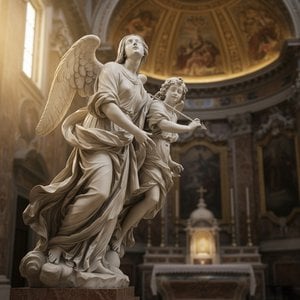
A Roman Genius: The Life and Legacy of Gian Lorenzo Bernini
Gian Lorenzo Bernini, a name synonymous with the Baroque era, was more than just a sculptor; he was an architect, painter, stage designer, and a true embodiment of the Renaissance ideal – *uomo universale*. Born in Naples in 1598, his journey to becoming Rome’s most celebrated artist began within a family steeped in artistic tradition. His father, Pietro Bernini, a respected sculptor himself, provided the initial foundation for Gian Lorenzo's prodigious talent, nurturing it within their workshop and exposing him to the classical heritage of Italy. This early immersion wasn’t merely about technical training; it was a deep dive into the forms and principles that would shape his artistic vision for decades to come.
Bernini’s innate skill quickly outstripped even his father's, hinting at the revolutionary force he was destined to become. He possessed an almost preternatural ability to capture emotion and movement in marble, transforming cold stone into expressions of profound psychological depth. This talent immediately attracted the attention of Cardinal Maffeo Barberini, who would later ascend to the papacy as Urban VIII and become Bernini’s most influential patron. Barberini recognized Bernini's extraordinary potential and provided him with unprecedented opportunities, shaping not only his career but also fundamentally altering the aesthetic landscape of Rome itself.
Sculpting Emotion: The Birth of Baroque Drama
Bernini is unequivocally considered the preeminent sculptor of the Baroque period – a style characterized by its dynamism, emotional intensity, and sheer grandeur. He didn’t simply sculpt figures; he breathed life into marble, capturing moments of intense action or spiritual climax with unparalleled skill. Unlike the idealized forms of the Renaissance, Bernini embraced movement, theatricality, and the raw power of human emotion. His work moved beyond mere representation to evoke a visceral response in the viewer – a feeling that resonated long after seeing the sculpture. Key elements defined his distinctive style: an extraordinary ability to convey complex emotions through facial expressions and body language; an astonishing technical proficiency that allowed him to render textures—flowing hair, delicate fabrics, smooth skin—with breathtaking realism; and above all, a commitment to dramatic narrative, depicting moments of intense action or spiritual climax. The *Ecstasy of Saint Teresa*, housed in the Cornaro Chapel of Santa Maria della Vittoria, remains perhaps his most iconic achievement – a swirling composition of marble, bronze, and light that captures a mystical experience with an almost overwhelming emotional force. The sculpture’s dynamism, its sense of movement and drama, set a new standard for Baroque art.
Alongside *The Ecstasy of Saint Teresa*, other masterpieces like *Apollo and Daphne* and *David* showcase this same dynamic energy, transforming stone into fleeting moments of transformation and poised tension. Bernini's genius lay not just in his technical skill but also in his ability to infuse his sculptures with a sense of life – as if they were about to step off the pedestal and engage the viewer in an intimate dialogue.
Beyond Sculpture: Architecture and Urban Visions
Bernini’s artistic vision extended far beyond the realm of sculpture; he was a remarkably versatile artist who made significant contributions to architecture and urban planning, fundamentally reshaping the cityscape of Rome. His architectural designs were never conceived in isolation; they were always integrated with his sculptural work, creating unified artistic experiences that blurred the boundaries between disciplines. The monumental *Baldacchino* (candelabrum) above the high altar of St. Peter’s Basilica is a testament to this holistic approach – a soaring bronze canopy that dominates the space and draws the eye upwards in awe. He also played a pivotal role in redesigning several Roman piazzas, transforming them into vibrant public spaces. The *Fountain of the Four Rivers* in Piazza Navona, with its allegorical figures representing major rivers from different continents, is a prime example of his ability to create dynamic and engaging urban environments – a celebration of Rome’s connection to the world.
His work on St. Peter’s Basilica, including the expansive colonnade that embraces visitors as they approach, dramatically altered the basilica's appearance and created a grand ceremonial space befitting the heart of Christendom. Bernini didn’t just build structures; he crafted entire experiences – spaces designed to inspire awe, wonder, and a sense of connection with the divine.
A Lasting Influence: Bernini’s Historical Significance
Gian Lorenzo Bernini profoundly impacted the course of Western art. His innovative approach to sculpture established the Baroque style as a dominant force in European art for over a century, influencing generations of artists with his dramatic compositions and technical virtuosity. He wasn't merely an imitator of classical forms; he synthesized them with a new sense of dynamism and emotional intensity, creating something entirely original. His integration of sculpture, architecture, and painting into unified artistic experiences set a new standard for artistic expression, demonstrating the power of art to engage all the senses and evoke profound emotions. As Howard Hibbard eloquently noted, Bernini’s impact was so significant that he stands as “the greatest sculptor of the 17th century.” His works continue to inspire awe and admiration, solidifying his place as one of history's most important artists – a true *uomo universale* whose legacy continues to resonate today.
Family & Further Achievements
- Pietro Bernini: Gian Lorenzo’s father, a sculptor who provided early training and guidance.
- Cardinal Scipione Borghese: An early patron whose commissions allowed Bernini to develop his signature style.
- Pope Urban VIII: Bernini's most significant patron, providing extensive opportunities for architectural and sculptural projects in Rome.
- Architectural Projects: Beyond St. Peter’s Basilica, Bernini designed churches like Sant’Andrea al Quirinale and contributed to the design of Palazzo Barberini.
- Theatrical Designs: He was also a playwright and stage designer, creating elaborate sets and machinery for theatrical productions.



 Перейти до друку
 Надіслати
 Поділитися
 Деталі
 Посібник

 Завантажити
 Схожі предмети колекціонування
 Слайд-шоу
 Статистика переглядів


 Читати далі






































 Скляний варіант доступний лише для розмірів до 110 см