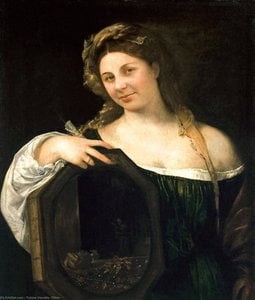
A Portrait of Dramatic Light: Unveiling "Lute Player"
Gerard van Honthorst’s “Lute Player,” a captivating portrait dating from the mid-17th century, offers a glimpse into the opulent world of Dutch Golden Age society. The painting immediately draws the eye to its subject – a woman presented with an arresting blend of elegance and vulnerability. Dressed in a vibrant yellow gown meticulously trimmed with deep blue, she embodies the fashionable sensibilities of her era while simultaneously radiating a quiet introspection. The composition itself is carefully constructed; the lute held delicately in her hand becomes not merely an instrument but a focal point, drawing attention to her gesture and suggesting a moment of private contemplation or perhaps even performance.
The Influence of Caravaggio: Tenebrism and Emotional Intensity
Honthorst’s artistic journey was profoundly shaped by his time in Rome, where he encountered the revolutionary work of Caravaggio. This encounter ignited within him a passion for *tenebrism*, a technique characterized by dramatic contrasts between intensely dark shadows and pools of brilliant light. In “Lute Player,” this is evident in the way light dramatically illuminates the woman’s face and gown, creating a sense of theatrical depth and emphasizing her features. The darkness surrounding her isn't merely an absence of light; it actively contributes to the painting’s emotional weight, suggesting hidden depths within the subject’s character. This masterful manipulation of light and shadow is what earned Honthorst his nickname, “Gherardo delle Notti,” or Gerard of the Nights – a testament to his ability to conjure atmosphere and drama with such profound skill.
A Window into Dutch Society: Setting and Symbolism
The setting within the painting provides valuable context for understanding its place in 17th-century Dutch life. The presence of a chair and dining table hints at an aristocratic or wealthy household, suggesting that the subject is likely a member of the upper class. A book resting near her adds another layer of meaning – perhaps representing education, refinement, or even musical knowledge. The inclusion of two other figures, partially visible in the background, subtly expands the narrative, inviting the viewer to imagine the social dynamics and relationships within this domestic scene. These details are not merely decorative; they contribute significantly to the painting’s overall story.
Emotional Resonance and Artistic Legacy
"Lute Player" transcends a simple portrait; it's an exploration of human emotion and psychological depth, a hallmark of Honthorst’s style. The woman’s gentle smile, combined with the dramatic lighting and carefully considered composition, evokes a sense of quiet beauty and perhaps even melancholy. Gerard van Honthorst’s work continues to resonate today because it captures not just a likeness but an essence – a moment frozen in time that speaks to universal themes of grace, contemplation, and the power of artistic expression. WahooArt.com is proud to offer meticulously crafted reproductions of this remarkable piece, allowing you to experience its beauty and historical significance firsthand.
Питання та відповіді
Як «Lute Player» роботи Герхард ван Хонтхорст пов’язує Dutch Baroque з батьківщиною митця?
«Lute Player» пов’язує мистецтво Dutch Baroque із Нідерланди через місце народження його творця.
У якій кімнаті рекомендується розмістити «Lute Player», враховуючи її палітру?
Кольорова палітра Dark у творі «Lute Player» роботи Герхард ван Хонтхорст ідеально підходить для рекомендованого інтер'єру: це Living Room.
Які сюжет та атмосферу поєднує в собі «Lute Player» роботи Герхард ван Хонтхорст?
«Lute Player» роботи Герхард ван Хонтхорст зображує lute player, portrait woman, dutch masterpiece, van honthorst art, baroque lighting, yellow dress”, “caravaggio influence” у Romantic настрої. Поєднання сюжету та атмосфери повністю розкриває цей твір.



 Переглянути в інтер'єрі
 Замовити картину ручної роботи
 Надіслати як листівку
 Поділитися
 Деталі витвору
 Посібник

 Завантажити
 Схожі екземпляри
 Рентгенівське дослідження
 Слайд-шоу
 Статистика
 Розгорнути текст






































 Скляний варіант доступний лише для розмірів до 110 см