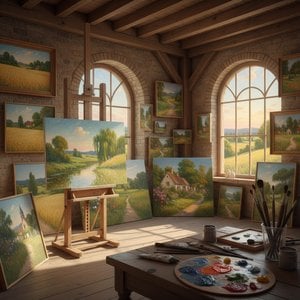
The Luminous Legacy of Frank Grant Faed
In the quiet, salt-kissed corners of the Channel Islands, there exists a particular quality of light that seems to dance between the sea and the shore. It was this very atmosphere that Sir Francis Grant Faed (1897–1964) dedicated his life to capturing. A true master of Jersey’s natural splendor, Faed possessed an uncanny ability to translate the fleeting textures of the British landscape into enduring oil paintings. Born in Saint Helier, his connection to the island was not merely geographical but deeply spiritual. His early years were shaped by a rigorous Victorian tradition of observation, instilled in him by his father, William Grant Faed. This foundation of meticulous detail would later serve as the structural skeleton upon which he draped the more fluid, emotive layers of his Impressionistic style.
The evolution of Faed’s artistry took a transformative turn when he moved to London to study at the prestigious Slade School of Fine Art between 1915 and 1918. It was within these hallowed halls that the artist encountered the revolutionary spirit of Impressionism. Absorbing the techniques of masters like Claude Monet and Pierre-Auguste Renoir, Faed began to move away from rigid photographic accuracy, seeking instead to capture the ephemeral essence of a moment. He learned to see light not as a static element, but as a living force that could dissolve edges and alter colors with every passing minute. This period marked his transition from a student of detail to a poet of atmosphere, a shift that would define his most celebrated works.
A Tapestry of Jersey Landscapes
Upon returning to his roots, Faed turned his gaze toward the rugged coastlines and verdant meadows of Jersey. His body of work serves as a visual chronicle of an island caught between the wild energy of the Atlantic and the serene tranquility of rural life. He was particularly drawn to the dramatic interplay of textures—the jagged, ancient cliffs plunging into turquoise waters and the soft, rhythmic swaying of wildflowers in summer breezes. Unlike many of his contemporaries who sought out grand, sweeping vistas to impress the viewer, Faed often favored a more intimate, human-scaled perspective. His canvases frequently focused on smaller, nuanced scenes that invited the observer to linger on subtle tonal gradations.
His technical approach, often described as Impressionistic realism, allowed him to maintain a sense of topographical truth while embracing painterly freedom. In works such as Trees and Rocky Headland, one can observe his skillful use of visible brushstrokes to suggest movement and depth. His palette was masterfully tuned to the local climate, leaning heavily into muted greens, soft blues, and warm yellows that reflected the specific, hazy light characteristic of the Channel Islands. Whether depicting a sun-drenched garden in Garden Space or the nostalgic charm of A Jersey Farmhouse, his work consistently evokes a sense of peace and timelessness.
Artistic Significance and Enduring Impression
The historical significance of Frank Grant Faed lies in his role as a custodian of Jersey’s aesthetic heritage. Through his eyes, the island's landscape became more than just scenery; it became a character in its own right, imbued with emotion and history. His ability to blend the precision of his early training with the light-centric philosophy of the Impressionists created a unique niche in British landscape painting. He did not merely paint what he saw; he painted how the light felt upon the skin and how the wind moved through the grass.
Today, Faed’s contributions are celebrated within the annals of British art, with many of his most precious pieces residing in collections such as the Jersey Museum and Art Gallery. His legacy continues to inspire those who find beauty in the quiet, overlooked corners of the natural world. To look upon a Faed painting is to experience a moment of profound stillness, a brief respite where the light of the past illuminates the present with unmistakable clarity.



 Переглянути в інтер'єрі
 Перейти до друку
 Надіслати
 Поділитися
 Деталі
 Посібник

 Завантажити
 Схожі предмети колекціонування
 Рентгенівське дослідження
 Слайд-шоу
 Статистика переглядів


 Читати далі






































 Скляний варіант доступний лише для розмірів до 110 см