Біографія митця
Félicien Rops – A Shadowy Visionary: The Life and Art of Félicien Rops
Félicien Victor Joseph Rops, born in Namur, Belgium (1833), stands as a singular figure bridging the stylistic currents of Realism, Symbolism, and the burgeoning realm of modern graphic storytelling. His life unfolded against a backdrop of considerable social transformation – his father’s textile enterprise representing bourgeois stability juxtaposed with an inner artistic restlessness—a duality that profoundly shaped his creative trajectory. Early training at local academies provided foundational skills, yet it was his relocation to Brussels at twenty that truly ignited the flame of his artistic vocation. Though briefly enrolled at the University of Brussels, Rops swiftly abandoned academic pursuits for the vibrant intellectual atmosphere of Saint-Luc Academy, where he honed his craft not solely in painting and drawing but also in the art of satire through lithography—a skill that would become central to his distinctive style. His debut publications in *Le Crocodile* and *L'Uylenspiegel*, featuring caricatures targeting societal hypocrisy, established him as a gifted satirist with an astute understanding of contemporary anxieties. These formative years weren’t merely about mastering technique; they were about discovering his voice—a voice that would soon become synonymous with challenging conventions and delving into the darker recesses of human psychology.
Early Years & Artistic Formation
Rops's childhood in Namur instilled a meticulous observation of detail and an appreciation for naturalistic representation, skills he carried forward into his artistic endeavors. However, it was Brussels—a city undergoing rapid industrialization and grappling with questions of national identity—that truly nurtured his rebellious spirit and propelled him toward innovative artistic experimentation. His enrollment at Saint-Luc Academy wasn’t merely a pursuit of formal training; it was an immersion in the intellectual currents of Symbolism, where he encountered influential figures like Gustave Moreau and Jean Frémiet d'Orléans who championed expressive color palettes and evocative imagery—influences that would permeate his subsequent work. Crucially, Rops recognized the power of lithography as a medium for disseminating social critique and capturing fleeting moments of emotion—a conviction that fueled his prolific output in student magazines and solidified his reputation as a master printmaker. His father’s textile business provided financial stability, allowing him to dedicate himself fully to artistic pursuits without compromising on personal comfort.
Parisian Encounters & The Embrace of Symbolism
The year 1862 marked a decisive juncture in Rops's life—his move to Paris, a city pulsating with artistic dynamism and intellectual ferment. Here, he encountered Félix Bracquemond and Jules Ferdinand Jacquemart—etchers who championed the use of aquatint and mezzotint techniques—artists whose mastery inspired him to push the boundaries of printmaking innovation. These encounters profoundly shaped his artistic vision, propelling him toward Symbolism’s exploration of dreamlike landscapes, mythological narratives, and psychological introspection. Perhaps most significantly, Rops forged an enduring connection with Charles Baudelaire—the poet who revolutionized literary aesthetics by embracing decay and confronting taboo subjects—a relationship that fueled his fascination with the darker side of human experience and solidified his position as a champion of Symbolist ideals. Baudelaire’s influence is palpable in Rops's haunting depictions of figures caught between beauty and terror, reflecting the anxieties of the fin de siècle—a period marked by scientific advancements alongside spiritual disillusionment.
A Pioneer of Printmaking & Graphic Narrative
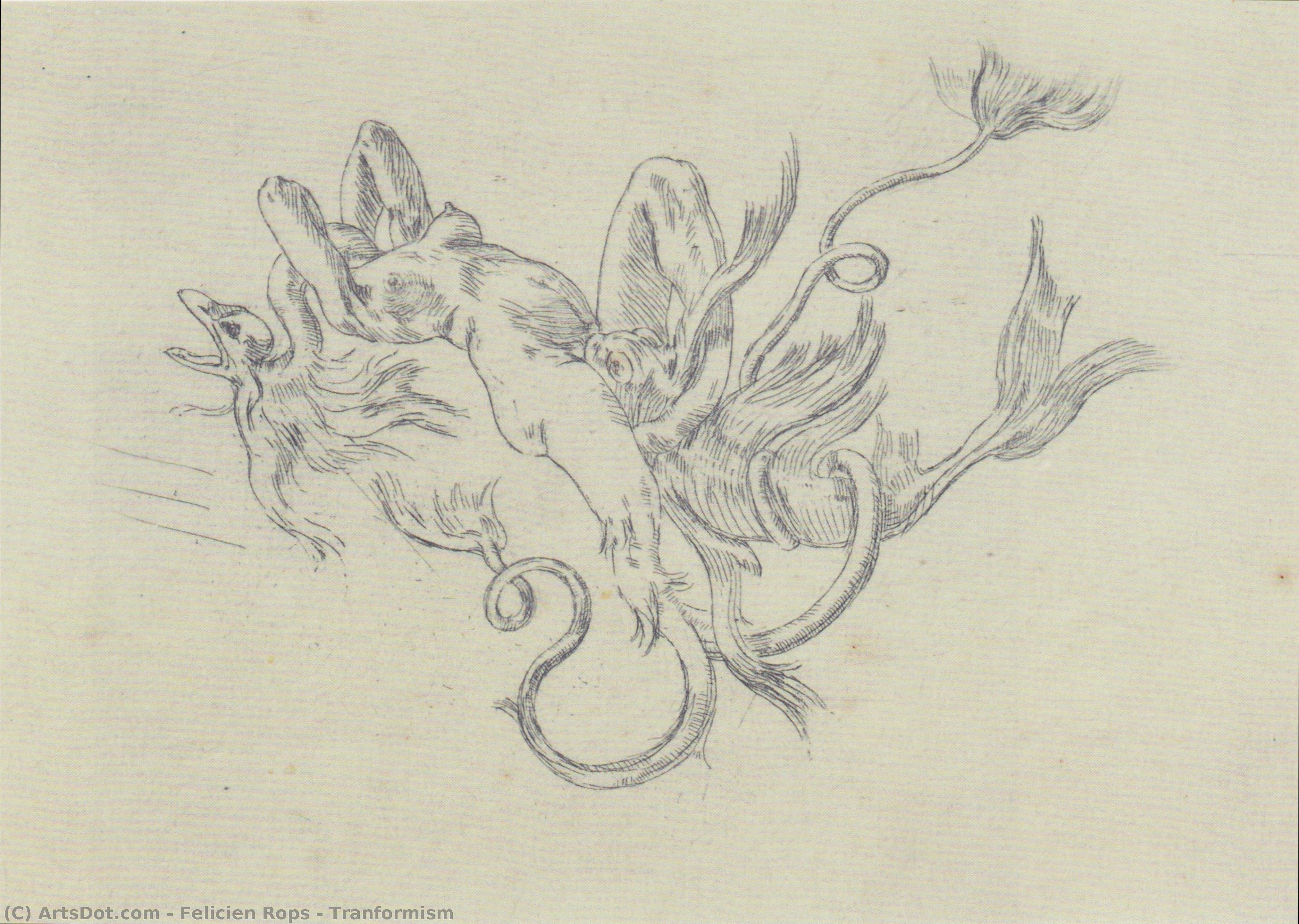
Rops distinguished himself as a virtuoso printmaker, mastering techniques rarely employed by his contemporaries—particularly soft-ground etching—which allowed him to achieve unparalleled tonal subtlety and expressive nuance. His prints are characterized by meticulous detail, dramatic chiaroscuro, and an atmosphere imbued with psychological depth—qualities that transcend mere visual representation and convey profound emotional resonance. Beyond his technical prowess, Rops revolutionized graphic storytelling through his contributions to student publications like *Le Crocodile* and *L'Uylenspiegel*, establishing himself as a pioneer of sequential art. His drawings captured the spirit of the era—social satire, political critique, and explorations of human psychology—often employing fantastical imagery and unsettling narratives that challenged conventional artistic norms. He skillfully integrated text and image, creating dynamic compositions that amplified narrative impact—a technique that foreshadowed developments in comic strips decades later.
Legacy & Influence
Rops’s oeuvre continues to captivate audiences today for its artistic merit, historical significance, and unwavering commitment to confronting taboo subjects—themes that resonate powerfully across generations of artists. Edvard Munch and Max Klinger recognized Rops's innovative printmaking techniques and his fearless exploration of psychological anxieties—artists whose work bears the indelible stamp of Symbolist aesthetics. His enduring influence extends beyond individual stylistic borrowings; it embodies a broader ethos of artistic experimentation, social critique, and psychological introspection—a legacy that secures his place as one of Belgium’s most visionary artists and a pivotal figure in the history of modern graphic art. He remains an exemplar of artistic integrity and intellectual curiosity—a testament to the transformative power of confronting darkness while striving for beauty.