Переглянути в інтер'єрі Примірка в AR Перейти до друку Перейти до цифрових зображень Надіслати
Деталі Посібник Додати до улюблених Завантажити Схожі предмети колекціонування Рентгенівське дослідження Слайд-шоу Статистика переглядів

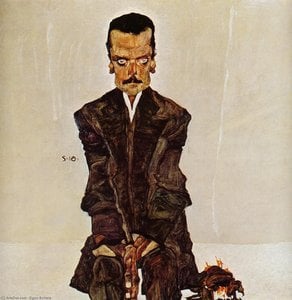
untitled (8356)

Explore Egon Schiele's haunting 'Untitled (8356)' – a psychologically charged portrait revealing vulnerability and mortality through intense lines & unsettling expression. A masterpiece of Expressionism.

Еґон Шілельє – австрійський экспресіоністський живописець, відомий своїми емоційно насиченими полотнами та символічним зображенням будинку з сухим пранням. Дізнайтесь більше про мистецтво Шілеля!

Олійная репродукція ручної роботи

Написана вручну олією на полотні у вашому розмірі та рамі, виготовлена на замовлення нашими художниками. ( Перейти до друку Перейти до цифрових зображень)

Corner sample of the P118B picture frame: формований полістирол, 5 cm wide and 3 cm thick
P118B ₴10
Corner sample of the P118H picture frame: формований полістирол, 5 cm wide and 3 cm thick
P118H ₴10
Corner sample of the P118W picture frame: формований полістирол, 5 cm wide and 3 cm thick
P118W ₴10
Corner sample of the P438Z picture frame: формований полістирол, 5.5 cm wide and 3.5 cm thick
P438Z ₴10
Corner sample of the P508JH picture frame: формований полістирол, 7 cm wide and 3.5 cm thick
P508JH ₴12
Corner sample of the P508YH picture frame: формований полістирол, 7 cm wide and 3.5 cm thick
P508YH ₴12
Corner sample of the P805H picture frame: формований полістирол, 5 cm wide and 3.5 cm thick
P805H ₴10
Corner sample of the P805Z picture frame: формований полістирол, 5 cm wide and 3.5 cm thick
P805Z ₴10
Corner sample of the P919BZ picture frame: формований полістирол, 7 cm wide and 3.5 cm thick
P919BZ ₴10
Corner sample of the P919G picture frame: формований полістирол, 7 cm wide and 3.5 cm thick
P919G ₴10
Corner sample of the P919XJ picture frame: формований полістирол, 7 cm wide and 3.5 cm thick
P919XJ ₴10
Corner sample of the P959ZH picture frame: формований полістирол, 5 cm wide and 3 cm thick
P959ZH ₴10
Corner sample of the P968JZ picture frame: формований полістирол, 6 cm wide and 4 cm thick
P968JZ ₴12
Corner sample of the W106C picture frame: масив дерева, 5 cm wide and 3 cm thick
W106C ₴8
Corner sample of the W218G picture frame: масив дерева, 5 cm wide and 3 cm thick
W218G ₴10
Corner sample of the W218JH picture frame: масив дерева, 5 cm wide and 3 cm thick
W218JH ₴8
Corner sample of the W218Y picture frame: масив дерева, 5 cm wide and 3 cm thick
W218Y ₴10
Corner sample of the W307PJ picture frame: масив дерева, 6 cm wide and 3 cm thick
W307PJ ₴10
Corner sample of the W316G picture frame: масив дерева, 6 cm wide and 3 cm thick
W316G ₴10
Corner sample of the W316PJ picture frame: масив дерева, 6 cm wide and 3 cm thick
W316PJ ₴8
Corner sample of the W316Y picture frame: масив дерева, 6 cm wide and 3 cm thick
W316Y ₴10
Corner sample of the W398PJ picture frame: масив дерева, 5 cm wide and 3 cm thick
W398PJ ₴8
Corner sample of the W4111J picture frame: масив дерева, 6.5 cm wide and 3.5 cm thick
W4111J ₴10
Corner sample of the W500HY picture frame: масив дерева, 7 cm wide and 5 cm thick
W500HY ₴15
Corner sample of the W500JH picture frame: масив дерева, 7 cm wide and 5 cm thick
W500JH ₴15
Corner sample of the W692G picture frame: масив дерева, 8 cm wide and 4 cm thick
W692G ₴12
Corner sample of the W849H picture frame: масив дерева, 5 cm wide and 3 cm thick
W849H ₴8
Corner sample of the W940BG picture frame: масив дерева, 7.5 cm wide and 4.5 cm thick
W940BG ₴15
Corner sample of the W953PJ picture frame: масив дерева, 6 cm wide and 3.5 cm thick
W953PJ ₴8

Стандартний розмір
на замовлення
CM
INCH

Обирайте з наших стандартних розмірів, що відповідають оригінальним пропорціям твору мистецтва.

ширина
висота

Введіть необхідну ширину та висоту, щоб картина підійшла до вашої рами або стіни. Оскільки це ручний розпис, для розміру іншої форми художник може написати трохи більше навколо картини або трохи обрізати її — вибір за вами. Перед початком роботи ми надішлемо вам цифровий макет для затвердження. Зображення, показане на цій сторінці, не є реальним результатом — лише макет відображає майбутній вигляд.

Приклади можливих змін: замінити обличчя на фото клієнта; додати домашню тварину (наприклад, замінити кота на собаку); додати приховане повідомлення на фоні; змінити ландшафт або елементи фону.
Після оформлення замовлення команда WahooArt.com зв'яжеться з клієнтом електронною поштою для отримання інструкцій та надасть попередній макет

Доставка по всьому світу () за 3–4 тижні замість стандартних 5 тижнів. (24 Жовтень). Без жодних компромісів у якості.

Безкоштовна експрес-доставка по всьому світу
Високоякісне лляне полотно
Повне страхове покриття доставки
Гарантія повернення митних зборів
Гарантія точного відтворення кольорів
Політика повернення протягом 100 днів (лише у разі виявлення дефектів)
Гарантія повернення 100% коштів
Знижка на оптові замовлення

Загальна вартість

₴ 12207

untitled (8356)

Техніка репродукції

Розмір репродукції

-

Загальна вартість

₴ 12207

Короткі факти

  • Movement: Expressionism
  • Title: untitled (8356)
  • Artistic style: Intense, raw
  • Artist: Egon Schiele

Тест на знання мистецтва

У кожному запитанні лише одна правильна відповідь.

Запитання 1:
Based on the image description, what is the primary emotion conveyed by the woman’s facial expression?
Запитання 2:
The image includes a clock and two books. What do these elements likely suggest about the scene’s setting or the woman's state of mind?
Запитання 3:
Egon Schiele was a prominent figure in which artistic movement?
Запитання 4:
Considering Egon Schiele's biography, what significantly influenced his artistic themes and style?
Запитання 5:
What is a key characteristic of Egon Schiele's artistic style, as evidenced in this image?

Egon Schiele’s Haunting Portrait: A Study in Anxiety and Desire

Egon Schiele's "untitled (8356)" is not merely a portrait; it’s a raw, unsettling glimpse into the psyche of a tormented artist grappling with mortality, sexuality, and the anxieties of early 20th-century Europe. Painted in 1917, during a period of intense personal struggle for Schiele – marked by illness, loss, and the looming shadow of World War I – this work embodies his signature Expressionist style: bold lines, distorted forms, and an unnerving intensity that refuses to offer easy answers.

The subject, a woman with a strikingly unusual expression, dominates the composition. Her mouth hangs slightly open in what appears to be a forced smile or perhaps a grimace of discomfort, her eyes wide and unblinking. This unsettling facial distortion is central to the painting’s power, immediately drawing the viewer into a space of unease and questioning. The background—a simple wall adorned with a clock and two books – provides a stark contrast to the woman's intense presence, suggesting a sense of isolation and perhaps a preoccupation with time and knowledge.

The Language of Line and Distortion

Schiele’s technique is instantly recognizable. He employs rapid, agitated brushstrokes that create a palpable sense of movement and instability. The lines are not smooth or refined; they are jagged, broken, and deliberately distorted – mirroring the emotional turmoil he sought to convey. Notice how the woman's features are elongated and exaggerated, her body subtly twisted as if caught in an awkward pose. This deliberate distortion isn’t simply stylistic; it’s a visual representation of psychological strain and vulnerability.

The use of color is equally significant. The palette is muted – predominantly browns, ochres, and greys—contributing to the painting's somber mood. However, Schiele strategically employs small bursts of brighter tones, particularly in the woman’s eyes, which seem to pierce through the darkness, demanding attention and revealing a flicker of underlying emotion.

Symbolism and Context: Mortality and the Modern Condition

Schiele's work is deeply intertwined with the anxieties of his time. The painting reflects the pervasive sense of uncertainty and disillusionment that gripped Europe in the wake of World War I, as well as a broader preoccupation with death and decay—themes frequently explored by Schiele throughout his oeuvre. The clock in the background serves as a potent symbol of mortality, reminding us of the relentless passage of time and the inevitability of our own demise.

Furthermore, the painting can be interpreted through the lens of Freudian psychology. The woman’s expression—a mixture of amusement and discomfort—suggests a complex interplay of desire and repression. Schiele was fascinated by sexuality and often depicted it in unconventional ways, challenging societal norms and exploring the darker aspects of human experience. The presence of the books hints at intellectual pursuits but also perhaps an inability to find solace or answers within them.

A Window into the Soul: Reproduction and Appreciation

"untitled (8356)" is a profoundly moving work that continues to resonate with viewers today. WahooArt offers meticulously crafted, hand-painted reproductions of this iconic painting, allowing you to experience its emotional depth and artistic brilliance in stunning detail. These reproductions capture not only the visual elements but also the very spirit of Schiele’s vision—a testament to his unique talent and enduring legacy. Consider adding this powerful image to your collection or incorporating it into your interior design – a reminder of the complexities of human emotion and the beauty found within vulnerability.

To learn more about Egon Schiele's life, artistic influences, and other significant works, explore our artist database or read our comprehensive article: Egon Schiele: Expressionism, Anxiety & the Modern Condition – A Comprehensive Exploration. For a deeper dive into one of his most famous paintings, you can find information on “Death and the Maiden (Schiele)” here: Wikipedia Search.

Запитання та відповіді

Який емоційний тон має «untitled (8356)» Еґон Шілельє?

«untitled (8356)» асоціюється з Melancholic відчуттям. Емоційний тон описує враження, яке справляє твір.

Наскільки насиченими є кольори у творі "untitled (8356)"?

Кольори твору «untitled (8356)» Еґон Шілельє демонструють Subtle Color насиченість із Balanced інтенсивністю.

Яке місце посідає «untitled (8356)» у творчій спадщині Еґон Шілельє?

«untitled (8356)» поділяє з іншими творами Еґон Шілельє характерний стиль Expressionism та притаманні йому теми: klimt’s influence, psychological depth, mortality, anxiety, introspection themes, vienna’s fin-de-siècle anxieties”, “self-portrait exploration, vulnerability”.


Біографія митця

A Life Forged in Expression

Egon Schiele’s life, a turbulent and intensely personal journey, unfolded from his birth in Tulln an der Donau in 1890, a small Austrian town nestled along the Danube. His early years were shadowed by profound loss – first the death of his father, Adolf Schiele, a railway station master consumed by syphilis when Egon was just fourteen, and later the untimely passing of his sister Elvira. This early exposure to mortality and grief became deeply ingrained within his artistic vision, fueling an enduring fascination with the fragility of existence and the inevitability of death. Raised initially by his mother and then under the somewhat controlling guardianship of his uncle Leopold Czihaczek, Schiele’s childhood lacked the stability often associated with conventional upbringing, yet it fostered a remarkable sense of independence and self-reliance—qualities that would profoundly shape his artistic approach. Even as a young boy, he exhibited an intense curiosity about trains – a motif that subtly reappeared throughout his career, symbolizing both movement and the passage of time. Simultaneously, he displayed a burgeoning talent for drawing, though this pursuit was initially met with disapproval from his father, who viewed it as a distraction from more “practical” endeavors. The early loss of his sister Elvira cast a long shadow over the young artist’s psyche, contributing to a pervasive sense of melancholy and vulnerability that permeated much of his work. These formative experiences—illness, loss, and a lack of stability—instilled within him an unparalleled sensitivity and emotional rawness, qualities that would become defining characteristics of his artistic expression, constantly grappling with the fundamental questions of life, death, and the human condition.

The Crucible of Vienna: Artistic Development

Schiele’s formal artistic training began at the Kunstgewerbeschule (School of Arts and Crafts) in Vienna, but he quickly found himself stifled by its conservative and rigidly academic approach. Seeking a more liberating environment, he transferred to the Akademie der bildenden Künste (Academy of Fine Arts), only to discover that even this institution failed to satisfy his artistic aspirations. The rigid traditions and emphasis on historical precedent clashed sharply with Schiele’s desire for innovation and personal expression. Dissatisfied with these constraints, he ultimately abandoned formal training altogether, choosing instead to forge his own path—a bold decision that underscored his unwavering commitment to his artistic vision. Crucially, during these formative years, Schiele was profoundly influenced by the work of Gustav Klimt, a leading figure in Viennese Secessionism. He admired Klimt’s distinctive decorative style and his exploration of symbolism, even receiving mentorship from the established artist. However, Schiele soon diverged significantly from Klimt's aesthetic, developing a uniquely personal style characterized by its stark honesty, psychological intensity, and unflinching portrayal of human vulnerability. This divergence was further fueled by his encounters with other progressive artists within Vienna’s avant-garde circles, leading to the formation of the Neues Wiener Kunstgruppe (New Viennese Art Group) in 1909—a collective dedicated to challenging conventional artistic norms and pushing the boundaries of modern art. The group included figures like Anton Faistauer, Rudolf Kalvach, and Hans Ehrlich, all seeking to redefine the role of art in a rapidly changing world.

Raw Emotion and Unflinching Truth

Egon Schiele’s art is immediately recognizable for its raw honesty and psychological depth. He fearlessly confronted themes often considered taboo – sexuality, death, anxiety, isolation – with an unflinching gaze. His distinctive style features elongated figures, contorted poses, and expressive lines that convey a sense of unease and emotional intensity. The human form, particularly the nude, became his primary subject, not as an object of idealized beauty but as a vehicle for exploring the complexities of human experience. Self-portraits constitute a significant portion of his oeuvre, offering intimate glimpses into his inner world—a world often marked by loneliness and self-doubt. He didn’t shy away from depicting himself in unflattering or vulnerable poses, revealing a profound level of self-awareness and introspection. Beyond self-portraiture, Schiele created numerous portraits of others, capturing their likenesses with an unsettling realism that seemed to penetrate beneath the surface. His landscapes, while less central to his work than his figurative paintings, demonstrate his mastery of form and color, often reflecting the same emotional intensity as his portraits. Recurring motifs like the *Physalis* plant – symbolizing death and transience with its delicate, papery husk – further underscore this preoccupation with mortality. The use of line is particularly striking in Schiele’s work; it's not merely a tool for defining shape but an expressive force that conveys emotion and psychological tension.

A Legacy Cut Short: Achievements & Significance

Despite facing censorship and legal challenges—including a brief imprisonment for allegedly corrupting minors with his art—Schiele gained recognition within Vienna’s avant-garde circles. His work challenged the conventions of the time, provoking both admiration and outrage. By the time of his untimely death during the Spanish flu pandemic in 1918 at the age of twenty-eight, he had established himself as a leading figure in Austrian Expressionism. Significant works such as *Self-Portrait with Physalis*, *Couple Embracing*, and *Field Landscape (Kreuzberg near Krumau)* stand as testaments to his artistic genius. His influence on subsequent generations of artists is undeniable, particularly those interested in exploring psychological themes and challenging conventional artistic norms. Schiele’s bold approach to form and subject matter continues to resonate with audiences today, making him one of the most important and influential figures in early 20th-century art. His paintings are now held in major museum collections worldwide, including the Leopold Museum in Vienna and the Egon Schiele Art Centrum in Český Krumlov, ensuring his artistic legacy endures. He left behind a body of work that is not merely aesthetically compelling but profoundly human—a testament to the power of art to confront the complexities of existence with honesty, courage, and unwavering vision.
  • Key Themes: Mortality, sexuality, isolation, psychological turmoil.
  • Influences: Gustav Klimt, Viennese Secession, personal trauma.
  • Style Characteristics: Elongated figures, contorted poses, expressive lines, raw emotion.

Еґон Шілельє

Еґон Шілельє

1890 - 1918 , Австрія

Довідкова інформація

  • Artistic Movement Or Style: Експресіонізм
  • Artists Or Movements Influenced By This Artist: ['Експресіонізм']
  • Artists Who Influenced This Artist: ['Густав Клімт']
  • Date Of Birth: 1890
  • Full Name: Еґон Шілельє
  • Nationality: Австрієць
  • Notable Artworks:
    • Автопортрет з фізалісом
    • Пара обіймається
    • Поле краєвид (Креуберг)
  • Place Of Birth: Тюльн, Австрія
Досліджуйте твори мистецтва, впорядковані за темами, стилями та характеристиками.