A Life Forged in Expression
Egon Schiele’s life, a turbulent and intensely personal journey, unfolded from his birth in Tulln an der Donau in 1890, a small Austrian town nestled along the Danube. His early years were shadowed by profound loss – first the death of his father, Adolf Schiele, a railway station master consumed by syphilis when Egon was just fourteen, and later the untimely passing of his sister Elvira. This early exposure to mortality and grief became deeply ingrained within his artistic vision, fueling an enduring fascination with the fragility of existence and the inevitability of death. Raised initially by his mother and then under the somewhat controlling guardianship of his uncle Leopold Czihaczek, Schiele’s childhood lacked the stability often associated with conventional upbringing, yet it fostered a remarkable sense of independence and self-reliance—qualities that would profoundly shape his artistic approach. Even as a young boy, he exhibited an intense curiosity about trains – a motif that subtly reappeared throughout his career, symbolizing both movement and the passage of time. Simultaneously, he displayed a burgeoning talent for drawing, though this pursuit was initially met with disapproval from his father, who viewed it as a distraction from more “practical” endeavors. The early loss of his sister Elvira cast a long shadow over the young artist’s psyche, contributing to a pervasive sense of melancholy and vulnerability that permeated much of his work. These formative experiences—illness, loss, and a lack of stability—instilled within him an unparalleled sensitivity and emotional rawness, qualities that would become defining characteristics of his artistic expression, constantly grappling with the fundamental questions of life, death, and the human condition.
The Crucible of Vienna: Artistic Development
Schiele’s formal artistic training began at the Kunstgewerbeschule (School of Arts and Crafts) in Vienna, but he quickly found himself stifled by its conservative and rigidly academic approach. Seeking a more liberating environment, he transferred to the Akademie der bildenden Künste (Academy of Fine Arts), only to discover that even this institution failed to satisfy his artistic aspirations. The rigid traditions and emphasis on historical precedent clashed sharply with Schiele’s desire for innovation and personal expression. Dissatisfied with these constraints, he ultimately abandoned formal training altogether, choosing instead to forge his own path—a bold decision that underscored his unwavering commitment to his artistic vision. Crucially, during these formative years, Schiele was profoundly influenced by the work of Gustav Klimt, a leading figure in Viennese Secessionism. He admired Klimt’s distinctive decorative style and his exploration of symbolism, even receiving mentorship from the established artist. However, Schiele soon diverged significantly from Klimt's aesthetic, developing a uniquely personal style characterized by its stark honesty, psychological intensity, and unflinching portrayal of human vulnerability. This divergence was further fueled by his encounters with other progressive artists within Vienna’s avant-garde circles, leading to the formation of the Neues Wiener Kunstgruppe (New Viennese Art Group) in 1909—a collective dedicated to challenging conventional artistic norms and pushing the boundaries of modern art. The group included figures like Anton Faistauer, Rudolf Kalvach, and Hans Ehrlich, all seeking to redefine the role of art in a rapidly changing world.
Raw Emotion and Unflinching Truth
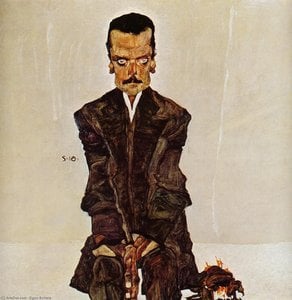
Egon Schiele’s art is immediately recognizable for its raw honesty and psychological depth. He fearlessly confronted themes often considered taboo – sexuality, death, anxiety, isolation – with an unflinching gaze. His distinctive style features elongated figures, contorted poses, and expressive lines that convey a sense of unease and emotional intensity. The human form, particularly the nude, became his primary subject, not as an object of idealized beauty but as a vehicle for exploring the complexities of human experience. Self-portraits constitute a significant portion of his oeuvre, offering intimate glimpses into his inner world—a world often marked by loneliness and self-doubt. He didn’t shy away from depicting himself in unflattering or vulnerable poses, revealing a profound level of self-awareness and introspection. Beyond self-portraiture, Schiele created numerous portraits of others, capturing their likenesses with an unsettling realism that seemed to penetrate beneath the surface. His landscapes, while less central to his work than his figurative paintings, demonstrate his mastery of form and color, often reflecting the same emotional intensity as his portraits. Recurring motifs like the *Physalis* plant – symbolizing death and transience with its delicate, papery husk – further underscore this preoccupation with mortality. The use of line is particularly striking in Schiele’s work; it's not merely a tool for defining shape but an expressive force that conveys emotion and psychological tension.
A Legacy Cut Short: Achievements & Significance
Despite facing censorship and legal challenges—including a brief imprisonment for allegedly corrupting minors with his art—Schiele gained recognition within Vienna’s avant-garde circles. His work challenged the conventions of the time, provoking both admiration and outrage. By the time of his untimely death during the Spanish flu pandemic in 1918 at the age of twenty-eight, he had established himself as a leading figure in Austrian Expressionism. Significant works such as *Self-Portrait with Physalis*, *Couple Embracing*, and *Field Landscape (Kreuzberg near Krumau)* stand as testaments to his artistic genius. His influence on subsequent generations of artists is undeniable, particularly those interested in exploring psychological themes and challenging conventional artistic norms. Schiele’s bold approach to form and subject matter continues to resonate with audiences today, making him one of the most important and influential figures in early 20th-century art. His paintings are now held in major museum collections worldwide, including the Leopold Museum in Vienna and the Egon Schiele Art Centrum in Český Krumlov, ensuring his artistic legacy endures. He left behind a body of work that is not merely aesthetically compelling but profoundly human—a testament to the power of art to confront the complexities of existence with honesty, courage, and unwavering vision.
- Key Themes: Mortality, sexuality, isolation, psychological turmoil.
- Influences: Gustav Klimt, Viennese Secession, personal trauma.
- Style Characteristics: Elongated figures, contorted poses, expressive lines, raw emotion.



 Переглянути в інтер'єрі
 Купити картину ручної роботи
 Надіслати
 Поділитися
 Деталі
 Посібник

 Завантажити
 Схожі предмети колекціонування
 Рентгенівське дослідження
 Слайд-шоу
 Статистика переглядів

 Читати далі






































 Скляний варіант доступний лише для розмірів до 110 см