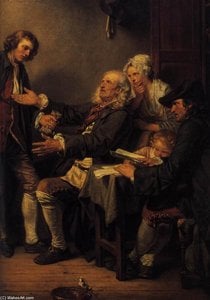
Edward Bird (1772–1819): A Life Rooted in Craft
Edward Bird, born in Wolverhampton in 1772, stands as a pivotal figure within the burgeoning British artistic landscape of the early nineteenth century. Unlike many artists of his time who pursued grand narratives of history painting, Bird’s artistic journey began humbly—within the practical confines of his father's carpentry workshop—a formative experience that instilled a meticulous attention to detail and an unwavering dedication to craftsmanship.
- Early Influences: Bird’s initial training centered on japanning artistry, honing skills in applying decorative designs onto tea trays. This painstaking process demanded precision and fostered an appreciation for textural nuances—elements that would permeate his subsequent oeuvre.
- George Cumberland & Artistic Inspiration: A crucial connection was forged with George Cumberland, a wealthy art collector whose expansive library provided invaluable access to the works of Old Masters, profoundly shaping Bird’s aesthetic sensibilities. Cumberland's patronage wasn’t merely financial; it nurtured an intellectual environment conducive to artistic exploration.
- The Bristol School & Collaborative Spirit: Bird relocated to Bristol in 1794, immersing himself in the vibrant cultural milieu of the city and establishing a formative relationship with fellow artists like Edward Villiers Rippingille and Nathan Cooper Branwhite. This informal collective—known as the Bristol School—championed experimentation and mutual encouragement, fostering a dynamic exchange of ideas that propelled artistic boundaries.
The Bristol School’s distinctive style prioritized fresh color palettes and an astute observation of everyday life—qualities that would become hallmarks of Bird’s work. Notably, his friendship with Cumberland facilitated access to Cumberland's impressive art collection, broadening his artistic horizons.
Genre Painting & The Pursuit of Naturalism
Bird initially sought to challenge David Wilkie’s dominance in genre painting—a stylistic choice that reflected a broader trend toward naturalistic representation. This ambition was fueled by an unwavering commitment to capturing the authenticity of human experience, mirroring the ethos of the Bristol School.
- Wilkie Rivalry: Bird's artistic endeavors were marked by a spirited rivalry with Wilkie, demonstrating a willingness to push stylistic boundaries and engage in critical dialogue within the art world.
- Bristol Landscape Studies: Regular evening sketching sessions and excursions into the surrounding countryside fostered both technical skill and a shared artistic vision—particularly evident in landscapes like ‘Landscape with Cottage,’ which showcased Bird’s ability to convey atmospheric subtleties.
Bird's meticulous technique—characterized by careful brushwork and nuanced color blending—became synonymous with the Bristol School’s aesthetic, establishing him as a leader of his generation.
Recognition & Historical Themes
His success at the Royal Academy in 1809 cemented Bird’s reputation and secured royal patronage. The acquisition of ‘Good News’ by Prince Regent underscored the significance of his artistic achievements—a testament to his ability to resonate with discerning audiences.
- Royal Patronage: Bird's connection with Cumberland extended beyond mere intellectual companionship; Cumberland’s generosity provided crucial financial stability, allowing him to pursue ambitious projects and explore diverse artistic avenues.
- Historical Commissions: Bird transitioned towards history painting—a genre demanding both technical mastery and a compelling narrative voice—accepting commissions that reflected his growing artistic confidence. Notable works include ‘The Field of Chevy Chase’ and ‘The Day After the Battle,’ demonstrating his capacity to convey dramatic emotion and capture pivotal moments in history.
His dedication to capturing the essence of historical events solidified Bird's legacy as a master storyteller—a distinction that distinguishes him from many artists of his era who prioritized stylistic convention over narrative depth.
Legacy & Artistic Style
Edward Bird’s influence extended beyond his immediate circle, inspiring subsequent generations of artists who embraced naturalism and sought to convey the immediacy of human experience. His meticulous attention to detail—a hallmark of his genre paintings—continues to captivate viewers today.
- Bristol School Influence: Bird's stylistic innovations profoundly impacted fellow Bristol School artists, notably Francis Danby, shaping the trajectory of British art history.
- Naturalistic Palette & Technique: Bird’s artistic style was characterized by a vibrant palette—inspired by Cumberland’s collection—and masterful brushwork—resulting in textured surfaces and luminous colors.
Ultimately, Edward Bird remains an emblem of artistic integrity—a testament to the enduring power of craftsmanship and the transformative potential of collaborative creativity.



 Переглянути в інтер'єрі
 Купити картину ручної роботи
 Надіслати
 Поділитися
 Деталі
 Посібник

 Завантажити
 Схожі предмети колекціонування
 Рентгенівське дослідження
 Слайд-шоу
 Статистика переглядів
 Читати далі






































 Скляний варіант доступний лише для розмірів до 110 см