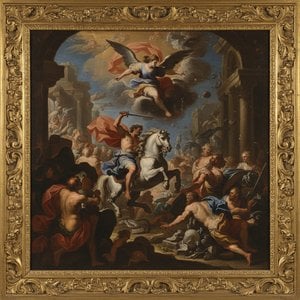
Early Life and Artistic Beginnings
Charles Le Brun, a name synonymous with the grandeur of Louis XIV’s France, was born in Paris in 1619 – a city already brimming with artistic ambition. From his earliest years, it became evident that he possessed an extraordinary gift for capturing beauty and form. Unlike many artists of his time who apprenticed under established masters, Le Brun's journey began at the remarkably young age of eleven, entering the studio of Simon Vouet, a prominent figure in the burgeoning world of French painting. This prestigious patronage came courtesy of Chancellor Pierre Séguier, a man known for his keen eye and support of emerging talent. Le Brun’s initial training was further enriched by studies with François Perrier, a skilled draughtsman and teacher, and crucially, he received early commissions from Cardinal Richelieu – a remarkable achievement for someone so young, demonstrating an immediate mastery of technique and composition.
A defining moment in Le Brun's artistic development arrived with his relocation to Rome between 1642 and 1646. This four-year sojourn proved transformative, placing him firmly within the heart of the European art world. Under the guidance of Nicolas Poussin – a master of classical composition and color theory – Le Brun immersed himself in the legacy of ancient Roman sculpture and meticulously copied works by Raphael. He absorbed not just the visual elements but also the philosophical underpinnings of Renaissance art, profoundly shaping his own artistic sensibilities and theoretical understanding of painting. This period wasn’t merely about imitation; it was a deliberate engagement with the foundations of Western art, preparing him for the challenges and opportunities that awaited him back in France.
The Rise to Prominence: Parisian Recognition
Upon his return to Paris in 1646, Charles Le Brun swiftly ascended to prominence. The artistic landscape of France was undergoing a shift, moving away from the Mannerist styles prevalent in previous decades and embracing a more dynamic and expressive Baroque aesthetic. Le Brun skillfully navigated this transition, building upon the foundations laid by Vouet and Poussin while forging his own distinctive voice. His early works showcased a remarkable ability to blend classical influences with contemporary Italian techniques, creating paintings that were both elegant and powerfully emotive.
His talent quickly attracted the attention of influential patrons, securing him commissions from prominent figures such as Cardinal Richelieu and later, the powerful Jean-Baptiste Colbert – Louis XIV’s chief minister. These early successes established Le Brun as a leading painter in France, solidifying his reputation for technical skill, compositional brilliance, and an understanding of how to capture the essence of human experience through art. He wasn't simply replicating existing styles; he was actively shaping the direction of French painting.
The Royal Patronage: Versailles and Beyond
Le Brun’s career reached its zenith during the reign of Louis XIV, a period often referred to as the “Golden Age” of France. The King recognized Le Brun's exceptional abilities and appointed him First Painter to the King in 1664 – an unprecedented honor that placed him at the very apex of the French art world. This position afforded him immense influence over artistic production throughout the kingdom, allowing him to shape not only individual works but also the overall style and direction of French painting.
His most enduring legacy is undoubtedly his involvement in the decoration of the Palace of Versailles – a project that consumed decades of his life and cemented his place as one of history’s greatest interior designers. He was responsible for creating iconic spaces such as the Ambassadors’ Staircase, the Hall of Mirrors (a dazzling spectacle of light and reflection), and the Peace and War Rooms – each a testament to his mastery of scale, color, and dramatic composition. These monumental works were not merely decorative; they served as powerful propaganda, glorifying the reign of Louis XIV and projecting an image of absolute power and magnificence.
Beyond Versailles, Le Brun continued to receive commissions from across France, designing elaborate tapestries, sculptures, and furnishings for royal palaces and noble residences. His influence extended far beyond the realm of painting; he was a true polymath, shaping virtually every aspect of French artistic production during this period.
Theoretical Influence and Lasting Legacy
Charles Le Brun’s impact on the art world extends beyond his individual creations. He played a pivotal role in establishing the Royal Academy of Painting and Sculpture in 1648 – an institution that served as both a training ground for young artists and a regulatory body overseeing artistic standards. As its director, he championed a rigorous approach to artistic education, emphasizing the importance of studying classical models and mastering fundamental techniques. His theoretical writings, particularly his treatise *Méthode pour apprendre à dessiner les passions…*, became a standard textbook for art students for centuries, shaping the training of generations of painters.
Le Brun’s legacy is complex and multifaceted. While he was often associated with the rigid formalism of the French Academy, his work itself retained a remarkable sense of dynamism and emotional intensity. He skillfully blended classical principles with Baroque exuberance, creating paintings that were both intellectually stimulating and visually captivating. Today, Charles Le Brun is remembered not only as one of France’s greatest painters but also as a key figure in shaping the course of Western art history – a master decorator who helped define the aesthetic standards of an entire era.



 Переглянути в інтер'єрі
 Перейти до друку
 Надіслати
 Поділитися
 Деталі
 Посібник

 Завантажити
 Схожі предмети колекціонування
 Рентгенівське дослідження
 Слайд-шоу
 Статистика переглядів


 Читати далі






































 Скляний варіант доступний лише для розмірів до 110 см