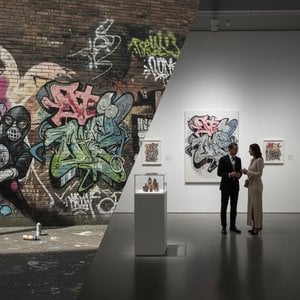
The Raw Energy of the Streets: Caledonia Curry & David Choe
Caledonia Curry, known globally as Swoon, and David Choe represent a fascinating intersection in contemporary art—a collision of delicate intricacy and unapologetic rawness. Both artists emerged from the vibrant street art scene of New York City and Los Angeles respectively, forging paths that defied traditional artistic boundaries and ultimately reshaped perceptions of public space and artistic value. Their individual practices, while distinct, share a common thread: an unflinching honesty and a willingness to engage with the complexities of urban life.
Swoon’s journey began in the late 1990s, amidst the burgeoning street art movement. Rejecting the often-ephemeral nature of graffiti, Curry pioneered a unique technique involving intricately carved wood or linoleum blocks. These blocks were then printed and pasted onto walls throughout New York City—wheatpaste portraits that possessed an almost haunting beauty. Her figures, predominantly women, are imbued with a sense of vulnerability and resilience, their faces etched with stories of hardship and hope. These weren’t mere images; they were acts of poetic intervention, transforming neglected urban landscapes into galleries for the public. The scale of her work often demanded collaboration, drawing in communities to assist with installation, fostering a spirit of collective creation. This participatory aspect became integral to Swoon's artistic philosophy—a desire to connect with and uplift marginalized voices.
From Provocative Murals to Unexpected Fortune
David Choe’s trajectory was markedly different, yet equally impactful. Born in Los Angeles in 1976, Choe developed a distinctive “dirty style” characterized by bold colors, explicit imagery, and a visceral energy that reflected the gritty realities of urban life. His early work often courted controversy, pushing boundaries with its unflinching depictions of violence, sexuality, and social commentary. Choe’s paintings weren't intended for polite society; they were raw expressions of his personal experiences and observations. He gained notoriety through large-scale murals commissioned by celebrities and a reputation for being an unpredictable and fiercely independent artist.
The turning point in Choe’s career arrived unexpectedly in 2004 when Facebook president Sean Parker commissioned him to paint the walls of the company's Palo Alto headquarters. Initially skeptical, Choe accepted the job, but with a unique stipulation: he would be compensated not in cash, but in Facebook stock. This gamble proved extraordinarily lucrative. As Facebook exploded in popularity, Choe’s shares ballooned in value, transforming him into one of the wealthiest artists alive—a narrative that continues to fascinate and challenge conventional notions of artistic success.
Collaboration & Nuart: Expanding Horizons
While Swoon and Choe initially pursued independent paths, their creative energies converged through collaborative projects. Their joint piece, ‘Untitled’, exemplifies this synergy—a powerful mural blending Swoon’s delicate portraiture with Choe’s bold, graphic style. This collaboration demonstrated a shared commitment to pushing artistic boundaries and engaging with public space.
Both artists have also found international recognition through participation in the Nuart Festival in Stavanger, Norway. Nuart is renowned for its focus on street art and urban intervention, providing a platform for artists to create large-scale works that challenge societal norms and spark dialogue. Their contributions to Nuart further solidified their positions as leading figures in the global street art movement.
Legacy & Historical Significance
Swoon and David Choe’s impact extends far beyond the realm of aesthetics. They have fundamentally altered perceptions of what constitutes “art” and where it can exist. By taking their work directly to the public, they bypassed traditional gallery systems and democratized access to art. Their willingness to engage with difficult subject matter has sparked important conversations about social justice, identity, and urban life.
Swoon’s emphasis on community collaboration and her use of delicate materials in a harsh urban environment represent a powerful act of resistance—a reclaiming of public space through beauty and vulnerability. David Choe’s journey from provocative street artist to unlikely millionaire challenges conventional notions of artistic success and raises questions about the commodification of art.
Their combined influence can be seen in the proliferation of street art festivals worldwide, the growing acceptance of urban art as a legitimate form of expression, and the increasing recognition of artists who prioritize social engagement over commercial gain. They are not merely creators of images; they are catalysts for change—artists who have transformed the landscape of contemporary art and left an indelible mark on the cultural fabric of our time.



 Переглянути в інтер'єрі
 Замовити картину ручної роботи
 Надіслати як листівку
 Поділитися
 Деталі витвору
 Посібник

 Завантажити
 Схожі екземпляри
 Рентгенівське дослідження
 Слайд-шоу
 Q&A
Q&A Статистика


 Розгорнути текст






































 Скляний варіант доступний лише для розмірів до 110 см