The Haunting Face of Loneliness
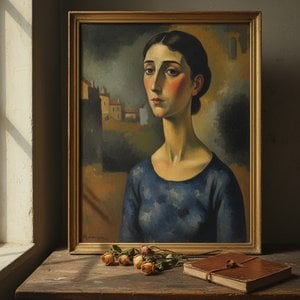
Amedeo Modigliani's “Untitled (7379),” a striking portrait dominated by a vibrant, almost aggressively red background, is more than just a depiction of a man’s face; it’s an embodiment of the artist’s own profound sense of isolation and yearning. Painted in 1918, shortly before his untimely death at the age of 35, this work encapsulates the core themes that define Modigliani's oeuvre: elongated forms, piercing eyes, and a pervasive atmosphere of melancholy. The subject, rendered with an almost brutal directness, possesses a large, prominent nose – a characteristic feature frequently employed by Modigliani to convey both strength and vulnerability – and two intensely focused eyes that seem to gaze beyond the confines of the canvas, lost in contemplation or perhaps regret.
The choice of red as the background is particularly significant. It’s not merely a decorative element; it acts as a visual amplifier, intensifying the emotional weight of the portrait. Red often symbolizes passion, anger, and even sacrifice, but here, its intensity suggests a simmering undercurrent of pain and unresolved longing. The stark contrast between the man's pale features and the fiery backdrop creates a dramatic tension, forcing the viewer to confront the subject’s internal struggles.
Expressionist Roots and Parisian Influence
“Untitled (7379)” firmly places Modigliani within the context of early 20th-century Expressionism. While he initially experimented with Cubism, his work quickly evolved into a highly personal style characterized by distorted forms and emotionally charged colors. This painting demonstrates a move away from purely geometric abstraction towards a more subjective representation of reality – a reflection of the artist’s own turbulent emotional state. His time in Paris, particularly during the vibrant artistic circles of Montmartre, profoundly shaped his aesthetic sensibilities. He was surrounded by fellow expatriates like Pablo Picasso and Constantin Brâncuși, all grappling with new ways of seeing and representing the world.
Modigliani’s background is equally crucial to understanding this work. Born in Livorno, Italy, into a family steeped in Sephardic Jewish heritage, his life was marked by financial instability and recurring illness. These experiences instilled within him a deep sensitivity to fragility and a profound awareness of the human condition – themes that are powerfully conveyed through his art. The influence of figures like Nietzsche and Baudelaire, introduced to him by his mother and grandfather, further fueled his exploration of existential questions and the complexities of human emotion.
The Elongated Form: A Symbol of Discomfort
A defining characteristic of Modigliani’s style is the deliberate elongation of faces, necks, and figures. This technique isn't simply a stylistic choice; it serves to heighten the sense of unease and alienation within his portraits. The elongated features in “Untitled (7379)” contribute to the overall feeling of discomfort and isolation, suggesting a disconnect between the subject’s inner world and the external reality.
The eyes, in particular, are captivating. They possess an almost unnerving intensity, as if peering directly into the viewer's soul. This directness is further emphasized by the lack of any discernible background detail – the red expanse serves only to isolate the subject and draw attention to his gaze. It’s a gaze that speaks volumes about loneliness, introspection, and perhaps even a quiet despair.
A Timeless Portrait of Human Vulnerability
“Untitled (7379)” remains a powerfully evocative work of art, offering a glimpse into the soul of one of the 20th century’s most enigmatic figures. Its raw emotion and striking visual impact continue to resonate with viewers today. A hand-painted reproduction from WahooArt.com allows you to experience this masterpiece in exquisite detail, capturing the nuances of Modigliani's technique and preserving the haunting beauty of his vision. It is a piece that invites contemplation, prompting us to consider the universal themes of longing, isolation, and the enduring power of human vulnerability.



 Переглянути в інтер'єрі
 Перейти до друку
 Надіслати як листівку
 Поділитися
 Детальніше

 Завантажити
 Схожі експонати
 Рентгенівське дослідження
 Слайд-шоу
 Статистика

 Читати далі






































 Скляний варіант доступний лише для розмірів до 110 см