The Haunting Beauty of a Fragmented Soul
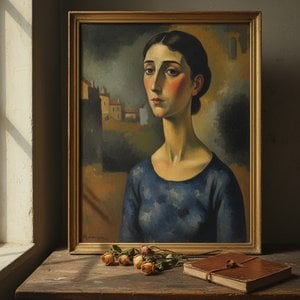
Amedeo Modigliani's “Untitled (6933),” a captivating study in red and repose, isn’t merely a depiction of a woman; it’s an embodiment of melancholy, a whispered echo of unfulfilled desire. Painted in 1917, during the artist’s tragically brief Parisian period, this work transcends simple portraiture, offering instead a profound meditation on beauty, fragility, and the inherent loneliness of the human condition. The image presents a figure lying on her side, bathed in the intense hues of red – a color that simultaneously evokes passion, vulnerability, and perhaps even a touch of blood. This deliberate use of color immediately establishes an atmosphere of heightened emotion, pulling the viewer into the scene’s intimate space.
The woman's elongated features, characteristic of Modigliani’s signature style, contribute to a sense of timelessness and ethereal beauty. Her face, rendered with subtle planes and sharp angles, possesses a haunting quality – an expression that seems caught between serenity and sorrow. The extended arm, reaching outward as if grasping for something just beyond her grasp, is particularly poignant, symbolizing a yearning for connection or perhaps a lost dream. Notice the delicate rendering of her skin, almost translucent in places, further emphasizing her vulnerability and the fleeting nature of beauty.
A World of Shadows: Context and Technique
To understand “Untitled (6933),” one must consider the artist’s life – a life marked by illness, poverty, and profound emotional turmoil. Modigliani's health was consistently precarious throughout his youth, battling pleurisy and typhoid fever, experiences that undoubtedly shaped his artistic sensibility. He arrived in Paris seeking acceptance and recognition, but struggled with addiction and found himself surrounded by a circle of bohemian artists – Picasso, Brancusi, Rouault – each grappling with their own demons. This environment fostered both collaboration and competition, contributing to Modigliani’s relative obscurity during his lifetime.
Technically, the painting is executed in oil on canvas, employing a technique that blends realism with an expressive distortion of form. The brushstrokes are loose and gestural, particularly evident in the rendering of the drapery and the background figures. Modigliani’s use of color is masterful – the deep reds create a dramatic contrast against the pale skin tones, intensifying the emotional impact of the image. He often worked quickly, sometimes even painting directly onto the canvas without preliminary sketches, resulting in a raw and immediate quality that is characteristic of his style.
Echoes of Longing: Symbolism and Interpretation
The two figures glimpsed in the background – likely Modigliani’s lover, Jeanne Hébuterne – add another layer of complexity to the scene. Their presence suggests a domestic setting, yet they remain indistinct, almost spectral, reinforcing the sense of isolation that pervades the painting. The woman at the center is often interpreted as embodying a universal archetype: the beautiful and vulnerable soul yearning for connection in a world that offers only fleeting moments of solace. The red color itself carries multiple symbolic meanings – passion, sacrifice, but also blood and mortality.
Furthermore, Modigliani’s elongated forms—a hallmark of his style—can be seen as an attempt to transcend the limitations of the physical world, reaching towards a realm of idealized beauty. The painting invites us to contemplate not just the woman's appearance but also her inner life – her hopes, fears, and unspoken desires. “Untitled (6933)” is therefore more than just a portrait; it’s a poignant exploration of human emotion and the enduring power of longing.
Bringing Modigliani Home: A Reproduction for Your Space
WahooArt offers meticulously hand-painted reproductions of “Untitled (6933),” allowing you to bring this iconic work into your home or office. Our skilled artists replicate Modigliani’s distinctive style and color palette with exceptional accuracy, ensuring that the reproduction captures the painting's original emotional depth. Choose from a range of sizes and canvas materials to perfectly complement your décor. A WahooArt reproduction is not merely a print; it’s a testament to the enduring legacy of Amedeo Modigliani – a reminder of beauty, melancholy, and the timeless power of art.



 Переглянути в інтер'єрі
 Перейти до друку
 Надіслати як листівку
 Поділитися
 Детальніше

 Завантажити
 Схожі експонати
 Рентгенівське дослідження
 Слайд-шоу
 Статистика
 Читати далі






































 Скляний варіант доступний лише для розмірів до 110 см