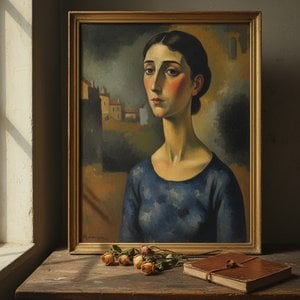
The Enigmatic Gaze: Unpacking Amedeo Modigliani's "Untitled (1471)"
Amedeo Modigliani’s “Untitled (1471),” a captivating portrait of a man and woman locked in an unspoken exchange, is more than just a depiction of two figures; it’s a profound meditation on connection, longing, and the inherent melancholy that permeated the artist's life. Painted around 1921, shortly before his untimely death at the age of 35, this work embodies the core tenets of Modigliani’s distinctive style – elongated forms, piercing eyes, and an atmosphere of quiet intensity. The painting immediately draws the viewer in with its carefully constructed composition: a man and woman stand side-by-side, their gazes directed towards something just beyond the frame, creating a sense of shared observation yet also individual introspection.
The man, rendered with Modigliani’s signature elongated neck and subtly almond-shaped eyes, exudes an air of contemplative seriousness. His posture is formal, accentuated by the tie he wears – a detail that hints at a societal expectation of decorum, perhaps contrasting with the emotional depth of his expression. Across from him, the woman possesses a captivating vulnerability. Her mouth is slightly open, as if caught mid-sentence or in a moment of profound thought, and her eyes hold a mixture of curiosity and gentle sadness. The interplay between these two figures – their averted gaze suggesting both intimacy and distance – forms the heart of the painting’s power.
A Study in Style: Modigliani's Unique Artistic Language
Modigliani’s artistic language was deeply rooted in his personal experiences and a rejection of academic conventions. He drew inspiration from African sculpture, Byzantine art, and the works of artists like Paul Gauguin and Odilon Redon, incorporating elements of abstraction and distortion into his portraits. The elongated forms characteristic of Modigliani's figures are not merely stylistic flourishes; they represent an attempt to capture the essence of a subject’s inner life – their emotional state, their vulnerability, their inherent humanity. Notice how he simplifies features, reducing them to their essential lines and planes, creating a sense of timelessness and universality.
Technically, “Untitled (1471)” is executed in oil on canvas, utilizing a technique that blends smooth, polished surfaces with areas of visible brushstrokes. This juxtaposition creates a dynamic tension between the figure’s physicality and the artist's hand. The muted color palette – dominated by browns, ochres, and subtle blues – contributes to the painting’s somber mood, further emphasizing the subjects’ emotional weight. The lighting is soft and diffused, casting gentle shadows that accentuate the contours of their faces and bodies.
Historical Context & A Life Etched in Longing
Understanding Modigliani's life provides crucial context for interpreting his art. Born into a Jewish family in Livorno, Italy, he faced numerous hardships throughout his youth – illness, financial instability, and the constant struggle to find acceptance within the Parisian artistic community. His personal relationships were often fraught with difficulty, marked by unrequited love and profound loneliness. This sense of longing permeates much of his work, particularly evident in portraits like “Untitled (1471).”
The painting’s creation coincided with a period of intense creativity for Modigliani, yet also one of increasing personal turmoil. He was deeply involved with Jeanne Charbonnière, a wealthy American socialite who became his muse and confidante, but their relationship was marked by jealousy, instability, and ultimately, tragedy. It's believed that the scene depicted – the shared gaze, the unspoken connection – reflects this complex dynamic, capturing a fleeting moment of intimacy amidst a backdrop of emotional uncertainty.
Symbolism & Emotional Resonance
While the precise subject of their attention remains ambiguous, “Untitled (1471)” is rich in symbolic potential. The averted gaze suggests a shared secret, a mutual understanding that transcends words. The woman’s open mouth could represent an invitation to dialogue, while the man's intense stare hints at contemplation or perhaps even a degree of melancholy. The painting speaks to the universal human experience of connection, longing, and the search for meaning in a world often characterized by isolation. It is this potent combination of vulnerability, introspection, and quiet intensity that continues to captivate viewers today, solidifying Modigliani’s place as one of the most poignant figures in 20th-century art.



 Переглянути в інтер'єрі
 Перейти до друку
 Надіслати як листівку
 Поділитися
 Детальніше

 Завантажити
 Схожі експонати
 Рентгенівське дослідження
 Слайд-шоу
 Статистика
 Читати далі






































 Скляний варіант доступний лише для розмірів до 110 см