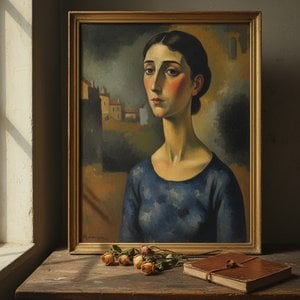
A Portrait of Longing: Amedeo Modigliani’s “Paul Guillaume”
Amedeo Modigliani's 1915 portrait of Paul Guillaume is more than just a likeness; it’s a distilled essence of melancholy, an intimate glimpse into the soul of a man caught between artistic ambition and personal struggle. This captivating work, rendered in muted earth tones on canvas, embodies the core tenets of early Modernism while simultaneously radiating a uniquely poignant emotional resonance. Measuring a substantial 521 x 749 cm, “Paul Guillaume” commands attention not merely through its scale but through the profound sense of quiet contemplation it evokes.
The painting’s composition is deceptively simple – a bust-length portrait facing forward, subtly asymmetrical in its arrangement. Modigliani masterfully employs elongated lines to define Guillaume's features and the folds of his clothing, creating an effect that borders on mask-like. These flowing lines, characteristic of the artist’s signature style, aren’t precise or sharply delineated; instead, they blend and soften, contributing to a feeling of fluidity and movement within the otherwise static image. The background, a loosely defined architectural space rendered in vertical and horizontal brushstrokes, serves as an atmospheric backdrop rather than a literal representation, further emphasizing the subject's isolation and introspective nature.
The Language of Line and Color
Modigliani’s palette is deliberately restrained, dominated by ochres, browns, greens, and creams – colors that imbue the portrait with a sense of quiet dignity and subdued intensity. The absence of vibrant hues amplifies the painting's melancholic mood, mirroring Guillaume’s own documented struggles and perhaps hinting at the artist’s awareness of his subject’s inner life. The use of line is paramount; it dictates both form and feeling. Notice how the lines subtly shift to create a sense of depth and volume within the face, while the angularity of the background provides a counterpoint, suggesting an underlying tension.
Technically, “Paul Guillaume” demonstrates Modigliani’s deliberate approach to surface unity. The brushstrokes are visible but not aggressively emphasized, creating a smooth, almost velvety texture that belies the complexity of the underlying structure. There's evidence of *impasto* in certain areas – particularly within the background – where thicker layers of paint build up a tactile quality, adding a subtle richness to the composition. The painting’s overall flatness is further accentuated by the soft, diffused lighting, which avoids strong highlights or shadows, contributing to an atmosphere of contemplative stillness.
A Window into Early Modernism and Guillaume's World
“Paul Guillaume” firmly situates itself within the broader context of early 20th-century artistic movements. It aligns with Cubo-Expressionism, a style characterized by its exploration of subjective experience and emotional intensity through distorted forms and fragmented perspectives. The elongated features, simplified shapes, and expressive use of line – hallmarks of Modigliani’s oeuvre – are directly traceable to this influential movement. Furthermore, the portrait reflects the intellectual currents of the time, capturing the spirit of a generation grappling with rapid social change and artistic experimentation.
Beyond its formal qualities, “Paul Guillaume” offers a poignant glimpse into the life of Paul Guillaume himself, an art dealer and Modigliani’s close friend and patron. The painting speaks to his role as a facilitator of modern art, connecting artists with collectors and shaping the cultural landscape of Paris. The melancholic gaze captured in the portrait hints at the personal challenges he faced – a life marked by both success and loneliness—a sentiment that resonates deeply within the artwork’s overall mood.
Collecting the Essence of Modigliani
Reproductions of “Paul Guillaume” offer an exceptional opportunity to bring this evocative masterpiece into your home or office. WahooArt.com meticulously recreates the painting's nuanced color palette, delicate brushwork, and emotional depth using only the finest archival materials and skilled hand-painted techniques. Whether you’re a seasoned art collector or simply seeking a piece of art that speaks to the soul, this reproduction captures the essence of Modigliani’s genius – a testament to his ability to transform fleeting moments into enduring works of beauty and introspection.



 Переглянути в інтер'єрі
 Перейти до друку
 Надіслати як листівку
 Поділитися
 Детальніше

 Завантажити
 Схожі експонати
 Рентгенівське дослідження
 Слайд-шоу
 Статистика


 Читати далі






































 Скляний варіант доступний лише для розмірів до 110 см