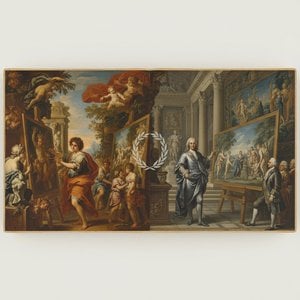
Alexandre Cabanel (1823-1889): The Quintessence of Academic Painting
Alexandre Cabanel, a name synonymous with the academic art of 19th-century France, was born in Montpellier on September 28, 1823. His journey toward artistic mastery began not within a family of artists, but as the son of a modest carpenter—a background that instilled in him a strong work ethic and perhaps a heightened appreciation for craftsmanship. Even at a young age, Cabanel’s talent was undeniable; by ten years old, he was already receiving formal instruction at the local art school in Montpellier, demonstrating an aptitude that warranted special attention. This early promise secured him a scholarship to study in Paris in 1839, entering the prestigious École des Beaux-Arts under the tutelage of François-Édouard Picot. Picot, himself a student of Jacques-Louis David, imparted a rigorous training rooted in classical principles—a foundation that would profoundly shape Cabanel’s artistic trajectory. The curriculum wasn't solely focused on technique; it encompassed a broad education in literature, history, and philosophy, fostering an intellectual depth that informed his subject matter. His early attempts at the coveted Prix de Rome scholarship, though initially unsuccessful, demonstrated ambition and a willingness to refine his skills. Finally, in 1845, he achieved this honor, granting him a period of study at the Villa Medici in Rome—a pivotal experience for any aspiring French artist.
- Early Life and Artistic Formation
- The Roman Years and Rise to Prominence
- A Master of Academic Style
- Notable Works
- Legacy and Influence
Early Life and Artistic Formation
Alexandre Cabanel, a name synonymous with the academic art of 19th-century France, was born in Montpellier on September 28, 1823. His journey toward artistic mastery began not within a family of artists, but as the son of a modest carpenter—a background that instilled in him a strong work ethic and perhaps a heightened appreciation for craftsmanship. Even at a young age, Cabanel’s talent was undeniable; by ten years old, he was already receiving formal instruction at the local art school in Montpellier, demonstrating an aptitude that warranted special attention. This early promise secured him a scholarship to study in Paris in 1839, entering the prestigious École des Beaux-Arts under the tutelage of François-Édouard Picot. Picot, himself a student of Jacques-Louis David, imparted a rigorous training rooted in classical principles—a foundation that would profoundly shape Cabanel’s artistic trajectory. The curriculum wasn't solely focused on technique; it encompassed a broad education in literature, history, and philosophy, fostering an intellectual depth that informed his subject matter. His early attempts at the coveted Prix de Rome scholarship, though initially unsuccessful, demonstrated ambition and a willingness to refine his skills. Finally, in 1845, he achieved this honor, granting him a period of study at the Villa Medici in Rome—a pivotal experience for any aspiring French artist.
The Roman Years and Rise to Prominence
Rome proved transformative for Cabanel. Immersed in the art and culture of antiquity, he absorbed the lessons of the Renaissance masters, studying their compositions, techniques, and mastery of form. This period wasn’t merely about copying the old masters; it was a process of internalizing classical ideals and adapting them to his own artistic vision. During this time, he forged a crucial relationship with Alfred Bruyas, a fellow native of Montpellier and an avid art collector who became Cabanel's patron. Bruyas commissioned several works from the artist, including *Albaydé*, *La Chiaruccia*, and *Man Contemplating, A Young Roman Monk*—paintings that reveal Cabanel’s growing skill in depicting both historical subjects and evocative scenes imbued with romantic sensibility. Upon his return to Paris, Cabanel quickly established himself as a leading figure in the Salon system, the official art exhibition of the Académie des Beaux-Arts. His paintings consistently garnered praise for their technical brilliance, elegant compositions, and captivating beauty. The breakthrough moment arrived in 1863 with *The Birth of Venus*. This painting, a stunning depiction of the goddess emerging from the sea, caused an immediate sensation—and not without controversy. While celebrated for its exquisite rendering of the female form and masterful technique, it also drew criticism from some quarters who found it overly sensual or lacking in originality. However, Napoleon III himself purchased the work for his personal collection, solidifying Cabanel’s reputation and ensuring his place among the most sought-after artists of the Second Empire.
A Master of Academic Style
Cabanel's artistic style is firmly rooted in academic realism—a tradition that emphasized precise draftsmanship, meticulous attention to detail, and a commitment to classical ideals of beauty. He excelled at portraying historical, mythological, and religious subjects, often imbuing them with a sense of drama and emotional intensity. His portraits were equally admired for their ability to capture not only the physical likeness of his sitters but also their character and personality. Cabanel’s technique was characterized by smooth brushwork, subtle gradations of tone, and a masterful use of light and shadow. He possessed an exceptional talent for rendering flesh tones with remarkable realism, creating figures that seemed to breathe on the canvas. He wasn't simply replicating reality; he was idealizing it—striving to create images that embodied classical notions of harmony, balance, and proportion. This pursuit of idealized beauty often led him to refine and perfect his subjects, resulting in paintings that were both technically flawless and aesthetically pleasing. *Ophelia*, painted in 1883, exemplifies this approach; the tragic heroine is depicted with a haunting beauty, her pose and expression conveying a profound sense of sorrow and despair. Similarly, his *Portrait of Countess E. A. Vorontsova Dashkova* showcases his ability to capture both the elegance and inner strength of his subject.
Notable Works
Cabanel’s oeuvre encompasses a remarkable range of subjects—historical narratives, mythological scenes, and portraits—each executed with unwavering dedication to classical principles. Among his most celebrated paintings are *The Birth of Venus*, *Ophelia*, *Phaedra*, and *Countess E. A. Vorontsova Dashkova*. These works stand as enduring monuments to Cabanel’s artistic genius, demonstrating his unparalleled mastery of technique and his profound understanding of human emotion. The meticulous detail with which he rendered the female form—particularly in *The Birth of Venus*—became a hallmark of his style and cemented his reputation as one of France's foremost portrait artists. His canvases are imbued with an atmosphere of serene grandeur, reflecting Cabanel’s unwavering belief in the transformative power of art.
Legacy and Influence
By 1864, Cabanel had achieved a level of success that allowed him to accept a professorship at the École des Beaux-Arts—a position he held until his death in 1889. As a teacher, he instilled in generations of artists the importance of precision, observation, and adherence to classical ideals. His pupils included numerous prominent figures who continued to practice academic painting—a testament to Cabanel’s enduring influence on French art history. Though overshadowed by Impressionism during his lifetime, Cabanel's legacy persists today—his paintings continue to inspire admiration and scholarly study, securing his place as a pivotal figure in the artistic landscape of the 19th century. His unwavering commitment to classical beauty ensured that his work would endure for centuries to come.



 Переглянути в інтер'єрі
 Перейти до друку
 Надіслати як листівку
 Поділитися
 Детальніше

 Завантажити
 Схожі експонати
 Рентгенівське дослідження
 Слайд-шоу
 Статистика


 Читати далі






































 Скляний варіант доступний лише для розмірів до 110 см