Théodore Géricault, 1791 – 1824

The 100 Most Famous Paintings by Théodore Géricault

The painting that made Théodore Géricault famous is Meduza Taşı (1818); it hangs in the Louvre Müzesi, Paris. Nymph and Satyr (Jupiter and Antiope) (1820) and The Oath of Brutus after the Death of Lucretia (1815) follow it in the hearts of collectors and museum visitors. Of the 183 works by Théodore Géricault in our catalogue, these 100 are the most admired, each presented with its date, its museum and what sets it apart.

Ranked by our popularity score, which combines the searches, visits and orders for each work. Updated Ekim 2026. Every masterpiece on this page can be ordered as a museum-quality, hand-painted oil reproduction or a fine art print, at the size you choose.

Portrait of Théodore Géricault
Théodore Géricault · 1791 – 1824
Born · died
1791 – 1824, Rouen
Movement
Romantic painting
Works in our catalogue
183
Most famous
Meduza Taşı (1818)
Most works at
Louvre Müzesi

Théodore Géricault: the ten masterpieces

Meduza Taşı (1818) by Théodore Géricault
1

Meduza Taşı

1818 · Tuval Üzerine Yağlı Boya · Louvre Müzesi, Paris

Jean-Louis André Théodore Géricault’ın anıtsal şaheseri, bir deniz kazasının tasvirinden çok daha fazlasıdır; insan çaresizliğinin, siyasi skandalların ve doğanın yüce gücünün içsel bir keşfidir. 1819 yılında tamamlanan bu devasa boyutlardaki tuval (491 x 716 cm), Fransız fırkateyni Méduse'un 1816 yılındaki batışının dehşet verici sonuçlarını ölümsüzleştirir. Bu trajedi, beceriksizlik ve yolsuzluktan doğan ve Fransa'yı sarsan bir olaydır.

Nymph and Satyr (Jupiter and Antiope) (1820) by Théodore Géricault
2

Nymph and Satyr (Jupiter and Antiope)

1820 · Acrylic On Canvas · Musée des Beaux-Arts et de la Céramique, Rouen

The Allure of the Divine Encounter: Géricault’s *Nymph and Satyr* Jean-Louis André Théodore Géricault's *Nymph and Satyr*, painted in 1819, isn’t merely a depiction of a mythological scene; it’s a profound exploration of desire, transgression, and the inherent tension between innocence and primal instinct. Born amidst the tumultuous backdrop of post-revolutionary France, Géricault, already recognized for his dramatic intensity, sought to capture not just a narrative but an emotional truth—a…

Lions in a Mountainous Landscape (1818) by Théodore Géricault
4

Lions in a Mountainous Landscape

1818 · Acrylic On Canvas · Metropolitan Sanat Müzesi, New York

This vigorous painting of six lions in a remote, spectrally illuminated lair—possibly intended to evoke the Atlas Mountains of Morocco—is an extraordinary example of Gericault’s spontaneous handling of paint. Rather than applying finishing touches to make a polished cabinet picture, the artist left the painting in a state known as an esquisse, or sketch, a work prized by fellow artists for its strength of directly capturing a subject or effect.…

The Kiss (1822) by Théodore Géricault
5

The Kiss

1822 · Acrylic On Canvas · Thyssen-Bornemisza Müzesi, Madrid

Théodore Géricault's "The Kiss," painted in 1816, isn’t merely a depiction of lovers entwined; it’s a visceral embodiment of the burgeoning Romantic movement’s fascination with raw emotion, dramatic intensity, and the sublime. This arresting work, housed within the Thyssen-Bornemisza Museum in Madrid, transcends simple representation to become a profound meditation on passion, vulnerability, and the very essence of human connection. Géricault, already a figure known for his unflinching portrayals of…

Wounded Soldiers Retrating from Russia (1814) by Théodore Géricault
6

Wounded Soldiers Retrating from Russia

1814 · Acrylic On Canvas · Musée des Beaux-Arts, Rouen

A Symphony of Suffering: Géricault’s “Wounded Soldiers Retrating from Russia” Jean-Louis André Théodore Géricault's "Wounded Soldiers Retrating from Russia" is not merely a painting; it’s a visceral embodiment of the horrors and human cost of war, rendered with an unprecedented level of realism and emotional intensity for its time. Completed in 1814, this monumental canvas—measuring a commanding 250 x 206 cm—captures a pivotal moment during Napoleon's disastrous invasion of Russia,…

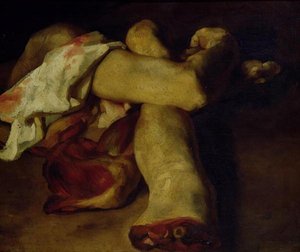
Study of Feet and Hands (1818) by Théodore Géricault
7

Study of Feet and Hands

1818 · Oil On Canvas · Musée Fabre, Montpellier

Jean-Louis André Théodore Géricault's "Study of Feet and Hands," painted in 1818, isn’t a grand statement of Romantic drama like his monumental “The Raft of the Medusa.” Instead, it offers a profoundly intimate glimpse into the artist’s meticulous process and a poignant meditation on the human form. This unassuming oil painting—measuring a modest 52 x 64 cm—is far more than just a preparatory sketch; it's a concentrated distillation of Géricault’s…

The Raft of the Medusa (detail) (1818) by Théodore Géricault
8

The Raft of the Medusa (detail)

1818 · Oil On Canvas · Louvre Müzesi, Paris

Jean-Louis André Théodore Géricault's "The Raft of the Medusa," a monumental detail from his 1818 painting, isn’t merely a depiction of shipwreck; it’s a visceral plunge into the depths of human suffering and political indictment. The scene, rendered with a dramatic intensity characteristic of Romanticism, captures the harrowing aftermath of the French frigate *Medusa*'s wreck off the coast of Mauritania in 1816. This disaster, largely attributed to the incompetence and…

The Wreck (1821) by Théodore Géricault
10

The Wreck

1821 · Oil On Canvas · Louvre Müzesi, Paris

Théodore Géricault's "The Wreck," painted in 1821, isn’t merely a seascape; it’s a visceral confrontation with the sublime—a raw depiction of humanity’s vulnerability against the overwhelming force of nature. Born amidst the turbulent currents of post-revolutionary France, Géricault, a figure both lauded and controversial within the burgeoning Romantic movement, channeled his own anxieties and the era's fascination with dramatic events into this monumental canvas. The painting immediately commands attention not…

More Théodore Géricault masterpieces, 11 to 100

The Horse Race (1816) by Théodore Géricault
#11

The Horse Race

1816 · Thyssen-Bornemisza Müzesi

Jean-Louis André Théodore Géricault's "The Horse Race," painted in 1816, isn’t merely a depiction of a sporting event; it’s a visceral embodiment of Romanticism’s core tenets – passion,…

Bring it home →
Swiss Guard and Wounded Veteran (1819) by Théodore Géricault
#12

Swiss Guard and Wounded Veteran

1819 · Louvre Müzesi

Jean-Louis André Théodore Géricault's "Swiss Guard and Wounded Veteran," painted in 1819, is not merely a historical depiction; it’s a profound meditation on duty, sacrifice, and the lingering…

Order a reproduction →
Mazeppa (1823) by Théodore Géricault
#13

Mazeppa

1823 · Château de Chantilly

Théodore Géricault's "Mazeppa," painted in 1823, isn’t merely a depiction of a dramatic legend; it’s a visceral embodiment of Romantic turmoil—a raw exploration of suffering, resilience, and the…

Bring it home →
Two Horses (1809) by Théodore Géricault
#14

Two Horses

1809 · The Phillips Collection

Jean-Louis André Théodore Géricault's "Two Horses," painted in 1808-1809, isn’t merely a depiction of two magnificent animals; it’s a visceral exploration of movement, power, and the fleeting nature…

Bring it home →
A Turk (Mustapha) (1820) by Théodore Géricault
#15

A Turk (Mustapha)

1820 · Louvre Müzesi

Jean-Louis André Théodore Géricault's "A Turk (Mustapha)," painted in 1820, is not merely a portrait; it’s a carefully constructed tableau of exoticism, melancholy, and the burgeoning Romantic sensibility…

Order a reproduction →
A Carabinier with his Horse (1814) by Théodore Géricault
#16

A Carabinier with his Horse

1814 · Musée des Beaux-Arts

In the quiet intensity of Jean-Louis André Théodore Géricault’s 1814 masterpiece, "A Carabinier with His Horse," we encounter more than a mere military portrait; we witness a profound…

Order a reproduction →
Binicisiz At Yarışları (detay) (1817) by Théodore Géricault
#17

Binicisiz At Yarışları (detay)

1817 · Louvre Müzesi

Zamanda Donmuş Bir An: Géricault’ın “Binicisiz At Yarışları” Jean-Louis André Théodore Géricault'ın "Binicisiz At Yarışları (detay)" adlı eseri, yalnızca bir spor etkinliğinin tasviri değildir; insan dramının, hırsın ve…

Bring it home →
Boxers (1818) by Théodore Géricault
#18

Boxers

1818 · Château de Chantilly

A Tempestuous Vision: Géricault’s “Boxers” Jean-Louis André Théodore Géricault's "Boxers," completed in 1818, isn’t merely a depiction of a boxing match; it’s a visceral embodiment of Romanticism’s fascination…

Order a reproduction →
The Epsom Derby (1821) by Théodore Géricault
#20

The Epsom Derby

1821 · Louvre Müzesi

Jean-Louis André Théodore Géricault's "The Epsom Derby," painted in 1821, isn’t merely a depiction of horse racing; it’s a visceral embodiment of Romanticism’s fascination with drama, movement, and…

Bring it home →
Three Lovers (1817) by Théodore Géricault
#22

Three Lovers

1817 · J. Paul Getty Müzesi

Théodore Géricault captured a private, feverish moment in Three Lovers. This small oil sketch, created about 1817–1820, offers a rare glimpse into the artist's more intimate preoccupations. It…

Order a reproduction →
Lion devouring a horse by Théodore Géricault
#26

Lion devouring a horse

Château de Chantilly

Théodore Géricault's "Lion Devouring a Horse," painted in 1819, isn’t merely a depiction of predatory action; it’s a visceral exploration of power, mortality, and the primal instincts that…

Bring it home →
Untitled (ARJCHM) by Théodore Géricault
#28

Untitled (ARJCHM)

Louvre Müzesi

In the annals of art history, few works command the room with such visceral intensity as Théodore Géricault’s The Raft of the Medusa. This monumental oil on canvas…

Bring it home →
Portrait of a Young Man (1818) by Théodore Géricault
#32

Portrait of a Young Man

1818 · Minneapolis Institute of Art

A young man emerges from a deep, indistinct darkness, his presence felt through the sudden, sharp clarity of light hitting his features. He sits in a quiet, intimate…

Order a reproduction →
A study for a nude. (1801) by Théodore Géricault
#33

A study for a nude.

1801 · Ulusal Müze Varşova

A study for a nude. emerges from the shadows as a powerful presence by Théodore Géricault. Created about 1801, this oil on canvas captures a singular moment of…

Bring it home →
Study of a Model (1818) by Théodore Géricault
#34

Study of a Model

1818 · J. Paul Getty Müzesi

This oil on canvas portrait study presents a close-up, three-quarter view of a Black man's head and shoulders. The subject is positioned slightly off-center, looking toward the viewer…

Commission a hand-painted copy →
The Martyrdom of Saint Peter (1814) by Théodore Géricault
#35

The Martyrdom of Saint Peter

1814 · Kunstmuseum Basel

The Martyrdom of Saint Peter is an oil on canvas by Théodore Géricault. Created about 1814, the work captures a moment of profound tension. The physical presence of…

Bring it home →
The Wreck (1824) by Théodore Géricault
#36

The Wreck

1824 · Louvre Müzesi

In the annals of French Romanticism, few works command the visceral attention of Théodore Géricault’s The Wreck as profoundly as this haunting seascape. Painted in 1824, a year…

Commission a hand-painted copy →
Mater dolorosa, Copy after Ribera (1811) by Théodore Géricault
#38

Mater dolorosa, Copy after Ribera

1811 · Kunstmuseum Basel

Mater dolorosa, Copy after Ribera is a religious oil painting by the French artist Théodore Géricault. Created about 1811–1815, the work reflects the artist's engagement with the traditions…

Bring it home →
Lion in Repose by Théodore Géricault
#39

Lion in Repose

Walters Art Museum

Jean-Louis André Théodore Géricault’s “Lion in Repose,” painted circa 1820-1823, isn’t merely a depiction of an animal; it’s a profound meditation on power, vulnerability, and the very nature…

Order a reproduction →
Portrait of a Negro (1800) by Théodore Géricault
#71

Portrait of a Negro

1800 · Palácio Nacional da Ajuda

Dating from 1800, Jean-Louis André Théodore Géricault’s “Portrait of a Negro” is more than just a depiction of an individual; it’s a poignant statement born from the turbulent…

Bring it home →
Portrait d'homme (1825) by Théodore Géricault
#73

Portrait d'homme

1825 · Musée Fabre

Portrait d'homme is an oil on canvas work attributed to the French Romantic painter Théodore Géricault. While historically categorized under various titles, including a mistaken identification as a…

Commission a hand-painted copy →
Horses of the Auvergne (1822) by Théodore Géricault
#76

Horses of the Auvergne

1822 · University of Michigan Museum of Art

In the quiet, monochromatic depths of Théodore Géricault’s 1822 lithograph, Horses of the Auvergne, we are transported to a rugged, mist-shrouded corner of France. This evocative work serves…

Commission a hand-painted copy →
A Prancing Grey Horse (1812) by Théodore Géricault
#77

A Prancing Grey Horse

1812 · Burrell Collection

A single light grey horse occupies the center of this oil painting, captured in a rearing pose. The animal's body is angled vertically, its muscular flanks and neck…

Bring it home →
Sheet of Figure Studies (1818) by Théodore Géricault
#78

Sheet of Figure Studies

1818 · Courtauld Galerisi

To gaze upon Jean-Louis André Théodore Géricault’s "Sheet of Figure Studies" is not merely to look at painted forms; it is to witness the very act of human…

Bring it home →
Portrait of an Artist in His Studio (1820) by Théodore Géricault
#79

Portrait of an Artist in His Studio

1820 · Louvre Müzesi

Jean-Louis André Théodore Géricault's “Portrait of an Artist in His Studio,” completed in 1820, is more than a simple depiction of a young man seated before his easel;…

Bring it home →
The Plaster Kiln (1823) by Théodore Géricault
#82

The Plaster Kiln

1823 · Louvre Müzesi

In the quiet, brooding landscapes of nineteenth-century France, few works capture the raw, unvarnished essence of pastoral life as poignantly as Théodore Géricault’s “The Plaster Kiln.” Completed in…

Order a reproduction →

Théodore Géricault's paintings by period

The subjects Théodore Géricault painted most

The four subjects that return most often among these masterpieces, with the finest example of each.

Where to see Théodore Géricault's paintings

The 8 museums that hold the most of the paintings on this page.

Museum City Works by Théodore Géricault Paintings from this list
Louvre Müzesi, ParisLouvre Müzesi Paris 20 Meduza Taşı, The Raft of the Medusa (detail), Leda and the Swan
Château de Chantilly, ChantillyChâteau de Chantilly Chantilly 6 Mazeppa, Boxers, Lion devouring a horse
J. Paul Getty Müzesi, Los AngelesJ. Paul Getty Müzesi Los Angeles 3 Three Lovers, Study of a Model, The Race of the Riderless Horses
Ulusal Müze Varşova, VarşovaUlusal Müze Varşova Varşova 3 Equestrian portrait of Wincenty Krasiński., A study for a nude., Study of a nude man
Burrell Collection, GlasgowBurrell Collection Glasgow 8 The Trumpeter of the Lancers of the Guard, A Prancing Grey Horse
Musée Fabre, MontpellierMusée Fabre Montpellier 4 Study of Feet and Hands, Portrait d'homme
Petit Palais, ParisPetit Palais Paris 3 The Scotsman, Italian Landscape with Tomb
Thyssen-Bornemisza Müzesi, MadridThyssen-Bornemisza Müzesi Madrid 2 The Kiss, The Horse Race

Théodore Géricault, decade by decade: the defining painting of each

  1. 1800s
    Two Horses (1809) by Théodore Géricault
    Rank 14 / 100

    Two Horses

    Age 9 – 18 · The Phillips Collection

    Jean-Louis André Théodore Géricault's "Two Horses," painted in 1808-1809, isn’t merely a depiction of two magnificent animals; it’s a visceral exploration of movement, power, and the fleeting nature…

  2. 1810s
    Meduza Taşı (1818) by Théodore Géricault
    No. 1 of 100

    Meduza Taşı

    Age 19 – 28 · Louvre Müzesi

    Jean-Louis André Théodore Géricault’ın anıtsal şaheseri, bir deniz kazasının tasvirinden çok daha fazlasıdır; insan çaresizliğinin, siyasi skandalların ve doğanın yüce gücünün içsel bir keşfidir. 1819 yılında tamamlanan bu…

  3. 1820s
    Nymph and Satyr (Jupiter and Antiope) (1820) by Théodore Géricault
    #2 of 100

    Nymph and Satyr (Jupiter and Antiope)

    Age 29 – 33 · Musée des Beaux-Arts et de la Céramique

    The Allure of the Divine Encounter: Géricault’s *Nymph and Satyr* Jean-Louis André Théodore Géricault's *Nymph and Satyr*, painted in 1819, isn’t merely a depiction of a mythological scene;…

Théodore Géricault's masterpieces: questions and answers

Which painting is Théodore Géricault best known for?Show the answer

Meduza Taşı (1818), Louvre Müzesi, Paris. Next come Nymph and Satyr (Jupiter and Antiope) (1820) and The Oath of Brutus after the Death of Lucretia (1815).

How old was Théodore Géricault when painting Meduza Taşı?Show the answer

27 years old: Meduza Taşı dates from 1818 and Théodore Géricault was born in 1791.

What are Théodore Géricault's ten greatest paintings?Show the answer

Meduza Taşı, Nymph and Satyr (Jupiter and Antiope), The Oath of Brutus after the Death of Lucretia, Lions in a Mountainous Landscape, The Kiss, Wounded Soldiers Retrating from Russia, Study of Feet and Hands, The Raft of the Medusa (detail), Leda and the Swan and The Wreck. The ranking above gives the year and the museum of each.

How many works did Théodore Géricault paint?Show the answer

Our catalogue lists 183 works by Théodore Géricault, dated from 1800 to 1824.

In which museums can I see Théodore Géricault's masterpieces?Show the answer

Most of them are in Louvre Müzesi (Paris), Château de Chantilly (Chantilly) and J. Paul Getty Müzesi (Los Angeles). The table above lists the museums one by one.

When did Théodore Géricault paint the masterpieces?Show the answer

In 1810s: 67 of the 100 works on this page date from then, among them Meduza Taşı.

What are the first and last famous paintings of Théodore Géricault?Show the answer

The earliest on this page is Portrait of a Negro (1800), the latest The Wreck (1824).

What were Théodore Géricault's favourite subjects?Show the answer

Man (12), Portrait (9) and Horse (8), among the 100 works on this page.

Which technique did Théodore Géricault favour?Show the answer

Oil On Canvas: 25 of the 100 works on this page.

What art movement is Théodore Géricault part of?Show the answer

Romantic painting, as the paintings on this page show.

Which masterpieces by Théodore Géricault hang at the Louvre Müzesi?Show the answer

Meduza Taşı, The Raft of the Medusa (detail) and Leda and the Swan are among the 14 works on this page held by the Louvre Müzesi, Paris.

Can I own a reproduction of a Théodore Géricault masterpiece?Show the answer

Yes. Every painting on this page can be ordered as a museum-quality, hand-painted oil reproduction or a fine art print, in the size you choose, from the painting's own page.

The life of Théodore Géricault

Romantik Ateşle Şekillenen Bir Hayat

Fransız Romantizminin filizlenen ruhuyla yankılanan bir isim olan Jean-Louis André Théodore Géricault, dramatik değişimlerin eşiğindeki bir dünyada dünyaya geldi. 1791 yılında Fransa'nın Rouen şehrinde başlayan hayatı, devrimin yankıları ve yükselen Napolyon hırsının gölgesinde şekillendi. Ailesinin tütün işletmesini de içeren hukuk ve ticaret girişimleri sayesinde konforlu bir yaşam miras almış olsa da, Géricastault'un kaderi hukuk veya ticaretin değil, sanatsal ifadenin derinliklerinde gizliydi. İngiliz spor sanatlarının ustası Carle Vernet'in yanında aldığı ilk eğitim, ona özellikle at tasvirlerinde belirginleşen keskin bir anatomi ve hareket gözü kazandırdı. Ancak, klasik kompozisyon temellerini atan Pierre-Narcisse Guérin ile yaptığı çalışmalar olsa da, Géricault'un huzursuz ruhu kısa sürede onu Louvre'un kutsal salonlarında bağımsız bir bilgi arayışına sürükledi.

Bir Akademi Olarak Louvre: Ustalarla Bir Diyalog

1810 ile 1815 yılları arasında Louvre, Géricault için gerçek bir akademiye dönüştü. Kendini sadece teknikleri kopyalamak için değil, sanat felsefeleriyle derin bir diyaloğa girmek amacıyla Eski Ustaların –Rubens, Titian, Velázquez ve Rembrandt– eserlerine adadı. Bu dönem; dramatik chiaroscuro (ışık-gölge), dinamik kompozisyonlar ve onu çağdaşlarından ayıran yoğun duygusallıkla karakterize edilen kendine özgü stilinin şekillenmesinde hayati bir rol oynadı. O sadece taklit etmiyordu; bu ustaların ışığa, gölgeye ve insan formuna yaklaşımlarını içselleştirerek onların özünü emiyordu. Bu kendi kendine yönlendirdiği eğitim, yakında hakim olan Neoklasik kurallara meydan okuyacak benzersiz bir sanatsal ses doğurdu. Atlı Chasseur (1812) gibi erken dönem eserleri, Rubens'in enerjik tuvallerini anımsatan cesur bir icra ve hareket tutkusuyla bu yeni gelişen duyarlılığın ipuçlarını şimdiden veriyordu. Atçılık temalarını keşfetmeye devam ederek, kariyeri boyunca yinelenen bir motif olarak kalacak olan atların gücünü ve zarafetini betimleme yeteneğini geliştirdi.

Medusa Salı: İnsan Acısına Bir Anıt

Géricault'un adı, Medusa Salı (1rak-1819) ile ayrılmaz bir şekilde bağlantılıdır; bu anıtsal tuval, salt tarihsel bir tasvirin ötesine geçerek insan kusurluluğuna ve toplumsal adaletsizliğe karşı yakıcı bir suçlama haline gelir. 1816 yılında Fransız fırkateyni Méduse'un batışının, ihmal ve beceriksizliğin yolcular için hayal edilemez acılara yol açtığı o sarsıcı gerçek hikayesinden esinlenen bu tablo; çaresizlik, umut ve umutsuzluğun içsel bir portresidir. Géricault, doğruluğu sağlamak adına hayatta kalanlarla görüşerek, hastanelerdeki cesetleri inceleyerek ve hatta salın kendisinin ölçekli bir modelini inşa ederek titiz bir araştırma yürüttü. Ortaya çıkan eser sadece bir trajedi tasviri değil; izleyiciyi insan acısının ham gerçekliğiyle yüzleştiren sürükleyici bir deneyimdir. Biri çaresizlik ve ölümü, diğeri ise umudu ve olası kurtuluşu temsil eden iki piramidal yapı etrafında inşa edilen kompozisyon, gözü tuval boyunca çeken dinamik bir gerilim yaratır. Medusa Salı, 1819 Salon sergisinde gösterildiğinde tartışmalara yol açmış, siyasi tartışmaları tetiklemiş ve Géricault'un cesur ve alışılmadık bir sanatçı olarak ününü pekiştirmiştir. Tablonun etkisi sanat dünyasının ötesine geçerek, hükümet beceriksizliğinin ve hayal edilemez zorluklar karşısında insan direncinin bir sembolü haline gelmiştir.

Trajedinin Ötesinde: Askeri Temalar ve Sanatsata Mirası

Medusa Salı en ünlü başarısı olmaya devam etse de, Géricault'un sanatsal üretimi bu tek başyapıtın çok ötesine uzanıyordu. Yaralı Cuirassier (1814) ve Epsom Derby (1821) gibi eserlerinde görüldüğü üzere, dram ve ifade gücüne olan tutkusunu sergileyerek askeri temalara sürekli geri döndü. Bu tablolar, çatışmanın fiziksel ve psikolojik bedellerine odaklanarak, baskı altındaki insan duygularını keşfetmeye devam ettiğini gösterir. Ayrıca portre ve litografi alanlarına da yönelerek sanatsal repertuarını daha da genişletti. Ne yazık ki Géricault'un hayatı, binicilik kazaları ve kronik tüberküloz enfeksiyonunun getirdiği yıllar süren acıların ardından, 1824 yılında 32 yaşında hastalık nedeniyle yarıda kesildi. Erken ölümü sanat dünyasını dahi bir yetenekten mahrum bıraktı ancak sonraki nesiller üzerindeki –özellikle Eugène Delacroix– etkisi derin oldu. O, zor gerçeklerle yüzleşmeye cesaret eden ve eserlerini bugün bile izleyicileri büyülemeye devam eden güçlü bir duygusal yankıyla donatan bir Romantizm öncüsü olarak hatırlanmaktadır. Paris'teki Père Lachaise Mezarlığı'ndaki mezarında, elinde fırçasıyla uzanan bronz figürü, Medusa Salı'daki o sarsıcı sahneyi betimleyen düşük kabartmalı bir panelin üzerinde durur; bu, hayatını insanlık durumunun karmaşıklıklarını ve çelişkilerini yakalamaya adamış bir sanatçıya layık bir saygı duruşudur.

Temel Özellikler ve Etkiler

  • Romantizm: Géricault, Neoklasik ideallerden uzaklaşarak duygusal yoğunluk ve dramatik ifadeye yönelen ilk Fransız Romantik ressamlarından biri olarak kabul edilir.
  • Dramatik Kompozisyon: Resimleri, hareket ve gerilim hissi yaratmak için genellikle diyagonal çizgileri ve zıt ışık-gölge kullanımını içeren dinamik kompozisyonlarıyla tanınır.
  • Realizm ve Araştırma: Géricault, eserlerinin doğruluğunu ve duygusal etkisini sağlamak için cesetleri incelemek ve hayatta kalanlarla görüşmek gibi kapsamlı araştırmalar yürüterek realizme bağlı kalmıştır.
  • Eski Ustaların Etkisi: Rubens, Titian ve Velázquez gibi Barok ustalarından ilham alarak, dramatik aydınlatma ve etkileyici fırça darbeleri için onların tekniklerini benimsemiştir.
  • İnsan Acısına Odaklanma: Sanatı sıklıkla trajedi, çaresizlik ve insan deneyiminin karanlık yönlerini tasvir ederek, yoğun duygulara yönelik Romantik bir hayranlığı yansıtır.

All 183 works by Théodore Géricault →