Max Slevogt, 1868 – 1932

Max Slevogt Paintings: The 100 Most Famous Works, Ranked

Max Slevogt's most famous painting is The Quarry at Albersweiler (1912). With The Singer Francisco d'Andrade as Don Giovanni in Mozart's Opera (1912) and Frau Voll mit Tochter (1895), it completes the three works everyone recognises. Our catalogue lists 102 works by Max Slevogt; the 100 below are the ones the world looks at most, each with its year, the museum that holds it and why it matters.

Ranked by our popularity score, which combines the searches, visits and orders for each work. Updated Ekim 2026. Every masterpiece on this page can be ordered as a museum-quality, hand-painted oil reproduction or a fine art print, at the size you choose.

Portrait of Max Slevogt
Max Slevogt · 1868 – 1932
Born · died
1868 – 1932, Landshut
Movement
Impressionism
Works in our catalogue
102
Most famous
The Quarry at Albersweiler (1912)
Most works at
Bavarian State Painting Collections

The 10 most famous Max Slevogt paintings

The Quarry at Albersweiler (1912) by Max Slevogt
1

The Quarry at Albersweiler

1912

A Glimpse into Industrial Transformation: Max Slevogt’s *The Quarry at Albersweiler* (1912) Max Slevogt's *The Quarry at Albersweiler*, painted in 1912, is more than just a landscape; it’s a compelling visual document of a changing world. Measuring 72 x 101 cm and executed with oil on canvas, the painting captures a pivotal moment where human industry begins to dramatically reshape the natural environment. While seemingly serene at first glance, a…

The Singer Francisco d'Andrade as Don Giovanni in Mozart's Opera (1912) by Max Slevogt
2

The Singer Francisco d'Andrade as Don Giovanni in Mozart's Opera

1912 · Oil On Canvas · Alte Nationalgalerie, Berlin

The canvas captures a moment of profound tension from Mozart's opera, specifically the graveyard scene where Don Giovanni invites the statue of the Commendatore to supper. Francisco d'Andrade, marking his thirtieth year on stage, is rendered with a sense of disembodied, floating quality. He is draped in a voluminous white cloak that flows toward the right, creating a stark contrast against a dark, moody background of muted blues and blacks.…

Frau Voll mit Tochter (1895) by Max Slevogt
3

Frau Voll mit Tochter

1895 · Oil · Alte Nationalgalerie, Berlin

Two figures emerge from a heavy, indistinct darkness. On the left, a woman gazes outward with a weary, solemn expression, her face etched with subtle shadows and fine lines. Her hair is pulled back tightly, a stark contrast to the soft, pale skin of her features. Beside her, a younger girl leans her head toward the older woman, her expression pensive and tired. A single patch of bright blue fabric…

Prince Regent Luitpold in the Ermine Cloak (1908) by Max Slevogt
4

Prince Regent Luitpold in the Ermine Cloak

1908 · Oil On Canvas · Bavarian State Painting Collections, Münih

In this 1908 oil on canvas, an elderly man, identified as Prince Regent Luitpold, is positioned against a dark, undifferentiated background. The subject is rendered in a vertical composition, standing slightly off-center. He wears a heavy blue mantle, which is lined with white ermine fur. The lighting originates from the upper left, casting illumination across the subject's face, the white fabric of his shirt, and the folds of the blue…

Theater Curtain (1931) by Max Slevogt
6

Theater Curtain

1931 · Painting · Bavarian State Painting Collections, Münih

The composition presents a formal, pyramidal arrangement of a multi-generational family, captured in a moment of staged stillness. Subjects are organized into two distinct rows: a seated group in the foreground and a standing assembly in the background. The scene is rendered in monochromatic sepia and warm reddish-brown tones, suggesting the chemical aging of a vintage photographic process. Soft, directional lighting defines the contours of facial features and the heavy…

Lady Adventure (1894) by Max Slevogt
7

Lady Adventure

1894 · Oil On Canvas · Städel Müzesi, Frankfurt

The oil on canvas presents a close-up view of two figures locked in a physical encounter. A figure clad in silver-toned metallic armor is intertwined with a nude female form. The composition follows a diagonal axis, creating a sense of movement through the interlocking limbs. Dark, moody tones of deep black and murky green dominate the background, which remains largely obscured by shadow. High-contrast lighting, or chiaroscuro, catches the edges…

Sailboats on the Alster River in the Evening (1905) by Max Slevogt
9

Sailboats on the Alster River in the Evening

1905 · Oil On Canvas

In the gentle transition from day to dusk, Max Slevogt’s Sailboats on the Alster River in the Evening captures a moment of profound serenity and communal joy. This 1905 masterpiece serves as a window into a bygone era of leisure, where the rhythmic movement of sailboats across the water mirrors the quiet pulse of life along the riverbanks. As the evening light begins to soften, Slevogt masterfully orchestrates a scene…

Max Slevogt, paintings 11 to 100

The Libyan Desert (1914) by Max Slevogt
#33

The Libyan Desert

1914

The painting The Libyan Desert is a stunning work of art created by the renowned artist Max Slevogt in 1914. This beautiful piece is a testament to the…

Bring it home →
Sailing into Syracuse Harbor (1914) by Max Slevogt
#35

Sailing into Syracuse Harbor

1914 · Bayerische Staatsgemaldesammlungen

Introduction to Max Slevogt and Sailing Into Syracuse Harbor Max Slevogt (1868-1932) represents a pivotal moment in German Impressionist painting, securing his place as a master of landscape…

Bring it home →
Summer House Garden (1912) by Max Slevogt
#78

Summer House Garden

1912

The Summer House Garden painting, created in 1912 by renowned German artist Max Slevogt, is a stunning representation of Impressionist art. This beautiful piece measures 62 x 77…

Order a reproduction →
Palatinate Landscape (1923) by Max Slevogt
#81

Palatinate Landscape

1923

In the quietude of 1923, Max Slevogt captured a moment that transcends time in his masterpiece, Palatinate Landscape. This evocative oil on canvas is far more than a…

Order a reproduction →
Palatinate Landscape (1921) by Max Slevogt
#85

Palatinate Landscape

1921 · Staatliche Kunsthalle

Max Slevogt's 1921 painting, “Palatinate Landscape,” isn’t merely a depiction of a forest; it’s an immersion into the heart of German Impressionism and a poignant reflection on the…

Order a reproduction →
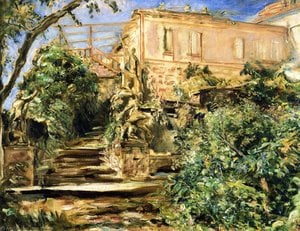
Garden Steps in Neukastel (1916) by Max Slevogt
#86

Garden Steps in Neukastel

1916

The Max Slevogt painting, Garden Steps in Neukastel, is a beautiful depiction of a serene garden setting. Created in 1916, this oil on canvas piece is a prime…

Bring it home →

Max Slevogt's paintings by period

The subjects Max Slevogt painted most

The four subjects that return most often among these masterpieces, with the finest example of each.

Where to see Max Slevogt's paintings

The 8 museums that hold the most of the paintings on this page.

Museum City Works by Max Slevogt Paintings from this list
Bavarian State Painting Collections, MünihBavarian State Painting Collections Münih 18 Prince Regent Luitpold in the Ermine Cloak, Theater Curtain, Angela von Tschudi
Staatliche Kunstsammlungen Dresden, DresdenStaatliche Kunstsammlungen Dresden Dresden 6 Sudanese women, Pirates, Sandstorm in the Libyan Desert
Lenbachhaus, MünihLenbachhaus Münih 5 Danae, Luise Papenhagen, Self-Portrait with Black Hat
Alte Nationalgalerie, BerlinAlte Nationalgalerie Berlin 4 The Singer Francisco d'Andrade as Don Giovanni in Mozart's Opera, Frau Voll mit Tochter, Requiem for the St. Georgsknights
Ulusal Müze Varşova, VarşovaUlusal Müze Varşova Varşova 3 Faun and a girl, Grape harvest., Landscape with a view of Landau
Westfälisches Landesmuseum, MünsterWestfälisches Landesmuseum Münster 3 Man on a Forest Path, Flower Garden I in Neu Cladow, Still life with Melon
Städel Müzesi, FrankfurtStädel Müzesi Frankfurt 2 Lady Adventure, Blossoming Lilac
Museum Kunstpalast, DüsseldorfMuseum Kunstpalast Düsseldorf 2 Female Nude from the Back, Neukastel - View of the Madenburg

Max Slevogt's most famous painting of each decade

  1. 1890s
    Frau Voll mit Tochter (1895) by Max Slevogt
    #3 of 100

    Frau Voll mit Tochter

    Age 22 – 31 · Alte Nationalgalerie

    Two figures emerge from a heavy, indistinct darkness. On the left, a woman gazes outward with a weary, solemn expression, her face etched with subtle shadows and fine…

  2. 1900s
    Prince Regent Luitpold in the Ermine Cloak (1908) by Max Slevogt
    #4 of 100

    Prince Regent Luitpold in the Ermine Cloak

    Age 32 – 41 · Bavarian State Painting Collections

    In this 1908 oil on canvas, an elderly man, identified as Prince Regent Luitpold, is positioned against a dark, undifferentiated background. The subject is rendered in a vertical…

  3. 1910s
    The Quarry at Albersweiler (1912) by Max Slevogt
    Rank 1 / 100

    The Quarry at Albersweiler

    Age 42 – 51

    A Glimpse into Industrial Transformation: Max Slevogt’s *The Quarry at Albersweiler* (1912) Max Slevogt's *The Quarry at Albersweiler*, painted in 1912, is more than just a landscape; it’s…

  4. 1920s
  5. 1930s
    Theater Curtain (1931) by Max Slevogt
    #6 of 100

    Theater Curtain

    Age 62 – 64 · Bavarian State Painting Collections

    The composition presents a formal, pyramidal arrangement of a multi-generational family, captured in a moment of staged stillness. Subjects are organized into two distinct rows: a seated group…

Questions about Max Slevogt's paintings

What is Max Slevogt's most famous painting?Show the answer

The Quarry at Albersweiler (1912). Next come The Singer Francisco d'Andrade as Don Giovanni in Mozart's Opera (1912) and Frau Voll mit Tochter (1895).

How old was Max Slevogt when The Quarry at Albersweiler was painted?Show the answer

44 years old: The Quarry at Albersweiler dates from 1912 and Max Slevogt was born in 1868.

What are the top 10 paintings by Max Slevogt?Show the answer

The Quarry at Albersweiler, The Singer Francisco d'Andrade as Don Giovanni in Mozart's Opera, Frau Voll mit Tochter, Prince Regent Luitpold in the Ermine Cloak, Requiem for the St. Georgsknights, Theater Curtain, Lady Adventure, Angela von Tschudi, Sailboats on the Alster River in the Evening and Scheherazade (Telling the Stories from 1001 Nights to the Caliph). The ranking above gives the year and the museum of each.

How many paintings did Max Slevogt make?Show the answer

Our catalogue lists 102 works by Max Slevogt, dated from 1893 to 1931.

Where are Max Slevogt's most famous paintings?Show the answer

Most of them are in Bavarian State Painting Collections (Münih), Staatliche Kunstsammlungen Dresden (Dresden) and Lenbachhaus (Münih). The table above lists the museums one by one.

When did Max Slevogt paint the most famous works?Show the answer

In 1910s: 33 of the 100 works on this page date from then, among them The Quarry at Albersweiler.

What are Max Slevogt's earliest and latest famous paintings?Show the answer

The earliest on this page is Red Arbor with Thundercounds (1893), the latest Theater Curtain (1931).

What did Max Slevogt paint most often?Show the answer

Landscape (11), People (6) and Gardens and parks (5), among the 100 works on this page.

What medium did Max Slevogt use most?Show the answer

Oil On Canvas: 15 of the 100 works on this page.

Which art movement does Max Slevogt belong to?Show the answer

Impressionism, as the paintings on this page show.

Which Max Slevogt paintings can I see at the Bavarian State Painting Collections?Show the answer

Prince Regent Luitpold in the Ermine Cloak, Theater Curtain and Angela von Tschudi are among the 18 works on this page held by the Bavarian State Painting Collections, Münih.

Can I buy a reproduction of a Max Slevogt painting?Show the answer

Yes. Every painting on this page can be ordered as a museum-quality, hand-painted oil reproduction or a fine art print, in the size you choose, from the painting's own page.

About Max Slevogt

Max Slevogt'un Işıltılı Mirası

Max Slevogt, manzara tasvirlerindeki ustalığı ve doğanın uçucu güzelliğini olağanüstü bir hassasiyetle yakalama yeteneğiyle Alman Empresyonist resim sanatının temel taşlarından biri olarak kabul edilir. 1868 yılında Bavyera'nın Landshut kentinde dünyaya gelen sanatçı, karanlık, akademik tonlu eskizlerden ışık ve renk dolu canlı tuvallere uzanan sanatsal bir yolculuğa çıktı; bu üslup değişimi, yüzyılın dönüm noktasında Avrupa sanatını yeniden şekillendiren geniş kapsamlı akımın simgesi haline gelmiştir. İlk yılları, dönemin hakim akademik üslubunun etkisiyle daha koyu paletler ve teknikleri denediği Münih Akademisi'nde yeteneklerini geliştirmekle geçmiştir.

Ancak, 1889 yılında Paris'e gerçekleştirdiği dönüm noktası niteliğinde ziyaret, onun sanatsal ruhunda derin bir dönüşümü ateşledi. Édouard Manet gibi ustaların savunduğu devrimci fikirlerle tanışan Slevogt'un vizyonu, doğal dünyanın doğrudan gözlemine öncelik veren daha cesur bir yaklaşıma doğru yöneldi. Fransız avangardıyla bu karşılaşma, fırça darbelerine hayat vererek onu plein air (açık hava) resim yapmaya ve ışığın manzara üzerindeki geçici dansını aramaya teşvik etti. Çalışmaları, katı atölye kompozisyonlarından uzaklaşarak, gerçeklikle daha spontane ve duyusal bir bağ kuran atmosferik bir canlılıkla atmaya başladı.

Işık ve Manzaranın Ustalığı

Slevogt'un üretken sanatı illüstrasyon, portre ve tür sahneleri gibi çeşitli türleri kapsasa da, manzaralar onun muhteşem eserlerinin her zaman hakim gücü oldu. Özellikle ömür boyu evi olan ve bitmek bilmeyen bir ilham kaynağına dönüşen Neukastel başta olmak üzere, Bavyera'nın alpin bölgelerini etkileyici tasvirleriyle büyük ün kazandı. Tuval çalışmaları, ışık ve gölgenin ince nüanslarını yakalama yeteneğiyle takdir edilir; doku ve renge gösterdiği titiz dikkat, onu çağdaşlarının birçoğundan ayırır.

Sanatçının teknik evrimi, birkaç temel özellik ile belirginleşir:

  • Dinamik Fırça İşçiliği: Kontrollü, akademik darbelerden daha akışkan ve enerjik boya uygulamalarına geçiş.
  • Kromatik Parlaklık: Gün ışığının sıcaklığını ve alacakaranlığın serinliğini iletmek için canlı bir palete artan bağımlılık.
  • Atmosferik Derinlik: Bir sahne içindeki nem, sis ve hava hissini yeniden yaratmak için yumuşak kenarların ve ışık dağılımının kullanımı.

Manzaralarının huzurlu güzelliğinin ötesinde Slevogt, insanlık tarihinin ağırlığını yakalama konusunda olağanüstü bir kapasiteye sahipti. Daha sonraki çalışmaları; Mısır'ın etkileyici tasvirlerini ve I. Dünya Savaşı'nın dehşet verici korkularını içeren, dünyayla daha derin ve daha karanlık bir bağ kuran eserleri yansıtır. İdil olanla derin olan arasında geçiş yapabilme yeteneği, onun büyüklüğünü tanımlayan duygusal yelpazeyi gözler önüne serer.

Kültürel Etki ve Tarihi Önem

Bireysel sanatsal başarılarının ötesinde, Slevogt'un kültürel kurumlardaki rolü, Weimar Almanyası'nın entelektüel manzarasındaki konumunu daha da sağlamlaştırdı. Berlin Secession ve Prusya Güzel Sanatlar Akademisi'nin önde gelen bir üyesi olarak, dönemin en önemli estetik tartışmalarının merkezindeydi. Geleneksel sanatsal ilkelere sarsılmaz bir bağlılık sürdürürken avangard ruhu da kucaklaması, klasik eğitim ile modern yenilik arasındaki boşluğu doldurmasına olanak tanıdı.

Çok yönlülüğü sahne sanatlarına kadar uzandı; özellikle Mozart'ın Don Giovanni operası için dekor tasarlaması, ressamlık vizyonunu tiyatro alanına aktarma yeteneğini sergiledi. Simplicissimus gibi dergilerdeki çalışmaları ve Alman Empresyonizmi üzerindeki kalıcı etkisiyle Max Slevogt, sanat tarihine silinmez bir iz bıraktı. Işığın, rengin ve doğanın ebedi ruhunun etkileşiminden etkilenen herkesin ruhunda yankılanmaya devam eden, saygın bir figür olarak kalmaktadır.

All 102 works by Max Slevogt →