Max Liebermann, 1847 – 1935

Max Liebermann: The 100 Most Famous Paintings

Amsterdam Yetimhanesi'nde Serbest Saat (1876) is the most famous painting by Max Liebermann. Self Portrait with Kitchen Still LIfe (1873) and Corner of a Dutch Village with Washing Hung up to Dry (1890) are the next two works the world knows best. From the 280 works of Max Liebermann in our catalogue, here are the 100 that collectors and museum visitors look at most, with the year, the museum and the story of each.

Ranked by our popularity score, which combines the searches, visits and orders for each work. Updated Ekim 2026. Every masterpiece on this page can be ordered as a museum-quality, hand-painted oil reproduction or a fine art print, at the size you choose.

Portrait of Max Liebermann
Max Liebermann · 1847 – 1935
Born · died
1847 – 1935, Berlin
Movement
Impressionism
Works in our catalogue
280
Most famous
Amsterdam Yetimhanesi'nde Serbest Saat (1876)
Most works at
Alte Nationalgalerie

Top 10: Max Liebermann's best-known paintings

Amsterdam Yetimhanesi'nde Serbest Saat (1876) by Max Liebermann
1

Amsterdam Yetimhanesi'nde Serbest Saat

1876 · Tuval Üzerine Yağlı Boya

Amsterdam Yetimhanesinde Ücretsiz Saat: Bir Anın İzlenimi Max Liebermann'ın "Amsterdam Yetimhanesinde Ücretsiz Saat" adlı eseri, 19. yüzyıl Amsterdam’ının toplumsal yaşamına dair büyüleyici bir anı ustalıkla yakalayan etkileyici bir çalışma. Bu tablo, izleyicileri dış mekanlı bir avluya davet ediyor; burada kadınlar ve çocuklar bir araya gelerek zengin sosyal etkileşimler ve kültürel miraslarla dolu bir sahne oluşturuyor. Liebermann'ın bu eseri, sadece bir anı değil, aynı zamanda o dönemin toplumsal dokusuna dair derinlemesine…

Self Portrait with Kitchen Still LIfe (1873) by Max Liebermann
2

Self Portrait with Kitchen Still LIfe

1873 · Oil On Canvas · Stadtisches Museum, Gelsenkirchen

To stand before Max Liebermann’s Self Portrait with Kitchen Still Life is not merely to observe a painting; it is to step directly into the vibrant, sun-drenched moments of late nineteenth-century Berlin. Created in 1873, this oil on canvas captures more than just a likeness; it encapsulates the artist's profound belief that true beauty resides within the quotidian—the humble objects and simple acts of daily life. Liebermann, a master whose…

Corner of a Dutch Village with Washing Hung up to Dry (1890) by Max Liebermann
3

Corner of a Dutch Village with Washing Hung up to Dry

1890 · Oil On Panel · Harvard Art Museums, Cambridge

The air feels heavy with the scent of damp fabric and the salt of a nearby coast. In this corner of a Dutch village, time seems to pause, caught in the soft, overcast light of 1890. A white building dominates the immediate view, its red door and blue shutters providing the only sharp interruptions to the muted, earthy tones of the village. Above the doorway, laundry hangs from a line,…

Restaurant De oude Vink (1905) by Max Liebermann
5

Restaurant De oude Vink

1905 · Oil

There is a certain quietude found in the middle of a crowd, a feeling captured here in 1905. In Restaurant De oude Vink, we find ourselves seated among patrons enjoying a meal under the dappled shade of trees. The scene is one of casual, unhurried leisure. Green chairs are scattered around tables, some occupied by figures lost in conversation, others left empty as if the guests have only just stepped…

Self-portrait (1916) by Max Liebermann
6

Self-portrait

1916 · Oil On Canvas · Kunsthalle Bremen, Bremen

An older man sits in a moment of quiet creation, his presence filling the space with a heavy, contemplative dignity. He faces the viewer directly, his gaze steady and unblinking, even as his hands remain occupied with the tools of his trade. In his right hand, he holds a palette, while his left hand brings a brush toward an easel, capturing a fragment of life in real-time. The light enters…

The Preserve Makers (1879) by Max Liebermann
7

The Preserve Makers

1879 · Oil On Canvas · Museum der bildenden Künste, Leipzig

The Preserve Makers is a somber and intimate realist painting that captures a group of women gathered within a dimly lit, rustic interior. The composition is dense and crowded, utilizing a shallow depth of field that brings the figures into the immediate foreground to create a sense of enclosure and shared labor. These women are engaged in the communal task of preparing vegetables, their presence evoking a sense of quiet…

The rest of the Max Liebermann ranking, 11 to 100

The farrier (1874) by Max Liebermann
#11

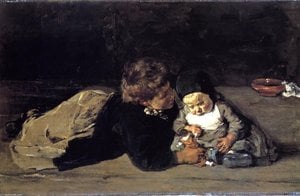
The farrier

1874 · Staatliche Kunsthalle Karlsruhe

The farrier (Beim Hufschmied) is an oil on panel painting by Max Liebermann. Created about 1874, the work belongs to the genre art category. It captures a specific…

Commission a hand-painted copy →
Albert Einstein (1879–1955) (1922) by Max Liebermann
#13

Albert Einstein (1879–1955)

1922 · Royal Society

Max Liebermann's 1922 portrait of Albert Einstein isn’t merely a likeness; it’s a carefully constructed distillation of intellect, contemplation, and the burgeoning promise of a revolutionary mind. Painted…

Order a reproduction →
Portrait Dr. Wilhelm Bode (1909) by Max Liebermann
#15

Portrait Dr. Wilhelm Bode

1909 · Alte Nationalgalerie

In this 1909 oil painting, titled Portrait Dr. Wilhelm Bode, the artist Max Liebermann presents a formal study of a man of significant intellectual standing. The work captures…

Order a reproduction →
The Siblings (1876) by Max Liebermann
#16

The Siblings

1876 · Staatliche Kunstsammlungen

In the quietude of Max Liebermann’s 1876 masterpiece, “The Siblings,” time seems to suspend its forward march, allowing a singular moment of human connection to breathe. This monochrome…

Bring it home →
Swimmers (1875) by Max Liebermann
#17

Swimmers

1875 · Dallas Sanat Müzesi

We are looking at Swimmers, a work by Max Liebermann that captures a quiet, unposed moment of daily life. Also known by the title Swimming boys, this painting…

Commission a hand-painted copy →
Dutch Farmhouse with Woman (1882) by Max Liebermann
#33

Dutch Farmhouse with Woman

1882 · Frye Art Museum

To gaze upon Max Liebermann’s "Dutch Farmhouse with Woman" is to step across the threshold of time and into a moment suspended in golden, gentle light. This 1882…

Bring it home →
A Dutch lacemaker (1881) by Max Liebermann
#55

A Dutch lacemaker

1881 · Hamburger Kunsthalle

The painting titled A Dutch lacemaker (Eine holländische Klöpplerin) is an oil on canvas work by the artist Max Liebermann. This specific piece was executed in 1881. The…

Bring it home →
Gerhart Hauptmann (1912) by Max Liebermann
#56

Gerhart Hauptmann

1912 · Hamburger Kunsthalle

A dignified and somber oil portrait of an elderly man, rendered with expressive, painterly brushstrokes that convey a sense of psychological depth and realism. The composition is a…

Order a reproduction →
Parrot Avenue (1902) by Max Liebermann
#76

Parrot Avenue

1902 · Kunsthalle Bremen

Max Liebermann's "Parrot Avenue," painted in 1902, is a captivating example of Impressionism that transports viewers to a vibrant scene of urban life. Measuring 88 x 72 cm,…

Commission a hand-painted copy →
Table with Pieces of Meat (1877) by Max Liebermann
#77

Table with Pieces of Meat

1877 · Neue Pinakothek

To gaze upon Max Liebermann’s Table with Pieces of Meat is to step directly into the warm, luminous heart of late nineteenth-century Berlin. This oil on canvas from…

Order a reproduction →
The Surgeon, Ferdinand Sauerbruch (1932) by Max Liebermann
#81

The Surgeon, Ferdinand Sauerbruch

1932

In the quiet, contemplative depths of Max Liebermann’s 1932 masterpiece, The Surgeon, Ferdinand Sauerbruch, we are invited into a moment of profound psychological stillness. The painting presents a…

Bring it home →
Jewish Street in Amsterdam (1908) by Max Liebermann
#88

Jewish Street in Amsterdam

1908 · Städel Müzesi

Jewish Street in Amsterdam is an oil painting by Max Liebermann. Created in 1908, the work depicts a bustling street market scene located in Amsterdam. The subject matter…

Bring it home →

Max Liebermann's paintings by period

The subjects Max Liebermann painted most

The four subjects that return most often among these masterpieces, with the finest example of each.

Where to see Max Liebermann's paintings

The 8 museums that hold the most of the paintings on this page.

Museum City Works by Max Liebermann Paintings from this list
Alte Nationalgalerie, BerlinAlte Nationalgalerie Berlin 17 Portrait of Richard Strauss, Portrait Study of Emil Rathenau, Portrait Dr. Wilhelm Bode
Hamburger Kunsthalle, HamburgHamburger Kunsthalle Hamburg 8 The Net Menders, The Terrace at the Hotel Louis C. Jacob in Nienstedten on the Elbe, A Dutch lacemaker
Bavarian State Painting Collections, MünihBavarian State Painting Collections Münih 7 Self portrait in painting smock (Selbstbildnis im Malkittel), Children Bathing in the Sea, Still life of meat (Fleischstillleben)
Wallraf-Richartz Müzesi, KölnWallraf-Richartz Müzesi Köln 6 Two riders on the beach, Self-portrait, The artist's daughter riding
Staatliche Kunsthalle Karlsruhe, KarlsruheStaatliche Kunsthalle Karlsruhe Karlsruhe 5 The farrier, The Basketweavers (Die Korbflechter), Copy of the Bohémienne after Frans Hals (Young woman)
Stadtisches Museum, GelsenkirchenStadtisches Museum Gelsenkirchen 3 Self Portrait with Kitchen Still LIfe, The Flower Terrace in the Wannsee Garden, Facing Northwest
Kunsthalle Bremen, BremenKunsthalle Bremen Bremen 3 Self-portrait, Parrot Avenue
Staatliche KunstSammlungen Dresden, DresdenStaatliche KunstSammlungen Dresden Dresden 3 Alfred von Berger, On the Alster in Hamburg

Max Liebermann through the decades: one masterpiece for each

  1. 1860s
  2. 1870s
    Amsterdam Yetimhanesi'nde Serbest Saat (1876) by Max Liebermann
    No. 1 of 100

    Amsterdam Yetimhanesi'nde Serbest Saat

    Age 23 – 32

    Amsterdam Yetimhanesinde Ücretsiz Saat: Bir Anın İzlenimi Max Liebermann'ın "Amsterdam Yetimhanesinde Ücretsiz Saat" adlı eseri, 19. yüzyıl Amsterdam’ının toplumsal yaşamına dair büyüleyici bir anı ustalıkla yakalayan etkileyici bir…

  3. 1880s
  4. 1890s
  5. 1900s
    Restaurant De oude Vink (1905) by Max Liebermann
    No. 5 of 100

    Restaurant De oude Vink

    Age 53 – 62

    There is a certain quietude found in the middle of a crowd, a feeling captured here in 1905. In Restaurant De oude Vink, we find ourselves seated among…

  6. 1910s
  7. 1920s
    Albert Einstein (1879–1955) (1922) by Max Liebermann
    #13 of 100

    Albert Einstein (1879–1955)

    Age 73 – 82 · Royal Society

    Max Liebermann's 1922 portrait of Albert Einstein isn’t merely a likeness; it’s a carefully constructed distillation of intellect, contemplation, and the burgeoning promise of a revolutionary mind. Painted…

  8. 1930s
    The Surgeon Dr. Ferdinand Sauerbruch (1932) by Max Liebermann
    No. 57 of 100

    The Surgeon Dr. Ferdinand Sauerbruch

    Age 83 – 88 · Hamburger Kunsthalle

    The painting, titled The Surgeon Dr. Ferdinand Sauerbruch, is an oil on canvas created in 1932. The portrait depicts a man wearing glasses and a white coat, seated…

Max Liebermann's paintings: frequently asked questions

What is the most famous Max Liebermann painting?Show the answer

Amsterdam Yetimhanesi'nde Serbest Saat (1876). Next come Self Portrait with Kitchen Still LIfe (1873) and Corner of a Dutch Village with Washing Hung up to Dry (1890).

At what age did Max Liebermann paint Amsterdam Yetimhanesi'nde Serbest Saat?Show the answer

29 years old: Amsterdam Yetimhanesi'nde Serbest Saat dates from 1876 and Max Liebermann was born in 1847.

Which are the 10 most famous Max Liebermann paintings?Show the answer

Amsterdam Yetimhanesi'nde Serbest Saat, Self Portrait with Kitchen Still LIfe, Corner of a Dutch Village with Washing Hung up to Dry, Portrait of Richard Strauss, Restaurant De oude Vink, Self-portrait, The Preserve Makers, Schreitender Bauer, KIRCHGANG IN Laren and Alfred von Berger. The ranking above gives the year and the museum of each.

How many paintings by Max Liebermann are there?Show the answer

Our catalogue lists 280 works by Max Liebermann, dated from 1865 to 1932.

Where can I see the most famous Max Liebermann paintings?Show the answer

Most of them are in Alte Nationalgalerie (Berlin), Hamburger Kunsthalle (Hamburg) and Bavarian State Painting Collections (Münih). The table above lists the museums one by one.

In which period did Max Liebermann paint the best-known works?Show the answer

In 1910s: 18 of the 100 works on this page date from then, among them Portrait of Richard Strauss.

What is the earliest famous Max Liebermann painting, and the latest?Show the answer

The earliest on this page is Portrait of Felix Liebermann (1865), the latest The Surgeon Dr. Ferdinand Sauerbruch (1932).

What subjects did Max Liebermann paint?Show the answer

Man (9), Portrait (6) and Garden scene (6), among the 100 works on this page.

What did Max Liebermann paint on, and with what?Show the answer

Oil On Canvas: 29 of the 100 works on this page.

Which movement does Max Liebermann's art belong to?Show the answer

Impressionism, as the paintings on this page show.

What Max Liebermann paintings does the Alte Nationalgalerie hold?Show the answer

Portrait of Richard Strauss, Portrait Study of Emil Rathenau and Portrait Dr. Wilhelm Bode are among the 9 works on this page held by the Alte Nationalgalerie, Berlin.

Where can I buy a Max Liebermann reproduction?Show the answer

Yes. Every painting on this page can be ordered as a museum-quality, hand-painted oil reproduction or a fine art print, in the size you choose, from the painting's own page.

Max Liebermann: biography

Max Liebermann’ın Işığa Düşen Hayatı: Bir Alman İzlenimci Ressamın Evreni

1847 yılında Berlin'de, varlıklı bir Yahudi ailesinin çocuğu olarak dünyaya gelen Max Liebermann’ın sanatçı olma yolu önceden çizilmiş değildi. Başlangıçta Berlin Üniversitesi'nde hukuk ve felsefe gibi saygın mesleklere yönlendirilen Liebermann’ın gerçek çağrısı, mahkeme salonlarından çok tuvalde daha güçlü yankı buldu. Ancak bu erken dönemdeki entelektüel keşifler, onun gözlemci bakışını ve dünyayı tasvir etme biçimine kesinlikle şekil verdi. Weimar, Paris ve Hollanda'daki çalışmalarla birlikte sanatsal tutkusu gerçek anlamda alevlendi; çeşitli stillerle tanışarak, anları eşsiz bir ışık ve renk duyarlılığıyla yakalamak üzerine kurulu bir kariyerin temellerini attı. Liebermann sadece gördüklerini resmetmiyordu; deneyimin özünü tuvale aktarıyordu. Erken dönem eserleri genellikle günlük yaşamdan sahneleri, özellikle de çalışan sınıfın hayatını tasvir ediyordu ve bu eserler dönemin hakim romantik estetiğine meydan okuyan bir doğallıkla sunuluyordu. Bu resimler sosyal yorum olarak değil, onurlu ve saygılı insan varoluşunun dürüst portreleri olarak tasarlanmıştı.

Alman Bağlamında İzlenimciliği Benimsemek

Liebermann’ın sanatsal gelişimi, Fransız Gerçekçiliğine ve özellikle de yükselen İzlenimci hareketine maruz kalmasından derinden etkilendi. Édouard Manet'nin ruhu – cesareti, akademik geleneklere meydan okuması, çağdaş hayata odaklanması – Liebermann ile derin bir rezonansa girdi. Ancak Paris’te gördüklerini basitçe kopyalamadı; bunun yerine bu ilkeleri Alman duyarlılığına uyarlayarak kendine özgü bir İzlenimcilik yarattı. Paleti daha parlak hale geldi, fırça darbeleri daha gevşek ve kendiliğinden oldu ve konuları burjuva eğlencesi sahnelerine ve Wannsee Gölü yakınlarındaki bahçesinin huzurlu güzelliğine kaydı. Bu bahçe özellikle kariyeri boyunca tekrarlayan bir motif haline geldi; dış dünyanın hızla değişen dünyasından bir sığınak sunarak ışık ve atmosferin keşifleri için sonsuz ilham kaynağı sağladı. Sadece çiçekler ve yapraklar resmetmiyordu; yazın hissini, güneşin sıcaklığını, yaprakların arasından esen hafif rüzgarı yakalıyordu. Manzaraların ötesinde Liebermann, Albert Einstein ve Paul von Hindenburg gibi ikonik figürlerin tasvirlerini içeren 200'den fazla sipariş üzerine portre tamamlayarak son derece aranan bir portreciliğe dönüştü. Bu portreler sadece benzerlikler değildi; ince jestler ve ifadeler aracılığıyla konularının iç yaşamını ortaya koyan derin karakter çalışmalarıydı.

Sanatsal Özgürlüğün Şampiyonu

Liebermann sadece resmetmekle yetinmedi; aynı zamanda sanatsal yeniliği ve bağımsızlığı aktif olarak savundu. Geleneksel sanat kuruluşlarının kısıtlayıcı etkilerini fark ederek, 1898'de Berlin Ayrılıkçılığı’nın öncüsü oldu ve on yıldan fazla bir süre bu avangart grubun liderliğini yaptı. Ayrılıkçılar geleneksel normlara meydan okudu ve akademik geleneğin sınırlarının dışında çalışan sanatçılara bir platform sağladı. Sanatsal özgürlüğe olan bu bağlılığı, kendi eserlerinin ötesine uzandı; Liebermann tutkuyla sanatçıların siyasi veya ideolojik baskılardan bağımsız olarak vizyonlarını keşfredebilmeleri gerektiğine inanıyordu. 1909'da Prusya Sanat Akademisi’ne seçilmesi ve ardından 1920'de başkanlığı, Alman sanat dünyasındaki artan etkisinin kanıtıydı; ancak bu pozisyonlar onu aynı zamanda yükselen anti-Semitizm ve milliyetçilikle yüz yüze getirdi ve bu durum sonunda hayatının işini tehdit edecekti.

Değişen Bir Dünyanın Gölgeleri: Mirası ve Dayanıklılığı

Nazizmin yükselişi, Liebermann’ın sonraki yıllarına karanlık bir gölge düşürdü. Ayrımcılığa karşı ilkeli duruşu, 1933'te Prusya Akademisi’nden istifasına yol açtı; bu cesur eylem değerlerinden ödün vermeyi reddetmesini gösterdi. Artan zulümle karşı karşıya kalmasına rağmen resmetmeye devam etti ve sanatında teselli ve amaç buldu. 1935 yılında Berlin'de hayatını kaybetti, geride zengin bir resim mirası bıraktı; baskılar ve sanatsal ifadeye olan derin bağlılığı kaldı. Eşi Martha, Holokost’un korkunç sonuçlarının yürek burkan bir kanıtı olarak deportasyondan kaçınmak için 1943 yılında hayatına son verdi. Savaştan sonra yıllarca Liebermann’ın eseri biraz göz ardı edildi; ancak son on yıllarda Alman İzlenimciliği ve modern sanat tarihine katkıları yeniden takdir gördü. Bugün, sadece parlak bir ressam olarak değil, aynı zamanda sanatsal ifadeyi cesurca savunan ve zulme karşı direnişin sembolü olarak hatırlanıyor. Resimleri, ışıklarının canlı güzelliği, derin gözlemleri ve kalıcı insanlığıyla izleyicileri büyülemeye devam ediyor.

Ana Başarıları ve Kalıcı Etkisi

  • "On İki Yaşındaki İsa Tapınakta": Bu erken dönem eseri, geleneksel dini ikonografiye meydan okuyan Semitik görünümlü bir İsa tasviri nedeniyle önemli tartışmalara yol açtı.
  • Berlin Ayrılıkçılığı’nın Liderliği: Bu avangart hareketin liderliğindeki kilit rolü sanatsal normlara meydan okudu ve Almanya'da modern sanatın önünü açtı.
  • Prusya Sanat Akademisi Başkanlığı: Nazizmin yükselişiyle tehlikeye girmiş olsa da, sanatsal yeteneğinin önemli bir tanınmasıydı.
  • Usta Portrecilik: 200'den fazla sipariş üzerine portrede konularının özünü yakalama becerisi, onu önde gelen bir portre ressamı olarak pekiştirdi.
  • Alman İzlenimciliği Üzerindeki Etkisi: Liebermann, İzlenimci ilkelerini benzersiz bir şekilde Alman bağlamına uyarlamayı başardı ve nesiller boyu sanatçılara ilham verdi.

All 280 works by Max Liebermann →