Fernando Botero, 1932 – 2023

Fernando Botero: The 100 Most Famous Paintings

The President and First Lady is the most famous painting by Fernando Botero. la collectionneuse and Dancing in Colombia (1980) are the next two works the world knows best. From the 279 works of Fernando Botero in our catalogue, here are the 100 that collectors and museum visitors look at most, with the year, the museum and the story of each.

Ranked by our popularity score, which combines the searches, visits and orders for each work. Updated Ekim 2026.

Portrait of Fernando Botero
Fernando Botero · 1932 – 2023
Born · died
1932 – 2023, Medellín
Movement
Boterismo
Works in our catalogue
279
Most famous
The President and First Lady
Most works at
National Museum of Colombia

Top 10: Fernando Botero's best-known paintings

The President and First Lady by Fernando Botero
1

The President and First Lady

Oil On Canvas

To stand before a work by Fernando Botero is not merely to observe paint on canvas; it is to encounter a celebration of form itself. His signature style, often termed Boterismo, immediately arrests the viewer with its magnificent exaggeration. Here, in "The President and First Lady," this characteristic volume takes center stage. The figures—the woman poised elegantly upon the horse, the attendant figures flanking the scene—are rendered with a delightful,…

la collectionneuse by Fernando Botero
2

la collectionneuse

Oil On Canvas

The gaze of the viewer meets the presence of la collectionneuse, a work that carries the unmistakable weight and volume of its creator. Fernando Botero, born in Medellín, Colombia, on April 19, 1932, breathes life into this scene through his singular way of seeing the world. The canvas holds a quiet, heavy energy that feels as though it has always existed in this specific, rounded state.

Dancing in Colombia (1980) by Fernando Botero
3

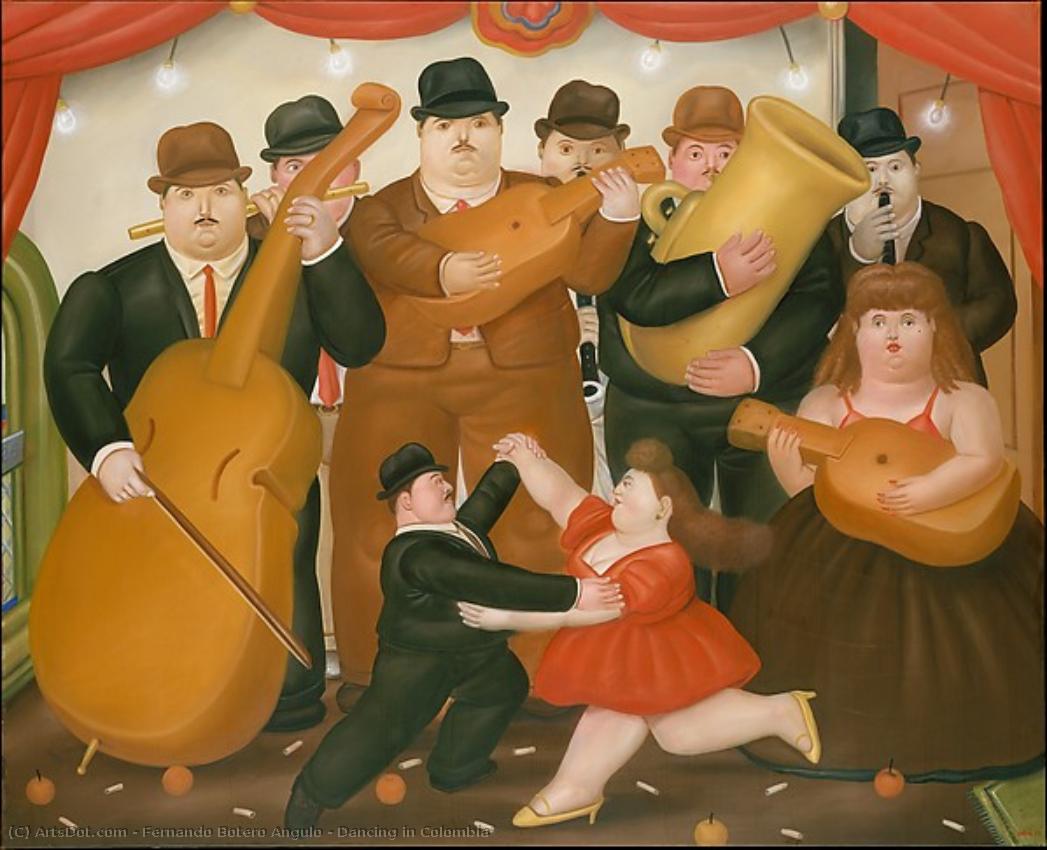
Dancing in Colombia

1980 · Oil On Canvas · Metropolitan Sanat Müzesi, New York

In the vibrant tapestry of twentieth-century Latin American art, few works capture the exuberant pulse of a nation quite like Fernando Botero’s Dancing in Colombia. Completed in 1980, this masterful oil painting serves as a window into a world where movement and mass coexist in a joyful, rhythmic embrace. At first glance, the viewer is swept up in a scene of delightful disorder; a crowded café or social gathering teems…

la famille by Fernando Botero
4

la famille

Oil On Canvas

To stand before Fernando Botero’s depiction of la famille is to be enveloped in an atmosphere of profound, almost monumental warmth. This painting transcends a mere portrait; it is a celebration of connection, a visual ode to the enduring bond that ties generations together. The composition centers on a family unit—a mother seated between her two children, all gathered beneath the sheltering canopy of a tree. Botero masterfully captures not…

scene de famille by Fernando Botero
5

scene de famille

Oil On Canvas

To gaze upon Fernando Botero’s Scene de Famille is to be enveloped in an atmosphere of profound, yet utterly comfortable, domesticity. This painting transcends a mere depiction; it captures the very essence of togetherness—the quiet moments shared between loved ones that form the bedrock of human experience. The composition centers around a family unit of four—a man, a woman, and two children—all settled into a tableau of relaxed intimacy. Botero’s…

mona lisa by Fernando Botero
6

mona lisa

Oil On Canvas

Introduction to the Artist and his Style Fernando Botero Angulo, a renowned Colombian figurative artist, is celebrated for his unique style characterized by voluminous, exaggerated forms. His work has been exhibited worldwide and can be found in prestigious museums such as the Metropolitan Museum of Art in New York City and the Museo de Arte Moderno in Bogotá. At AllPaintingsStore.com, we offer handmade oil paintings reproductions of famous artwork, including…

Frank Lloyd et sa famille à paradise island by Fernando Botero
7

Frank Lloyd et sa famille à paradise island

Oil On Canvas

In this scene, we find ourselves on a tropical shore, observing a quiet moment shared by a family of four. Two adults and two children are positioned amidst the soft sands of paradise island, their presence anchored to the landscape. There is a certain weight to the figures; they do not merely occupy the beach but seem to emerge from it, their rounded silhouettes mirroring the organic curves of the…

les musiciens by Fernando Botero
8

les musiciens

Oil On Canvas

The scene unfolds through les musiciens, a work that carries the unmistakable presence of its creator, Fernando Botero. Created in 1986, this piece captures a moment of quiet musicality. The artist, who was born in Medellín, Colombia, in 1932, brings a specific sense of weight and volume to the figures within the frame. Every shape feels substantial, as if the air in the room has a physical density that holds…

Dog Turning a Corner (1980) by Fernando Botero
9

Dog Turning a Corner

1980 · Oil On Canvas

In the masterful hands of Fernando Botero, a simple street corner is transformed into a theatrical stage where life unfolds with exaggerated grace and exuberant color. Dog Turning a Corner invites the viewer into a sun-drenched village scene, captured with the unmistakable warmth that defines the Colombian master's vision. The painting presents a bustling tableau of small-town life, where yellow buildings glow under an unseen sun, casting a nostalgic radiance…

Walk in the hills (1977) by Fernando Botero
10

Walk in the hills

1977 · Oil On Canvas

In the vast landscape of twentieth-century Latin American art, few figures command attention with as much whimsical gravity as Fernando Botero. His 1977 masterpiece, Walk in the hills, serves as a profound window into the artist's signature aesthetic, often referred to as "Boterismo." At first glance, the painting presents a scene of quietude: a solitary figure, draped in heavy, dark garments and crowned with a black hat, stands amidst the…

The rest of the Fernando Botero ranking, 11 to 100

July 20th (1984) by Fernando Botero
#11

July 20th

1984 · National Museum of Colombia

Fernando Botero’s “July 20th,” painted in 1984, isn't merely a depiction of two figures on a street; it’s a carefully constructed tableau brimming with quiet drama and subtle…

Quatre Musiciens by Fernando Botero
#12

Quatre Musiciens

Fernando Botero Angulo's "Quatre Musiciens" is a captivating oil painting that exemplifies the artist’s signature style – a harmonious blend of bold colors, exaggerated forms, and a playful…

couple dansant by Fernando Botero
#13

couple dansant

is an oil painting by the Colombian artist Fernando Botero. The work captures a couple lost in the rhythm of dance, presenting a scene of movement and intimacy.…

monna lisa by Fernando Botero
#14

monna lisa

The gaze of the woman in monna lisa by Fernando Botero holds a quiet, heavy presence. She sits before us, draped in a black dress that anchors her…

danse en colombie by Fernando Botero
#15

danse en colombie

The painting "Danse en Colombie" by Fernando Botero Angulo is a captivating representation of the rich cultural heritage of Colombia. This vibrant artwork, available as a handmade oil…

tablao flamenco by Fernando Botero
#16

tablao flamenco

In the painting tablao flamenco by Fernando Botero, the scene captures a lively performance taking place within a club setting. At the center of the activity is a…

le chasseur by Fernando Botero
#17

le chasseur

The work before us is titled le chasseur, a painting by the Colombian artist Fernando Botero. Born in Medellín, Colombia, in 1932, Botero developed a singular visual language…

pastèques et oranges by Fernando Botero
#18

pastèques et oranges

To stand before a piece evoking the spirit of Fernando Botero’s still life compositions is to encounter an immediate sense of opulent, almost monumental presence. This painting, featuring…

tête de christ by Fernando Botero
#20

tête de christ

The work before us is titled tête de christ, a painting by the Colombian artist Fernando Botero. Born in 1932 in Medellín, Colombia, Botero developed a singular visual…

oranges by Fernando Botero
#21

oranges

In the vibrant world of Fernando Botero, even the simplest objects undergo a profound transformation. His painting, oranges, invites the viewer into a tactile universe where volume and…

nature morte à la soupe verte by Fernando Botero
#22

nature morte à la soupe verte

To stand before Nature Morte à la Soupe Verte is to be enveloped in the warm, generous embrace of Colombian artistry. Fernando Botero Angulo’s vision here transcends a…

les soeurs by Fernando Botero
#23

les soeurs

In the captivating realm of Fernando Botero’s les soeurs, the viewer is immediately enveloped by a sense of profound intimacy and exaggerated grace. The painting presents a tender…

The Widower (1968) by Fernando Botero
#30

The Widower

1968

“The Widower,” painted in 1968 by Colombian artist Fernando Botero, is a striking oil painting depicting a poignant family portrait set within the confines of a domestic interior.…

jeune fille sur l'ane by Fernando Botero
#46

jeune fille sur l'ane

jeune fille sur l'ane is an oil painting by Fernando Botero. The artist was born in 1932 in Medellín, Colombia, and maintained a presence in international art hubs…

nature morte de fruits by Fernando Botero
#73

nature morte de fruits

Fernando Botero Angulo's “nature morte de fruits” is more than just a depiction of fruit; it’s an embodiment of the artist’s singular vision, a testament to his mastery…

Guitar Lesson (1960) by Fernando Botero
#81

Guitar Lesson

1960 · National Museum of Colombia

Fernando Botero’s “Guitar Lesson,” painted in 1960, isn’t merely a depiction of a musical scene; it’s an embodiment of the artist’s signature style – what he himself termed…

hommage à Bonnard by Fernando Botero
#83

hommage à Bonnard

The painting Hommage à Bonnard by Fernando Botero Angulo is a unique and fascinating work of art that pays tribute to the French painter Pierre Bonnard. As a…

rubens et sa femme by Fernando Botero
#84

rubens et sa femme

In the captivating realm of Fernando Botero, reality is not merely observed but reimagined through a lens of magnificent abundance. His work, rubens et sa femme, serves as…

chambre avec jeux d'enfants by Fernando Botero
#85

chambre avec jeux d'enfants

In the captivating realm of Fernando Botero, reality is not merely observed but reimagined through a lens of magnificent abundance. The painting chambre avec jeux d'enfants invites the…

le bain des évêques dans un fleuve by Fernando Botero
#86

le bain des évêques dans un fleuve

A Moment of Leisure: "Le Bain des Évêques dans un Fleuve" by Fernando Botero Angulo This captivating painting, “Le Bain des Évêques dans un Fleuve” (The Bathing of…

l'étude de vermeer by Fernando Botero
#87

l'étude de vermeer

The painting l'étude de vermeer emerges from the year 1964, a moment when Fernando Botero captures a singular presence on canvas. This work presents a portrait of a…

The subjects Fernando Botero painted most

The four subjects that return most often among these masterpieces, with the finest example of each.

Where to see Fernando Botero's paintings

The 6 museums that hold the most of the paintings on this page.

Museum City Works by Fernando Botero Paintings from this list
National Museum of Colombia, BogotaNational Museum of Colombia Bogota 2 July 20th, Guitar Lesson
Bavarian State Painting Collections, MünihBavarian State Painting Collections Münih 2 The First Lady, El Presidente
Metropolitan Sanat Müzesi, New YorkMetropolitan Sanat Müzesi New York 1 Dancing in Colombia
Museum of Latin American Art, Long BeachMuseum of Latin American Art Long Beach 1 Title translation: The Family
Tucson Museum of Art, TucsonTucson Museum of Art Tucson 1 Sailor Boy
Antwerp Kraliyet Güzel Sanatlar Müzesi, AnversAntwerp Kraliyet Güzel Sanatlar Müzesi Anvers 1 The Prima Donna

Fernando Botero through the decades: one masterpiece for each

  1. 1950s
  2. 1960s
  3. 1970s
    Walk in the hills (1977) by Fernando Botero
    No. 10 of 100

    Walk in the hills

    Age 38 – 47

    In the vast landscape of twentieth-century Latin American art, few figures command attention with as much whimsical gravity as Fernando Botero. His 1977 masterpiece, Walk in the hills,…

  4. 1980s
    Dancing in Colombia (1980) by Fernando Botero
    #3 of 100

    Dancing in Colombia

    Age 48 – 57 · Metropolitan Sanat Müzesi

    In the vibrant tapestry of twentieth-century Latin American art, few works capture the exuberant pulse of a nation quite like Fernando Botero’s Dancing in Colombia. Completed in 1980,…

  5. 1990s

Fernando Botero's paintings: frequently asked questions

What is the most famous Fernando Botero painting?Show the answer

The President and First Lady. Next come la collectionneuse and Dancing in Colombia (1980).

Which are the 10 most famous Fernando Botero paintings?Show the answer

The President and First Lady, la collectionneuse, Dancing in Colombia, la famille, scene de famille, mona lisa, Frank Lloyd et sa famille à paradise island, les musiciens, Dog Turning a Corner and Walk in the hills. The ranking above gives the year and the museum of each.

How many paintings by Fernando Botero are there?Show the answer

Our catalogue lists 279 works by Fernando Botero, dated from 1959 to 1992.

Where can I see the most famous Fernando Botero paintings?Show the answer

Most of them are in National Museum of Colombia (Bogota), Bavarian State Painting Collections (Münih) and Metropolitan Sanat Müzesi (New York). The table above lists the museums one by one.

In which period did Fernando Botero paint the best-known works?Show the answer

In 1960s: 10 of the 100 works on this page date from then, among them Camera degli Sposi (Homage to Mantegna) II.

What is the earliest famous Fernando Botero painting, and the latest?Show the answer

The earliest on this page is Mona Lisa, Age Twelve (1959), the latest Title translation: The Family (1992).

What subjects did Fernando Botero paint?Show the answer

Woman (14), Portrait (9) and Volume (8), among the 100 works on this page.

What did Fernando Botero paint on, and with what?Show the answer

Oil On Canvas: 22 of the 100 works on this page.

Which movement does Fernando Botero's art belong to?Show the answer

Boterismo, as the paintings on this page show.

What Fernando Botero paintings does the National Museum of Colombia hold?Show the answer

July 20th and Guitar Lesson are among the 2 works on this page held by the National Museum of Colombia, Bogota.

Fernando Botero: biography

Erken Yaşam, Aile ve Sanat Eğitimi

Fernando Botero, 19” Nisan 1932 tarihinde Kolombiya'nın Medellín şehrinde dünyaya geldi. Çocukluk yılları, geçimini sağlamaya çalışan bir ailenin sessiz ve istikrarlı ritimleriyle şekillendi. Babası David Botero, müşterilerine ulaşmak için sık sık at sırtında seyahat eden bir satış temsilcisi olarak hayatını kazanıyordu. Annesi Flora Angulo ise bir terzi olarak çalışıyor ve ailenin ihtiyaç duyduğu desteği sağlıyordu. Bu erken dönem çevresi, sanatçının şehirden ayrıldıktan çok sonra bile ruhunda taşıyacağı derin bir aidiyet duygusu ve mekan algısı sundu.

Gençlik yıllarında Fernando Botero, matador okullarında birkaç yıl geçirdi. Boğa güreşi arenasının hareketleri ve gelenekleri üzerine eğitim aldı; ancak zamanla ilgi alanları onu arenadan uzaklaştırdı. 16 yaşına geldiğinde, odağı çizim ve eskiz yapmaya kaymıştı. 1948 yılında, ilk illüstrasyonları El Colombiano gazetesinin Pazar ekinde yayımlandı ve bu durum, görsel çalışmaları aracılığıyla kamusal alandaki varlığının başlangıcını müjdeledi.

Sanatsal Eğitim ve Avrupa Yolculukları

1952 yılında Botero, galerilerindeki satışlardan elde ettiği kazançla Avrupa'ya doğru yelken açtı. İlk durağı Barselona olsa da çok geçmeden rotasını Madrid'e çevirdi. İspanya'da, Academia de San Fernando'da eğitim görmeye başladı. Prado Müzesi'nde geçirdiği vakitlerde, Goya ve Velázquez'in eserlerini karşısına alıp onları kopyalayarak saatlerce başında beklerdi. Eski Ustaları inceleme ve onlardan ders çıkarma alışkanlığı, sanat pratiğinin ayrılmaz bir parçası haline geldi.

Eğitim süreci onu nihayetinde Academia de San Marcos'un bulunduğu Floransa'ya taşıdı. 1953 yılına gelindiğinde ise artık Paris'teydi. Zamanının büyük bir kısmını Louvre Müzesi'nde, ışığın ve formun müzenin görkemli salonlarındaki figürler üzerinde nasıl bir dans sergilediğini izleyerek geçirdi. Avrupa'da geçen bu yıllar; Madrid, Floransa ve Paris gibi şehirler arasında mekik dokuyarak, klasik sanatın o sarsılmaz ağırlığını ve varlığını ruhuna hapsetmekle geçti.

Boterismo Stilinin Doğuşu

Fernando Botero'nun eserlerindeki formlar, kendine has bir ağırlık ve varlık taşır. Genellikle Boterismo olarak adlandırılan bu yaklaşım, figürlerin ve insanların devasa, abartılı hacimlerle yeniden yorumlanmasına odaklanır. Sanatçı, ince çizgilerin peşinden gitmek yerine, mekanı ağır bir varlıkla dolduran yuvarlak ve dolgun formlara yönelir. Bu figürler, sanki boyanın kendisi bir kütleye dönüşmüşçesine, fiziksel bir yoğunluk ve kütlesellik hissi uyandırır. Formları tanımlamak için sıklıkla canlı renkler ve belirgin dış hatlar kullanan sanatçı, öznelerin arka planlarından sıyrılıp öne çıkmasını sağlar.

1964 yılına gelindiğinde, bu hacim tutkusu tuvalin sınırlarını aşarak üç boyutlu dünyaya adım atmıştır. Heykel sanatına yönelen Fernando Botero, resimlerindeki o genişleme hissini bronz ve diğer malzemelere de aktarmaya başlamıştır. Tablolarındaki o karakteristik yuvarlaklık, bu katı formlarda yeni bir hayat bularak abartılı oranların kamusal alanlarda da var olabilmesine olanak tanımıştır. İster bir insan figürü ister bir hayvan olsun, sanatçının tüm çalışmaları konunun saf fiziksel varlığına ve heybetine odaklanmaya devam eder.

Sanatçının bu evrimini yansıtan önemli eserler:

Temel Eserler ve Sanatsal Temalar

Fernando Botero'nun eserleri, genellikle insan formunun ağırlığı ve sosyal ortamların içindeki o sessiz gerilim etrafında şekillenir. Mona Lisa, Age Twelve (1959) adlı çalışmasında, konu geleneksel oranlardan uzaklaşan, kendine has ve yuvarlak bir varlıkla resmedilmiştir. Hacme olan bu odaklanma, daha karmaşık sosyal yapıları keşfetmenin bir yolu haline gelmiştir. The Presidential Family (1967) eserinde ise figürlerin abartılı formları, kütleyi iktidardaki insanlara dair bir yorum aracı olarak kullanarak siyasi elitlere ince bir bakış sunar. Sanatçı, bu formları hem yaşamın coşkusunu hem de çatışmaların ağırlığını ele almak için kullanmıştır.

Temalar, genellikle kutlama ile şiddetin gerçekliği arasında gidip gelir. Dancing in Colombia (1980), müzisyenlerin ve dansçıların canlı bir sahnesini yakalarken, figürlere dokunsal ve ağır bir nitelik kazandırmak için kalın boya katmanlarından yararlanır. Buna karşılık, daha sonraki çalışmaları sıklıkla vatanının karanlık yönleriyle yüzleşmiştir. The Death of Pablo Escobar (1999/2006) ve Abu Ghraib'deki hak ihlallerini ele alan çeşitli serileri, imza stilini zorlu gerçeklerle yüzleşmek için kullanma konusundaki kararlılığını gösterir. La paloma de la paz (2016) gibi daha geç dönem eserleri bile, konu bir insan, bir hayvan ya da bir barış sembolü olsun, anıtsal bir ağırlık hissi taşır.

  • Mona Lisa, Age Twelve (1959)
  • The Presidential Family (1967)
  • Dancing in Colombia (1980)
  • The Death of Pablo Escobar (1999/2006)
  • La paloma de la paz (2016)

Son Yılları ve Vefatı

Hayatının son on yılları, birkaç uluslararası merkez arasında mekik dokuyarak geçti. New York, Paris ve Monte Carlo gibi şehirlerde ikametlerini sürdürürken, köklerine olan bağlılığını korumak adına sık sık Medellín'e geri dönüyordu. Bronz heykelleri farklı kıtalardaki parklarda ve meydanlarda yerini aldıkça, kamusal alanlardaki varlığı daha da güçlendi. Yaş aldıkça bile sanatı, Kolombiya'daki sosyal ve politik gerilimler ile Abu Ghraib hapishanesindeki olaylar gibi ağır ve sarsıcı temaları işlemeye devam etti.

Ömrünün son yıllarında Monako Prensliği'nde yaşayan sanatçı, 15 Eylül 2023 tarihinde, 91 yaşında hayata gözlerini yumdu. Ölüm nedeni zatürre komplikasyonları olarak açıklandı. Onun vefatı, insan formunu ve sosyal yaşamın karmaşıklıklarını, hacim ve oranlara dayalı o kendine has merceğinden izleyerek geçirdiği uzun ve görkemli bir kariyerin sonunu temsil etti.

Miras ve Etki

Fernando Botero'nun kamusal alandaki varlığı, hayatı boyunca kesintisiz bir süreklilik arz etti. New York City'de, heykelleri Park Avenue gibi mekanlarda şehrin mimarisiyle yan yana duran o ağır ve yuvarlak formlarıyla kendine yer bulurken; Kolombiya'da, eserleri ülkenin günlük yaşamına ilmek ilmek işlenmiş bir ulusal hazineye dönüştü. Yaşadığı dönemde Latin Amerika'nın en çok tanınan ve eserlerine en çok atıfta bulunulan sanatçısı olması, figürlerinin sınırları aşarak pek çok farklı kültürden insan için tanıdık birer simge haline gelmesiyle kanıtlanmıştır.

Sanatçının kendi topraklarına olan bağlılığı, gerçekleştirdiği devasa ölçekli bağışlarla somut bir gerçeklik kazandı. 2000 yılında Cumhuriyet Bankası'na 208 sanat eseri armağan etmesi, Bogotá'nın kültürel dokusunun şekillenmesinde hayati bir rol oynadı. Ayrıca kişisel koleksiyonunun büyük bir kısmını paylaşarak, Museo Botero'ya 123 ve 85 parça eser bağışladı. Bu cömert katkılar, Fernando Botero'nun dünyayı görme biçiminin, kendisinden sonra gelen nesiller için her zaman erişilebilir kalmasını sağladı.

  • La paloma de la paz
  • The Death of Pablo Escobar
  • Mona Lisa, Age Twelve

Eserlerini Bugün Nerede Görebilirsiniz?

Fernando Botero'nun sanatsal izleri, Bogota'nın sessiz köşelerinde, özellikle de La Candelaria mahallesinin tarihi dokusunda derinden hissedilir. Sanatçının eserlerinin büyük bir kısmı, kendi kararıyla pek çok parçasını ulusa bağışlamasıyla büyüyen devasa bir koleksiyon olarak Museo Botero'da yaşamaya devam etmektedir. Medellín'de ise Museum of Antioquia, sanatçının kökleriyle olan bağını koruyarak eserlerinin önemli bir kısmına ev sahipliği yapar. Bu mekanlar, onun hacimle olan büyüleyici dansını ve figürlerine yüklediği o eşsiz ağırlığı, zamanın yavaş aktığı bir atmosferde incelemek için eşsiz fırsatlar sunar.

Kolombiya sınırlarının ötesine geçtiğimizde ise, tablolarının New York'taki Metropolitan Museum of Art gibi dünya çapındaki bir kurumun görkemli atmosferinde bambaşka bir karaktere büründüğüne şahitlik ederiz. Figürlerinin ölçeği, bu küresel sanat mabedinin arka planında daha da devasa bir anlam kazanır. Bronz heykelleri ise Floransa ve Medellín sokaklarında kamusal alanlarda kalıcı yuvalar bularak, insanları etraflarında dolaşmaya ve bu anıtsal formlarla buluşmaya davet eder. Bu ağır ve yuvarlak formlar, şehrin ışığına ve hareketine tabi olarak açık havada, hayatın tam kalbinde varlığını sürdürür.

  • Dancing in Colombia (1980)
  • July 20th (1984)
  • Mona Lisa (yaklaşık 1959)
  • The Death of Pablo Escobar (yaklaşık 1999)

All 279 works by Fernando Botero →