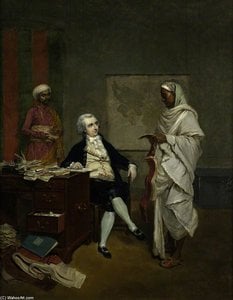
Thomas Hickey: A Journey Through Brushstrokes and Empires
Born in Dublin, Ireland, in 1741, Thomas Hickey’s life was a remarkable tapestry woven across continents – from the bustling streets of his native city to the opulent courts of India, the strategic landscapes of Mysore, and the diplomatic circles of Peking. More than just an artist, Hickey was a chronicler of his time, a witness to pivotal historical events, and a skilled observer who translated the vibrant energy of diverse cultures onto canvas. His career spanned nearly eight decades, marked by both artistic triumphs and personal tragedies, ultimately solidifying his place as one of the most intriguing figures in 18th-century European art.
Hickey’s early training was rooted in the traditional methods of the Royal Dublin Society schools under Robert West. This foundation provided him with a solid grasp of classical techniques and portraiture, skills he would later refine through extensive travel and experience. However, it was his journey to India that truly shaped his artistic vision. Unlike many European artists who sought exotic subjects for mere novelty, Hickey immersed himself in the local culture, capturing not just outward appearances but also the essence of Indian life – its customs, rituals, and social dynamics. His depictions of Tipu Sultan’s family, including portraits of the ruler's sons, uncle, and subaider, are particularly noteworthy for their nuanced portrayal of character and their remarkable attention to detail, reflecting a genuine engagement with the subject matter.
His time in Bengal was a period of intense activity. He wasn’t merely painting; he was documenting. The capture of his vessel by French and Spanish fleets thrust him into Lisbon, where he secured commissions that allowed him to hone his skills further. He then traveled to India, arriving just as the Fourth Mysore War raged, providing him with a front-row seat to history and an unparalleled opportunity to record the era’s key figures. The sketches produced during this period are invaluable historical documents, offering insights into the political landscape and social fabric of 18th-century India – far exceeding simple portraits; they were meticulous studies of power, lineage, and daily life.
The Artist's Travels and Artistic Development
Hickey’s artistic development wasn’t confined to a single style or technique. His travels exposed him to diverse artistic traditions, influencing his approach to portraiture and genre scenes. His early training in Italy instilled a classical sensibility, evident in the precision of his draftsmanship and his understanding of anatomy. However, his experiences in India profoundly altered his perspective, leading him to embrace looser brushwork, brighter colors, and a greater emphasis on capturing atmosphere and emotion. This fusion of influences is particularly apparent in his portraits of Indian nobility – they are not merely likenesses but evocative representations of personality and status.
His time in London between 1776 and 1780 saw him working alongside other prominent artists, absorbing new techniques and expanding his network. He also served as official painter to the Chinese embassy led by George Macartney, a significant undertaking that showcased his versatility and diplomatic skills. This expedition provided him with access to a world of exotic sights and customs, further enriching his artistic repertoire.
Portraits of Power and Personal Tragedy
Hickey’s portraiture is characterized by its remarkable realism and psychological depth. He possessed an uncanny ability to capture the essence of his subjects – their personalities, emotions, and social standing. His portraits of Dr. Robert Emmet, State Physician for Ireland, and his son, Robert, are particularly admired for their intimate portrayal of family life. The detail with which he rendered their features and expressions reveals a keen understanding of human nature.
However, Hickey’s life was not without its sorrows. His younger brother, John Hickey, a sculptor, tragically died in 1796, leaving him heartbroken. This loss undoubtedly impacted his artistic output, though it didn't extinguish his passion for painting. His final years were marked by continued commissions and a dedication to his craft, culminating in his death in Madras in 1824.
Legacy and Historical Significance
Despite not achieving widespread fame during his lifetime, Thomas Hickey’s work has gained increasing recognition in recent decades. His sketches of Tipu Sultan's court are now considered invaluable historical documents, offering a unique window into the world of 18th-century Mysore. His portraits, too, reveal a remarkable sensitivity to human character and a keen eye for detail.
Today, his paintings can be found in prestigious collections around the world – including the Courtauld Institute of Art (London), the Honolulu Museum of Art, the National Gallery of Ireland, the Tate, and the Victoria Art Gallery (Bath). His legacy extends beyond his artistic achievements; he was a true explorer of cultures, a skilled observer, and a testament to the transformative power of travel. The works of Thomas Hickey stand as a vibrant reminder of a fascinating era in European art history.
Further Resources: