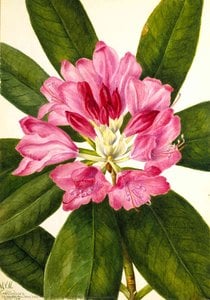
Mary Vaux Walcott (1860-1940): A Life Blossoming in Watercolor
Mary Vaux Walcott, affectionately known as “the Audubon of Botany,” stands as a singular figure in American art history—a woman who defied societal expectations and fused artistic passion with scientific rigor to create an unparalleled legacy. Born in Philadelphia in 1860 into a Quaker family steeped in intellectual tradition, her early life foreshadowed the extraordinary path she would forge. Little did anyone realize that a simple set of watercolor paints gifted at age eight would ignite a lifelong devotion to capturing the delicate beauty of wildflowers and propel her to international acclaim.Early Influences & Artistic Beginnings
Mary Morris Vaux’s artistic journey commenced with an instinctive fascination for color and form—qualities she honed through diligent observation and meticulous practice. Unlike many women of her era who pursued domestic pursuits, Vaux possessed a restless spirit and an unwavering determination to pursue her own interests. Her formal education focused on the humanities, fostering a deep appreciation for literature and philosophy alongside scientific inquiry. Crucially, her father encouraged her intellectual curiosity and nurtured her burgeoning talent—a rare combination that would prove instrumental in shaping her artistic vision. The family’s annual summer expeditions to the Canadian Rockies served as formative experiences, exposing her to breathtaking landscapes and inspiring her to translate their grandeur onto canvas. It was during these travels that she began experimenting with watercolor techniques, striving for realism while simultaneously conveying emotion—a stylistic hallmark of her oeuvre. Her initial sketches, signed “M.M. Vaux 4th month 1873,” reveal a remarkable sensitivity to detail and an early mastery of color blending—qualities that would characterize her later masterpieces.The Rocky Mountain Landscape & Scientific Observation
The Canadian Rockies became Mary Vaux Walcott’s primary artistic laboratory, providing the backdrop for groundbreaking scientific research alongside breathtaking visual inspiration. Accompanied by her brothers, she undertook comprehensive studies of glacial movements, mineralogy, and alpine flora—activities that demanded both physical stamina and intellectual acuity. Unlike artists who merely sought aesthetic pleasure from nature, Vaux approached it with a scientist’s eye—measuring distances, charting contours, and documenting plant species with unwavering precision. Her meticulous observations informed her artistic renderings, resulting in images that were not only beautiful but also scientifically accurate—a distinction that cemented her reputation as “the Audubon of Botany.” The expedition to Mount Stephen in 1900 marked a pivotal moment in Vaux’s life—she became the first woman recorded to ascend this formidable peak, demonstrating courage and resilience alongside her artistic talent. Her detailed photographic documentation of the glacier complemented her watercolor paintings, offering invaluable insights into glacial recession—a phenomenon that foreshadowed the looming threat of climate change decades before it gained widespread recognition.Botanical Illustration & Recognition
Mary Vaux Walcott’s contribution to botanical illustration transcends mere aesthetic beauty; it represents a revolutionary approach to documenting plant life. Rejecting conventional artistic conventions, she prioritized scientific accuracy alongside expressive artistry—a daring decision that distinguished her work from its contemporaries. Her method involved scaling plants to life size, meticulously rendering their intricate structures and vibrant colors with unparalleled detail—a technique that would become synonymous with her style. Recognizing the significance of her achievement, botanists eagerly sought her collaboration on projects aimed at documenting rare species—a testament to her reputation as a leading botanical artist. The publication of *North American Wild Flowers* in 1925—a monumental five-volume collection featuring over 400 of her illustrations—established her place among the titans of American art and cemented her legacy as “the Audubon of Botany.” This ambitious undertaking garnered critical acclaim and solidified her reputation for scientific rigor and artistic excellence.A Lasting Legacy & Enduring Influence
Mary Vaux Walcott’s influence extends far beyond the realm of botanical illustration—she embodies a spirit of adventure, intellectual curiosity, and unwavering determination to pursue one's passions regardless of societal constraints. Her pioneering achievements serve as an inspiration for aspiring artists and scientists alike—demonstrating that creativity and scientific inquiry can coexist harmoniously. Beyond her artistic accomplishments, Vaux championed women’s rights and advocated for improved conditions on Native American reservations—affirming her commitment to social justice alongside her artistic pursuits. Her bequest to the Smithsonian Institution ensured that future generations would benefit from scientific research and publication—a final testament to her enduring legacy as a visionary artist and humanist. Mary Vaux Walcott's story continues to resonate today, reminding us of the transformative power of curiosity, courage, and an unwavering devotion to capturing the beauty and complexity of the natural world.Soru ve Cevaplar
Mary Vaux Walcott adlı sanatçının eserlerini belirli bir renk paletine göre nasıl bulabilirim?
Mary Vaux Walcott tarafından üretilen eserleri belirli bir renk paletinde bulmak için sanatçının Renk Paletlerine Göre sayfasını kullanabilirsiniz.
Mary Vaux Walcott sanatçısının en çok görüntülenen eserleri hangileridir?
Mary Vaux Walcott'in İstatistikler sayfası, Mary Vaux Walcott'in bu web sitesi üzerinde listelenen eserlerinden elde edilen istatistikleri sunar.
Mary Vaux Walcott hangi ülkede doğdu?
Mary Vaux Walcott, Amerika Birleşik Devletleri doğumludur.