Jerzy Faczynski, 1917 – 1943

Jerzy Faczynski: En Ünlü 69 Tablo

Ballerina, Jerzy Faczynski tarafından yapılmış en ünlü tablodur. Abstract Woman ve Shepherd, dünyanın en iyi bildiği sonraki iki eserdir. Katalogumuzdaki Jerzy Faczynski adlı sanatçının 69 eseri arasından, koleksiyonerlerin ve müze ziyaretçilerinin en çok ilgi gösterdiği, yılı, sergilendiği müze ve hikayesiyle birlikte sunulan 69 eser şunlardır:

Her bir eser için yapılan aramalar, ziyaretler ve siparişlerin birleşimiyle oluşturulan popülerlik puanımıza göre sıralanmıştır. Kasım 2026 tarihinde güncellenmiştir. Bu sayfadaki her bir şaheser, seçtiğiniz boyutta müze kalitesinde, el yapımı yağlı boya reprodüksiyon veya sanat baskısı olarak sipariş edilebilir.

Jerzy Faczynski portresi
Jerzy Faczynski · 1917 – 1943
Doğum · ölüm
1917 – 1943
Kataloğumuzdaki eserler
69
En ünlüları
Ballerina

En İyi 10: Jerzy Faczynski'in en bilinen tabloları

Jerzy Faczynski sıralamasının geri kalanı, 11 ile 69 arası

Jerzy Faczynski tarafından en çok resmedilen konular

Bu şaheserler arasında en sık rastlanan dört konu ve her birinin en seçkin örneği.

Jerzy Faczynski'in tabloları: sıkça sorulan sorular

Jerzy Faczynski sanatçısının en ünlü tablosu hangisidir?Yanıtı göster

Ballerina. Ardından Abstract Woman ve Shepherd gelir.

En ünlü 10 Jerzy Faczynski tablosu hangileridir?Yanıtı göster

Ballerina, Abstract Woman, Shepherd, Faces, Nude, Nude, Nude, Ballerina, Woman ve The Madonna And Child. Yukarıdaki sıralama, her birinin yapıldığı yılı ve bulunduğu müzeyi göstermektedir.

Jerzy Faczynski tarafından yapılmış kaç tablo var?Yanıtı göster

Kataloğumuz Jerzy Faczynski tarafından yapılmış 69 eseri listelemektedir.

Jerzy Faczynski hangi konuları resmetti?Yanıtı göster

Bu sayfadaki 69 eser arasında Women (11), Nudes (7) ve Buildings (6) yer almaktadır.

Jerzy Faczynski reprodüksiyonu nereden satın alabilirim?Yanıtı göster

Evet. Bu sayfadaki her tablo, tablonun kendi sayfasından seçtiğiniz boyutta, müze kalitesinde, el yapımı bir yağlı boya reprodüksiyon veya bir sanat baskısı olarak sipariş edilebilir.

Jerzy Faczynski: biyografi

A Life Forged in Conflict and Creation


The life of Jerzy Faczynski was a profound testament to the resilience of the human spirit amidst the wreckage of the twentieth century. Born in 1917 in Yenakiieve, Ukraine, to Polish parents, his early years were steeped in an atmosphere of artistic appreciation, nurtured by his mother, Marian, a dedicated artist and teacher. This foundational connection to beauty would later become his sanctuary during the darkest chapters of his life. When the shadows of World War II descended upon Europe, Faczynaryski’s path took a dramatic turn from the studio to the cockpit, as he enlisted in the Polish Air Force. His journey was marked by the harrowing realities of war, including capture by Nazi forces and a daring, resolute escape that mirrored the very strength found in his later architectural designs. As a refugee in Britain, he did not merely survive; he sought to rebuild the cultural identity of a displaced nation, joining the Polish School of Architecture in Liverpool—a vital beacon of intellectual life for the Polish diaspora.

The Architecture of Faith and Modernity


Faczynski’s architectural legacy is defined by a singular mission: to translate the eternal essence of the Catholic faith into the language of modern form. His work represents a masterful intersection of Art Deco elegance and the rigorous, functional principles of Modernism. Drawing deep inspiration from the Bauhaus movement, he sought to strip away the superfluous, focusing instead on how light, space, and structure could evoke spiritual transcendence. This pursuit led him to design more than fifty churches, works that stand as monuments to both his technical precision and his liturgical devotion. His architectural vocabulary was not merely about stone and mortar but about creating sacred spaces that resonated with the contemporary era, blending historical reverence with an innovative, forward-looking aesthetic that sought to capture the very soul of the liturgy.

A Versatile Hand: From Ink to Expressionism


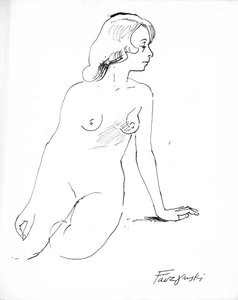
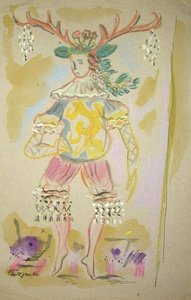
While his architectural achievements provided a structural legacy, his graphic works offered a window into his emotional landscape. Faczynski’s artistry was remarkably diverse, ranging from the delicate precision of monochrome sketches to the raw, emotive power of watercolor and ink. In pieces such as Manor House, one observes a captivating, almost nostalgic exploration of historical themes through impressionistic detail. Conversely, his more experimental works reveal a fascination with the psychological depths of the human condition. His haunting watercolor, Man With A Cigarette, utilizes expressive distortion and vibrant color to evoke profound feelings of isolation and vulnerability, bordering on the realms of Surrealism. Similarly, his ink drawings, such as the Reclining Woman, utilize the dynamic, fragmented lines of Abstract Expressionism to capture raw emotion. Through these varied mediums, Faczynski remained a lifelong witness to the beauty and the turbulence of the world, leaving behind a body of work that continues to resonate with historical depth and artistic brilliance.