The Visionary of Shadows and Light: The Life of Ion Alin Gheorghiu
In the quiet, evocative realms of Romanian modernism, few names resonate with as much profound tension and poetic grace as Ion Alin Gheorghiu. Born in Bucharest on September 29, 1929, Gheorghiu emerged from a period of immense historical upheaval, navigating a world caught between the rigid ideological constraints of Soviet-influenced Socialist Realism and an unyielding personal desire for formalist expression. His journey was not merely one of artistic evolution, but a courageous struggle for creative autonomy. As a painter and sculptor, he possessed the rare ability to transform the mundane into the monumental, turning simple objects into vessels of deep, symbolic resonance.
Gheorghiu’s artistic foundation was laid at the Institute of Fine Arts ‘Nicolae Grigorescu,’ where he studied under the legendary Camil Ressu. This mentorship provided him with a rigorous command of classical aesthetics, yet it also planted the seeds of rebellion. His academic path was famously interrupted when his final degree piece, “Creanga si Eminescu la Iasi,” was deemed politically unacceptable by the establishment due to its perceived nationalist and formalist tendencies. This rejection forced Gheorghiu into a period of profound hardship; for years, he lived without a studio, sustaining himself through manual labor at train stations. Yet, it was within this crucible of isolation that his unique voice began to crystallize, far removed from the state-mandated narratives of his era.
A Symphony of Form and Symbolism
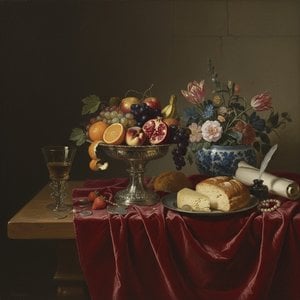
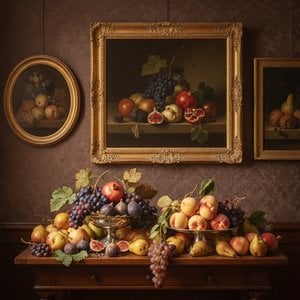
As the political climate in Romania shifted following the withdrawal of the Red Army in 1958, Gheorghiu’s work finally found its way into the light of national and international exhibitions. His mature style became a captivating dialogue between abstraction and figuration, where the boundaries of reality seemed to dissolve into texture and emotion. He was a master of the still life, but his compositions were never merely observational; they were psychological landscapes. In works such as Still Life with Mandolin and Scissors, he invites the viewer into an intimate, twilight world where deep, resonant crimsons and heavy shadows create a sense of timelessness.
The brilliance of Gheorghiu’s technique lies in his tactile manipulation of light and medium. He utilized deliberate brushwork to imbue surfaces with a physical presence, making the cold metal of scissors or the curved wood of a mandolin feel almost tangible. His art often explored the following thematic dualities:
- Creation and Destruction: The juxtaposition of musical instruments representing harmony against utilitarian tools suggesting severance.
- Memory and Presence: Using layered textures, such as the ghostly appearance of sheet music, to evoke a sense of history and lost melodies.
- Light and Shadow: A sophisticated use of chiaroscuro to guide the eye through complex, rhythmic compositions.
Legacy and Historical Significance
Beyond the canvas, Gheorghiu’s contribution to the sculptural arts added another dimension to his multifaceted genius. His ability to navigate the complexities of the Soviet era—maintaining an international presence despite censorship—marks him as a pivotal figure in the history of Eastern European abstraction. He did not merely exist within his time; he resisted it, using the language of myth and abstraction to preserve a sense of individual truth.
Today, Ion Alin Gheorghiu is remembered not just as a Romanian master, but as a visionary who found beauty in the intersection of silence and sound, precision and chaos. His legacy remains etched in the vibrant textures of his paintings, serving as a testament to the enduring power of the human spirit to find light even in the most shadowed historical epochs. Through his work, the ephemeral echoes of the past are made permanent, inviting every generation to rediscover the profound poetry hidden within the everyday.