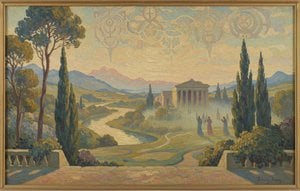
A Toulouse Son: The Life and Art of Henri Jean Guillaume Martin
Henri Jean Guillaume Martin, born in the heart of Toulouse on August 5th, 1860, emerged as a pivotal figure in the transition from Impressionism to Symbolism and early Pointillism. His story is one of artistic conviction, nurtured by a supportive yet initially hesitant father—a cabinet maker who eventually yielded to his son’s fervent desire to paint. This early encouragement proved foundational, setting Martin on a path that would lead him through rigorous academic training and ultimately, to the embrace of innovative techniques and a deeply personal artistic vision. He began his formal studies at the Toulouse School of Fine Arts under Jules Garipuy in 1877, laying the groundwork for his future explorations. A scholarship then propelled him to Paris, where he honed his skills within Jean-Paul Laurens’ studio, absorbing diverse influences that would shape his unique style. Martin wasn't merely a student of technique; he was an observer of light, color, and the subtle nuances of human emotion—qualities that would become hallmarks of his mature work.From Academic Roots to Luminous Landscapes
Martin’s artistic journey wasn’t one of immediate rebellion against established norms. He initially excelled within the academic system, earning recognition at the Paris Salon in 1886 and securing a coveted scholarship for an Italian tour in 1887. This sojourn proved transformative. Immersed in the works of Renaissance masters like Giotto and Masaccio, he developed a profound appreciation for composition, form, and the expressive power of color. However, Italy also sparked a shift towards a more luminous palette and a fascination with capturing fleeting moments of light—influences that would gradually distance him from strict academic conventions. His 1889 canvas submission to the Salon garnered significant acclaim, earning him a gold medal for work described as Pointillist, signaling his embrace of this innovative technique. This wasn’t simply an adoption of style; Martin infused Pointillism with his own sensibility, using it not merely as a scientific exercise but as a means to evoke atmosphere and emotion. He became increasingly associated with the Symbolist painter Puvis de Chavannes, whose emphasis on idealized forms and allegorical themes resonated deeply with Martin's evolving aesthetic.A Master of Light and Atmosphere
Martin’s mature work is characterized by a remarkable ability to capture the essence of light and atmosphere. His landscapes, particularly those depicting Brittany and Collioure, are bathed in a radiant glow, evoking a sense of tranquility and poetic reverie. He wasn't interested in merely replicating nature; he sought to convey its emotional impact—the feeling of warmth on the skin, the scent of salt air, the stillness of a summer afternoon. His technique, while rooted in Pointillism, evolved into something more fluid and expressive. He employed small, carefully placed brushstrokes of vibrant color, allowing them to blend optically and create shimmering effects of light and shadow. This approach lent his paintings a unique luminosity and depth, drawing viewers into the scenes he depicted. Beyond landscapes, Martin also excelled at portraiture and allegorical compositions, often imbuing his subjects with a sense of melancholy and mystery. His friendship with Auguste Rodin further enriched his artistic sensibility, fostering an appreciation for form and emotional intensity.Recognition and Legacy
Throughout his career, Henri Jean Guillaume Martin received numerous accolades, culminating in the Grand Prize at the 1900 World Fair and election to the Académie des Beaux-Arts in 1917. These honors acknowledged not only his technical skill but also his significant contribution to French art. He undertook important public commissions, decorating spaces such as the Salle de l'Assemblée générale in the Palais-Royal, the Élysée Palace, and the Sorbonne—leaving an indelible mark on Parisian landmarks. Seeking respite from the bustling city, Martin eventually settled at the Domaine de Marquayrol near Cahors, where he continued to paint until his death in 1943. This tranquil environment allowed him to fully immerse himself in his art, producing some of his most celebrated works. His legacy extends beyond his paintings; he was also a dedicated teacher, mentoring the American painter Nellie Ellen Shepherd and inspiring generations of artists with his innovative techniques and poetic vision.A Lasting Influence
Henri Jean Guillaume Martin occupies a unique position in art history, bridging the gap between Impressionism and Symbolism while forging his own distinctive path. He wasn’t simply a follower of trends; he was an innovator who synthesized diverse influences into a cohesive and deeply personal style. His mastery of light, color, and atmosphere, combined with his ability to evoke emotion and create a sense of poetic reverie, continues to captivate audiences today. Martin's work serves as a reminder that true artistry lies not in adhering to rigid rules but in expressing one’s unique vision with passion and conviction. His paintings are more than just depictions of landscapes or portraits; they are windows into the soul—invitations to contemplate the beauty and mystery of the world around us.Soru & Cevap
Henri Martin hangi akımlarda çalıştı?
Henri Martin tarafından çalışılan akımlar, eserleri akımlara göre gruplandıran sanatçının Tüm Akımlar sayfasında görülebilir.
Henri Martin adlı sanatçının eserlerini anahtar kelimelere göre keşfedebilir miyim?
Henri Martin tarafından üretilen eserleri belirli bir temada bulmak için, sanat eserlerini anahtar kelimelere göre gruplandıran Henri Martin'in Anahtar Kelimelere Göre sayfasını kullanabilirsiniz.
Henri Martin tarafından üretilen tüm eserleri nerede görebilirim?
bu web sitesi üzerindeki Henri Martin imzalı tüm eserlere sanatçının Tüm Eserler sayfasından göz atabilirsiniz.