Giuseppe Recco: A Master of Still Life’s Delicate Drama
Giuseppe Recco (1634 – 29 May 1695) stands as a pivotal figure in the Baroque art landscape, particularly renowned for his exquisitely rendered still lifes that captured the essence of both opulent feasts and poignant meditations on mortality. Born in Naples, Italy—a city brimming with artistic fervor during its golden age—Recco’s lineage steeped him in a tradition of painting. His father, Giacomo Recco, and uncle, Giovanni Battista Recco, established a family legacy dedicated to portraying the natural world with unparalleled precision and emotional depth. This formative environment undoubtedly instilled within him an appreciation for meticulous observation and masterful technique, shaping his artistic trajectory throughout his life.
While precise biographical details of his early years remain scarce, evidence suggests that Recco apprenticed under his family members, absorbing the stylistic sensibilities of Naples’s most prominent painters. A profound connection to Giovanni Battista Ruoppolo significantly influenced his approach to composition and color palette, guiding him toward a style that balanced grandeur with intimate detail. His career eventually unfolded across borders, notably in Spain during the reign of Philip IV. There, he gained considerable acclaim for his captivating assemblies of foodstuffs—fruits, vegetables, and meats—alongside decorative floral arrangements. These commissions were often undertaken for aristocratic patrons eager to showcase their wealth and sophistication, reflecting the prevailing tastes of an era that found beauty in both abundance and decay.
The Artistry of Light and Texture
Recco’s distinctive style was characterized by a luminous chiaroscuro—the dramatic interplay of light and shadow—which became a hallmark of his Baroque mastery. He achieved remarkable realism through the painstaking layering of glazes and meticulous attention to detail, capturing textures and nuances with breathtaking accuracy. Whether depicting the iridescent scales of a fish or the velvety petals of a tulip, his canvases pulsated with life, conveying not merely visual beauty but also a deep psychological resonance.
His technical prowess allowed him to explore various thematic depths within the still life genre:
- Vanitas and Mortality: In works such as Still life with fishes, Recco utilized the imagery of decaying organic matter to serve as a powerful meditation on the fleeting nature of life, a common theme in the Dutch Golden Age influence.
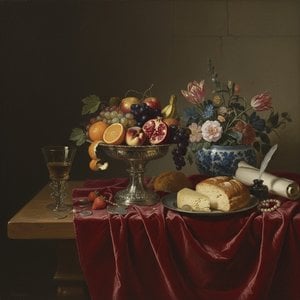
- Sensory Opulence: Through masterpieces like Still-life with the Five Senses, he celebrated the richness of the physical world, using vibrant tulips and opulent pastries to engage the viewer's senses.
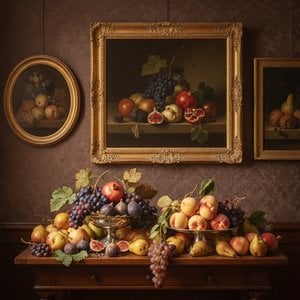
- Natural Abundance: His ability to render Still-Life with Fruit and Flowers showcased a dramatic display of color and texture that captured the very essence of 17th-century Italian artistry.
Legacy and Historical Significance
The historical significance of Giuseppe Recco lies in his ability to elevate the still life from a mere decorative genre to a profound narrative medium. By blending the lushness of Neapolitan tradition with the dramatic tension of the Baroque, he created works that functioned as both celebrations of prosperity and reminders of time's inevitable passage. His influence resonated through the decades, leaving behind an oeuvre that continues to captivate collectors and historians alike. Today, his paintings remain iconic symbols of a period where art sought to find the divine within the tangible, making him a true master of the delicate drama found in the natural world.
Soru & Cevap
Giuseppe Recco sanatçısının sanat akımlarına göre gruplandırılmış eserlerine nereden ulaşabilirim?
Giuseppe Recco eserlerine, sanatçının Tüm Akımlar sayfasından akımlara göre göz atabilirsiniz.
Giuseppe Recco eserlerinden oluşan sanal bir müzeyi ziyaret edebilir miyim?
Sanal bir ziyaret mümkün: Giuseppe Recco sanatçısının 3B Müze sayfası, sanatçının eserlerini üç boyutlu bir galeride sunuyor.
Giuseppe Recco sanatçısının doğum yeri ve yılı nedir?
Giuseppe Recco, 1634 yılında Naples şehrinde doğdu.