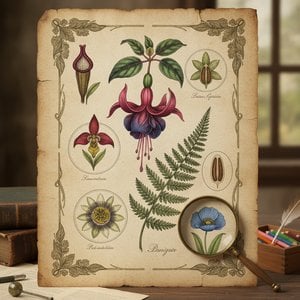
A Pioneer Forged in Flora: The Life and Legacy of Elizabeth Blackwell
Elizabeth Blackwell, born around 1707 in Aberdeen, Scotland, was a remarkable figure who defied the conventions of her time to become a celebrated botanical illustrator. Her story is one of artistic dedication, entrepreneurial spirit, and resilience in the face of considerable hardship. While often overshadowed by later figures like Maria Sibylla Merian, Blackwell occupies a crucial position as one of the earliest women to achieve recognition for scientific illustration – a field historically dominated by men. Her father, Leonard Simpson, was an artist himself, providing Elizabeth with foundational training that would prove invaluable. This early exposure nurtured not only her artistic skill but also instilled in her a deep appreciation for the natural world, setting the stage for her future endeavors. Marriage to Alexander Blackwell, a Scottish doctor and economist, initially seemed a partnership of shared intellectual pursuits, yet it soon became intertwined with financial instability and personal trials that would ultimately define much of her life’s work.
The Genesis of ‘A Curious Herbal’
The creation of A Curious Herbal, published in installments between 1737 and 1739, was born not from scholarly ambition but from necessity. Alexander Blackwell's imprudence led to mounting debts and a period of imprisonment. Facing dire circumstances, Elizabeth conceived the ambitious project of illustrating an herbal – a compendium of plants and their medicinal properties – as a means of securing her family’s livelihood and freeing her husband. This was no small undertaking; existing herbals were often outdated or lacked accurate depictions. Elizabeth recognized a need for a comprehensive guide showcasing exotic plants from across the globe, particularly those newly discovered in the Americas. The work wasn't solely hers, however. While Elizabeth provided all 500 meticulously rendered illustrations and engraved the copper plates herself – an extraordinary feat of technical skill – Alexander contributed the botanical descriptions, drawing upon his medical background even while incarcerated. Crucially, recognizing her own lack of formal botanical training, Blackwell sought guidance from Isaac Rand, the curator of Chelsea Physick Garden in London. She relocated near the garden to directly observe and draw plants from life, ensuring accuracy and detail in her depictions.
Artistic Technique and Scientific Precision
Blackwell’s illustrations are distinguished by their remarkable precision and aesthetic quality. Each plate demonstrates a keen eye for botanical detail, capturing not only the overall form of the plant but also the intricate textures of leaves, petals, and stems. Her technique involved a painstaking process: first creating detailed drawings, then transferring them to copper plates which she engraved herself – an exceptionally demanding task requiring both artistic talent and technical expertise. The resulting engravings were then carefully hand-colored, adding another layer of artistry and realism. This complete control over the entire production process—from initial sketch to finished print—was unusual for the time and speaks volumes about Blackwell’s dedication and skill. A Curious Herbal wasn't merely a collection of pretty pictures; it was intended as a practical reference guide for physicians and apothecaries, demanding scientific accuracy alongside artistic merit. The plants were depicted with enough detail to allow for confident identification, making the herbal a valuable resource in an era when access to botanical knowledge was limited.
A Life Marked by Resilience and Recognition
The success of A Curious Herbal, though modest, did provide the financial means to secure Alexander’s release from prison. However, their fortunes continued to fluctuate. Alexander eventually left his family for Sweden, where he briefly served as court physician to Frederick I before becoming embroiled in a conspiracy and facing execution in 1747. Elizabeth remained steadfastly loyal throughout these tumultuous events. She followed him to Sweden, engaging in agricultural experiments – breeding horses and sheep, managing dairy operations – demonstrating her adaptability and resourcefulness. Despite the personal tragedies she endured, Blackwell continued to pursue her interests, leaving a lasting mark on the field of botanical illustration. A genus of plants, Blackwellia, was named in her honor, a testament to her contribution to botanical knowledge. Elizabeth Blackwell died in 1758 and was buried at All Saints Church in Chelsea, London. Today, her work is recognized as a “classic of botanical illustration,” accessible online through institutions like the British Library, ensuring that her legacy continues to inspire artists and scientists alike. Her story serves as a powerful reminder of the often-overlooked contributions of women to scientific advancement during the 18th century.