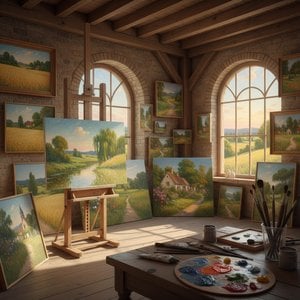
Agnes Beverly Burton: A Rural Visionary of the Early 20th Century
Agnes Beverly Burton (1892-1967) remains a quietly significant figure in British art, an artist whose evocative landscapes and intimate portraits capture the essence of rural England during a period of profound social and technological change. Born in Monmouthshire, Wales, her artistic journey unfolded largely outside the established circles of London’s avant-garde, resulting in a distinctive style deeply rooted in observation and a nuanced understanding of the lives she depicted. Burton's work offers a poignant glimpse into a vanishing world – the rhythms of agricultural life, the weathered beauty of vernacular architecture, and the quiet dignity of its inhabitants.
Early Life and Artistic Beginnings
Born in 1892, Agnes Beverly Burton’s early life was shaped by her family's connection to the land. Her father, a farmer, instilled in her a deep appreciation for the natural world and the practical skills of rural existence. While formal artistic training remained elusive – she never attended an art school – Burton possessed a keen eye for detail and a natural talent for rendering light and shadow. She began painting seriously around 1920, initially producing watercolors that focused on scenes from her family’s farm in Monmouthshire. These early works demonstrate a remarkable sensitivity to color and texture, foreshadowing the distinctive qualities of her later paintings.
A Distinctive Style: Rural Realism with Impressionistic Touches
Burton's artistic style is often described as a blend of rural realism and impressionistic technique. Unlike many contemporary artists who sought to capture grand, sweeping vistas, Burton focused on the intimate details of everyday life in the countryside. Her paintings are characterized by a meticulous attention to detail – from the weathered bark of trees to the folds of a farmer’s clothing – yet they are imbued with a sense of atmosphere and fleeting light. She employed loose brushstrokes and vibrant color palettes reminiscent of Impressionism, particularly capturing the effects of sunlight on fields and buildings. Her use of color was notably restrained, favoring earthy tones and muted greens and blues to create a sense of quiet harmony.
- Subject Matter: Primarily rural landscapes – farms, fields, hedgerows, and small villages.
- Technique: Loose brushwork, layered glazes, emphasis on light and shadow.
- Color Palette: Earthy tones, muted greens, blues, and ochres.
- Composition: Often featuring figures within the landscape, emphasizing their connection to the land.
Key Works and Notable Achievements
Among Burton’s most celebrated works are “Cacti,” a remarkably detailed depiction of succulents in a terracotta pot, showcasing her ability to render texture with precision; "Tudor Street," which captures the charm of a small English village street; and, perhaps most powerfully, her self-portraits. These paintings offer intimate glimpses into her personality and artistic process. Her work was exhibited sporadically throughout her career, primarily in Wales and England, but she never achieved widespread recognition during her lifetime. However, in recent decades, Burton’s art has gained increasing attention from scholars and collectors, recognized for its quiet beauty and understated emotional depth.
Legacy and Historical Significance
Agnes Beverly Burton's legacy lies not in grand exhibitions or critical acclaim, but rather in the enduring quality of her paintings. She represents a vital voice within British art—a witness to a disappearing way of life. Her work speaks to the importance of observation, the beauty of the everyday, and the profound connection between people and their environment. Burton’s dedication to capturing the authentic spirit of rural England makes her an important figure in understanding the social and artistic landscape of early 20th-century Britain. Her paintings continue to resonate with viewers today, offering a poignant reminder of a time when life moved at a slower pace and the rhythms of nature held sway.
Soru & Cevap
Agnes Beverley Burton adlı sanatçıya ait incelemek için kaç adet sanat eseri mevcut?
Tüm Eserler sayfasında Agnes Beverley Burton imzalı 6 sanat eseri eseri inceleyebilirsiniz.
Agnes Beverley Burton hangi tarihi dönemde eser vermiştir?
Agnes Beverley Burton, Modern döneminde çalışmalarını sürdürmüştür. Bu dönem, sanatçının faaliyetlerini tarihsel bir bağlama oturtur.
Agnes Beverley Burton’in kariyeri dönemlere nasıl ayrılıyor?
Agnes Beverley Burton sanatçısının Kronoloji sayfası, sanatçının eserlerini kariyer dönemlerine göre gruplandırılmış bölümler halinde kronolojik sırayla sunan, kaydırmaya duyarlı bir zaman çizelgesidir.