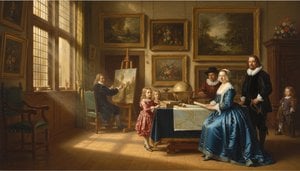
Johannes Vermeer’s Illusion: A Trompe l'Oeil of an Etching by Ferdinand Bol
Johannes Vermeer, that enigmatic master of Delft, rarely offered the viewer a direct gaze into his world. Instead, he meticulously constructed scenes of domestic tranquility, imbued with an almost unbearable stillness and a profound sense of light. Among his remarkably small oeuvre, “Trompe l’Oeil of an Etching by Ferdinand Bol” stands as a particularly captivating example of this approach – not merely a painting, but a carefully orchestrated illusion. Completed around 1675, this work transcends the boundaries of simple representation, inviting us to step into a meticulously crafted space where reality and artifice blur seamlessly.
At first glance, the composition appears deceptively straightforward: a wooden panel bearing an etching by the esteemed Ferdinand Bol. The etching itself depicts an older gentleman, his face etched with wisdom and lined with time, seated in contemplative repose. He wears a wide-brimmed hat, a heavy coat, and a prominent cross hanging from a chain around his neck – symbols laden with religious significance and hinting at a life lived within the confines of faith. However, Vermeer’s genius lies not in replicating Bol's etching faithfully, but in transforming it into an integral element of the painting itself. The paper of the print is rendered with astonishing detail: the subtle crinkles, the delicate creases, even the slight imperfections that betray its handmade nature are meticulously captured. The knot within the wooden panel, a seemingly insignificant detail, is treated with equal care, adding to the illusion of tactile reality.
The Artist’s Technique: Vermeer's Mastery of Illusion
Vermeer wasn’t simply aiming for visual accuracy; he sought to elevate painting beyond mere imitation. He achieved this remarkable feat through a masterful application of *trompe l'oeil*, a technique that derives its name from the French phrase “to deceive the eye.” This ambitious approach demanded an unparalleled level of skill and patience. Vermeer would have begun by preparing the wooden panel with multiple coats of gesso – finely powdered plaster mixed with pigment – creating a flawlessly smooth surface for subsequent layers of paint.
Crucially, he employed *glazing*, applying thin washes of translucent color over previous layers to build up depth and luminosity. This painstaking process allowed him to capture the subtle nuances of light and shadow, imbuing the scene with an ethereal glow that defies conventional representation. Unlike many artists of his time who favored bold brushstrokes, Vermeer’s style was characterized by remarkable delicacy – a testament to his unwavering dedication to achieving maximum visual impact.
Historical Context: Trompe l'Oeil in Delft
The practice of *trompe l'oeil* flourished during the Dutch Golden Age (roughly 1650-1700), reflecting a broader fascination with illusion and perspective. Artists like Bol actively explored innovative techniques to challenge viewers’ perceptions, pushing the boundaries of artistic convention. Vermeer’s decision to incorporate Bol’s etching into his painting wasn't merely stylistic; it served as a subtle nod to the intellectual currents of the era – a demonstration that art could engage in dialogue with other disciplines.
Furthermore, the inclusion of the etching speaks to Delft’s prominent role as a center for printmaking. Bol was one of the most celebrated engravers of his time, and Vermeer's embrace of this medium underscores the interconnectedness of artistic traditions during this period of unprecedented cultural dynamism.
Symbolism and Emotional Resonance: Contemplation and Faith
Beyond its technical brilliance, “Trompe l’Oeil” resonates with profound emotional depth. The elderly gentleman depicted in Bol's etching embodies wisdom gained through experience and the quiet contemplation that accompanies a life devoted to faith. The wide-brimmed hat and heavy coat symbolize status and protection, while the cross hanging from his neck serves as a poignant reminder of mortality – yet also offers solace in the belief of an afterlife.
Vermeer’s masterful rendering of this scene invites viewers to pause and consider these weighty themes. The subdued palette—muted browns, creams, and reds—mirrors the tones of aged paper and wood, reinforcing the illusion of authenticity and enhancing the painting's contemplative atmosphere. It’s a testament to Vermeer’s ability to transform visual artistry into an experience that transcends mere observation.
Order your hand painted museum quality oil reproduction today. We'll paint any painting from any image in any size. Visit our Showcase to see more of our work and place your order today.



 Önizleme yap
 Switch to Print
 Paylaş
 Paylaş
 Detayları Gör

 İndir
İndir
 Benzerlerini gör
 X-Işını
 Slayt Gösterisi
 Stats
Stats


 Tümünü Gör






































 Cam seçeneği yalnızca 110 cm altındaki boyutlar için mevcuttur.