The Chess: A Fragmented World of Analytical Cubism
Pablo Picasso’s “The Chess” – painted in 1911 during his intensely focused period of Analytical Cubism – isn't merely a depiction of a game; it’s a radical exploration of perception and representation. This work, housed within the collection of The Metropolitan Museum of Art, invites us into a world where form dictates function, and reality is broken down into its most fundamental geometric components. It’s a testament to Picasso’s groundbreaking approach to painting, one that irrevocably altered the course of modern art.
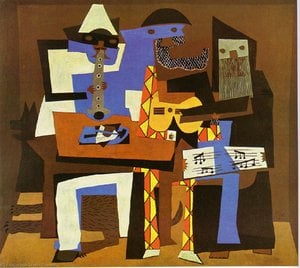
At first glance, the scene appears deceptively simple: a man seated at a table, engaged in a game of chess. However, upon closer inspection, the familiar elements are fractured and rearranged. The table itself isn’t presented as a solid plane but rather as a collection of interlocking planes, each rendered in shades of gray and brown. Similarly, the chair, the cup, and even the man himself are dissected into a multitude of angular shards, suggesting multiple viewpoints simultaneously. This deliberate fragmentation is characteristic of Analytical Cubism – Picasso's attempt to capture not just what an object *looks* like, but how it *appears* from various angles at once.
The Influence of Paul Cézanne and the Birth of Analytical Cubism
Picasso’s shift towards Analytical Cubism was profoundly influenced by the late works of Paul Cézanne. As art historian Malcolm Gee notes, Picasso was captivated by Cézanne's emphasis on geometric forms and his exploration of multiple perspectives within a single composition. Cézanne’s influence is particularly evident in “The Chess,” where Picasso seems to be attempting to distill the essence of an object – its underlying structure – rather than simply reproducing its surface appearance. This period, roughly 1909-1912, saw Picasso moving away from the brighter colors and more expressive brushstrokes of his earlier works towards a more restrained palette and a meticulous attention to detail.
The painting’s monochromatic color scheme – primarily grays, browns, and blacks – further emphasizes this analytical approach. Color is used sparingly, serving primarily to delineate the various planes and shapes that comprise the scene. The lack of vibrant hues forces the viewer to focus on the underlying structure of the composition, encouraging a deeper engagement with the artwork’s intellectual complexity.
Symbolism and the Fragmented Self
Beyond its purely formal qualities, “The Chess” is rich in symbolic potential. The game itself – a metaphor for strategic thinking and decision-making – suggests a contemplation of life's complexities. The fragmented figures can be interpreted as representing the fractured nature of modern experience, reflecting the anxieties and uncertainties of the early 20th century. Some art historians have suggested that the chess pieces themselves represent different aspects of the self, each viewed from a unique perspective.
Furthermore, the inclusion of multiple cups scattered throughout the scene adds to the painting’s sense of disorientation and ambiguity. They could symbolize fleeting moments, distractions, or perhaps even the fragmented memories that shape our perception of reality. The overall effect is one of intellectual stimulation and emotional resonance – a challenge to the viewer to actively participate in the creation of meaning.
A Legacy of Innovation
“The Chess” stands as a pivotal work in the history of art, marking a crucial transition from Post-Impressionism to Cubism. It exemplifies Picasso’s relentless experimentation and his willingness to challenge conventional notions of representation. His exploration of multiple perspectives, fragmented forms, and monochromatic color palettes paved the way for subsequent developments in abstract art and influenced generations of artists. The painting's impact extends far beyond its own aesthetic qualities, solidifying Picasso’s position as one of the most influential figures in modern art.
WahooArt offers meticulously crafted, hand-painted oil reproduction reproductions of “The Chess,” allowing you to experience this masterpiece in stunning detail and quality. Explore our collection today and bring a piece of Cubist history into your home or office.



 Tabloyu Sipariş Et
 Paylaş
 Paylaş
 Detaylar

 İndir
İndir
 Benzerlerini gör
 X-Işını
 Slayt Gösterisi


 Tümünü Gör






































 Cam seçeneği yalnızca 110 cm altındaki boyutlar için mevcuttur.