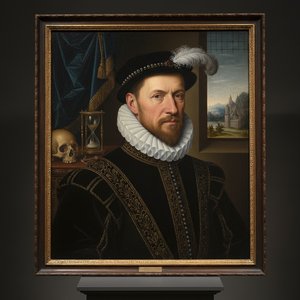
Hans Holbein the Younger’s *The Ambassadors*: A Portrait of Ambition and Mortality
Hans Holbein the Younger's 1533 masterpiece, *The Ambassadors*, isn't merely a portrait; it’s a meticulously constructed microcosm of Renaissance thought, a visual testament to the anxieties and intellectual fervor of its time. Within its richly detailed confines lies a complex allegory – a conversation between earthly ambition and spiritual contemplation, a meditation on the fleeting nature of life itself. The painting, currently residing in the National Gallery, London, continues to exert a powerful pull on viewers, inviting us to decipher its layers of symbolism and marvel at Holbein’s unparalleled technical skill.
The scene unfolds with an arresting immediacy. Jean de Dinteville, French ambassador, stands confidently beside Georges de Selve, Bishop of Lavaur, their postures radiating authority and purpose. They are presented not as isolated individuals but as representatives of a burgeoning era – the Renaissance – characterized by a renewed interest in classical learning, scientific inquiry, and diplomatic exchange. The opulent fabrics of their clothing—Dinteville’s rich silks and de Selve's clerical robes—immediately establish their status and roles within the complex political landscape of 16th-century Europe. The direct gaze of each man, unflinching and assured, commands attention, yet a subtle tension underlies their composure, hinting at the precariousness of power and the ever-present threat of conflict.
A Renaissance Tableau: Detail and Technique
Holbein’s mastery is immediately apparent in the astonishing level of detail rendered within the painting. It's not simply *painted*; it’s sculpted with light and shadow, meticulously crafted to create a sense of tangible reality. The textures—the velvet of Dinteville’s garments, the polished surfaces of the scientific instruments, the intricate patterns woven into the Turkish carpet—are rendered with breathtaking realism. This meticulous approach is characteristic of Northern Renaissance painting, where precise observation and detailed representation were highly valued. Holbein's ability to capture likeness was legendary; he wasn't simply *painting* people, but capturing their very essence – a skill that earned him commissions from some of Europe’s most powerful figures.
The use of oil paint allows for subtle gradations of color and light, creating a sense of depth and dimensionality that draws the viewer into the scene. The composition itself is carefully balanced, with the figures occupying a central space within a richly textured environment. Notice the careful perspective—the receding lines of the table, the diminishing size of the objects as they recede into the background – all contributing to the illusion of three-dimensionality. This technical virtuosity elevates *The Ambassadors* beyond a mere portrait; it’s a testament to Holbein's profound understanding of artistic principles and his ability to translate them into a visually stunning work.
Decoding the Symbols: A Language of Meaning
Beyond its formal qualities, *The Ambassadors* is laden with symbolism – a veritable encyclopedia of Renaissance iconography. The objects on the table are not randomly placed; each one carries a specific meaning, contributing to the painting’s complex narrative. Globes (celestial and terrestrial) represent exploration and geographical knowledge—a reflection of the era's burgeoning interest in cartography and navigation. Mathematical instruments symbolize scientific advancement – astrolabes, quadrants, and other devices used for measuring angles and calculating distances. Books allude to humanist learning, representing the rediscovery of classical texts and the rise of secular education.
However, not all symbols are celebratory. A broken lute string signifies discord, perhaps reflecting the religious and political tensions of the time – specifically the fracturing of Christendom due to the Reformation. The hymnbook open to a Lutheran text further emphasizes this point. Even the partially peeled lemon is symbolic, representing transience and decay—a poignant reminder of mortality (*memento mori*). The careful arrangement of these objects creates a visual dialogue, prompting viewers to contemplate the complex relationship between knowledge, power, and death.
A Timeless Reflection: Mortality and Ambition
At the heart of *The Ambassadors* lies a profound meditation on mortality. The most striking element of the painting is undoubtedly the distorted skull floating in the foreground, rendered using an anamorphic technique – an optical illusion that requires the viewer to approach the painting from a specific angle to perceive its true form. This unsettling image serves as a stark reminder of human frailty and the inevitability of death—a *memento mori* that cuts across the display of worldly power and intellectual achievement. The presence of this skull subtly undermines the ambassadors’ confidence, reminding us that even in the midst of great knowledge and ambition, death remains an inescapable reality.
*The Ambassadors* continues to resonate with viewers today because it speaks to universal themes: the pursuit of knowledge, the exercise of power, and the inevitability of mortality. A reproduction of this iconic work will bring a touch of Renaissance grandeur and intellectual depth to any space, sparking conversation and inspiring reflection.



 Önizleme yap
 Baskı Moduna Geç
 Paylaş
 Paylaş
 Detayları Gör

 İndir
İndir
 Benzerlerini gör
 X-Işını
 Slayt Gösterisi
 İstatistikler

 Tümünü Gör






































 Cam seçeneği yalnızca 110 cm altındaki boyutlar için mevcuttur.


![Jean De Dinteville Ve Georges De Selve'nin Çift Portresi (diğer Adıyla Elçiler) [detay] — Hans Holbien, Kuzey Rönesansı](/media/artworks/images-thumb/42/81/42813dc49b2f72bce897aaf8b747ad5b.jpg)