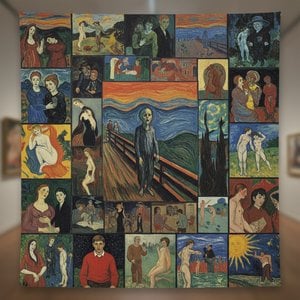
A Symphony of Sunset and Sorrow: Exploring Edvard Munch’s Untitled (2455)
Edvard Munch's *Untitled (2450)*, a captivating depiction of the Norwegian coastline at twilight, transcends mere landscape painting; it embodies the profound emotional resonance characteristic of Munch’s oeuvre. Painted in 1893, this artwork stands as a testament to his masterful ability to translate psychological turmoil into visual form—a skill honed by personal experiences that profoundly shaped his artistic vision. The scene unfolds with quiet grandeur: a vast expanse of ocean bathed in the fiery hues of a setting sun, dominating the canvas with its dominant crimson and orange tones. Two figures lie languidly upon the beach, seemingly undisturbed by the melancholic beauty surrounding them—a deliberate juxtaposition designed to heighten the painting’s emotional impact. Scattered rocks punctuate the shoreline, grounding the composition while simultaneously emphasizing the vulnerability inherent in confronting nature's majesty.
- Style: Expressionism – Munch’s approach eschews realistic representation, prioritizing instead the conveyance of inner feelings and sensations.
- Technique: Oil on canvas—Munch employed a technique known for its layering and blending, creating textures that contribute to the painting's palpable atmosphere. He utilized thin washes of color combined with thicker impasto strokes, particularly in the depiction of the rocks and sky, to imbue the artwork with dynamism.
The inclusion of a solitary bird soaring above the ocean is not merely decorative; it serves as a powerful symbol of freedom and aspiration against the backdrop of impending darkness. This element speaks to Munch’s preoccupation with themes of existential anxiety—the bird represents hope amidst despair, mirroring the artist's own struggles for solace and meaning in life. Furthermore, the color palette itself – predominantly reds and oranges – is laden with symbolic significance. Red, traditionally associated with passion, anger, and primal instinct, underscores the underlying emotional intensity of the scene. Simultaneously, it evokes associations with blood—a recurring motif in Munch’s work reflecting his fascination with mortality and suffering.
Historical Context: Painted during Munch's formative years as an artist, *Untitled (2450)* reflects the broader anxieties prevalent in European art circles at the time. Expressionism emerged as a reaction against Impressionism’s focus on objective observation, asserting instead that art should grapple with subjective experience and psychological states—a stance perfectly aligned with Munch’s artistic philosophy. The painting anticipates the stylistic developments of later Expressionist artists like Ernst Ludwig Kirchner and Emil Nolde, establishing Munch as a pioneer in exploring the darker recesses of human consciousness.
- Emotional Impact: *Untitled (2450)* compels viewers to confront uncomfortable truths about existence—the inevitability of loss, the fragility of joy, and the pervasive presence of fear. Its haunting beauty derives precisely from its ability to evoke a visceral response, prompting contemplation on themes of solitude and vulnerability.
- Interior Design Inspiration: Consider incorporating muted reds and oranges into your interior spaces to capture a similar mood—one that balances serenity with subtle hints of melancholy. The textured surface achieved through Munch’s technique can be replicated in fabrics or wall coverings, adding depth and visual interest.
Ultimately, Edvard Munch's *Untitled (2450)* remains an enduring masterpiece not simply for its aesthetic qualities but for its profound articulation of the human condition. It invites us to gaze upon a landscape imbued with sorrow—a poignant reminder that beauty can coexist with pain and that art possesses the capacity to illuminate the complexities of our inner lives. Reproductions of this artwork offer a remarkable opportunity to experience firsthand the emotional power of Munch’s visionary style.



 Tabloyu Sipariş Et
 Paylaş
 Paylaş
 Detaylar

 İndir
İndir
 Benzerlerini gör
 X-Işını
 Slayt Gösterisi
 Tümünü Gör






































 Cam seçeneği yalnızca 110 cm altındaki boyutlar için mevcuttur.