A Life Bridging Diplomacy, Commerce, and Artistic Vision
William Wyld, born in London in 1806, embodies a fascinating intersection of worlds – the refined circles of diplomacy, the bustling energy of commerce, and ultimately, the captivating realm of art. His journey was not one of immediate artistic dedication, but rather a gradual unfolding of passion nurtured by circumstance and opportunity. Inheriting drawing materials at the tender age of six following a family tragedy sparked an early inclination towards visual expression, yet his path initially led him away from formal training. Following his father’s death, connections secured Wyld a position as secretary to the British Consulate in Calais, immersing him in European culture and political landscapes. This formative period proved crucial, exposing him not only to international affairs but also to artistic influences that would shape his future style. It was in Calais that he came under the tutelage of François Louis Thomas Francia, a watercolourist deeply influenced by masters like Thomas Girtin and Richard Parkes Bonington – a mentorship that laid the groundwork for Wyld’s own distinctive approach.Early Influences and Artistic Beginnings
Wyld's formative years in Calais instilled within him an appreciation for meticulous observation and atmospheric rendering—skills honed under Francia’s guidance. The landscapes of Northern France, particularly those depicted by Bonington and Girtin, served as a powerful stimulus to his burgeoning artistic sensibilities. These masters championed the watercolor medium, prioritizing tonal subtlety and capturing fleeting moments of light and shadow – techniques that would become hallmarks of Wyld's oeuvre. While initially hesitant about pursuing a full-time career, Wyld’s innate talent persisted, fueled by continued sketching expeditions and a growing fascination with depicting the natural world. His early drawings demonstrate an exceptional command of watercolor, foreshadowing his later achievements in capturing the grandeur of Venetian vistas and the dynamism of industrial cities.Champagne Exports and Artistic Exploration
A serendipitous encounter with Horace Vernet propelled Wyld onto an unexpected trajectory: the realm of champagne export. From 1827 to 1833, he established a business transporting Épernay champagne to England, fostering valuable connections within aristocratic society and deepening his understanding of French viticulture. This commercial venture wasn’t merely a means of financial stability; it provided invaluable experience in navigating social circles and appreciating the beauty of rural landscapes—elements that would later enrich his artistic vision. Wyld consistently painted during these travels alongside Vernet, diligently refining his technique while patiently awaiting the opportunity to fully dedicate himself to art. He deliberately delayed pursuing a full-time career as an artist, prioritizing the establishment of his younger brother in the family business – a testament to his familial responsibility and unwavering loyalty.The Venetian Influence and Recognition at the Salon
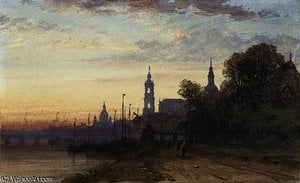
Wyld’s artistic breakthrough arrived at the Paris Salon of 1839 with “Venice at Sunrise,” a monumental watercolor that captured the ethereal beauty of the city at dusk. The painting, lauded for its masterful tonal gradation and evocative depiction of light—a technique directly influenced by Bonington—earned him a prestigious first gold medal, catapulting him into artistic prominence. This accolade solidified his reputation as one of the foremost watercolourists of his time and secured commissions from influential patrons, including Queen Victoria herself. Wyld’s subsequent voyages to Brittany further nurtured his artistic inspiration, resulting in paintings that embody the spirit of Romanticism—characterized by dramatic landscapes and emotionally resonant compositions.A Legacy of Detail and Atmospheric Skill
Throughout his career, William Wyld remained actively engaged with the artistic community, becoming a member of both the New Society of Painters in Watercolors and later the Royal Institute of Painters in Watercolour. His meticulous attention to detail—a characteristic inherited from Francia—allowed him to reproduce landscapes and cityscapes with unparalleled accuracy and expressive power. He continued exhibiting at various salons until his death in Paris in 1889, leaving behind a substantial body of work that exemplifies the highest standards of watercolor painting. Wyld’s legacy lies in his ability to synthesize diverse artistic influences—particularly Bonington's tonal subtlety and Girtin's topographical precision—to create paintings that transcend mere representation and convey profound emotional resonance. He stands as a significant successor to Richard Parkes Bonington, inheriting his keen eye for detail and ability to capture the atmosphere of place. His paintings offer not merely depictions of scenes but immersive experiences, inviting viewers to step into the vibrant world he so skillfully portrayed. Wyld’s enduring influence can be seen in subsequent generations of watercolour artists who sought to emulate his masterful technique and expressive vision—a testament to his indelible mark on British art history.Frågor och svar
Var kan jag se alla konstverk av William Wyld?
Alla verk av William Wyld på denna webbplats kan utforskas via artistens Samtliga konstverk-sida.
Var kan man utforska William Wylds konstverk sorterade efter motiv?
William Wylds verk kan utforskas efter motiv på artistens Ämnesindex-sida.
Kan jag studera William Wylds färgval genom hela det konstnärliga skapandet?
Palettens genom för William Wyld är en sida som presenterar färgprofilen i konstnärens samlade verk.