Masaccio, 1401 – 1428

Masaccios målningar: De 97 mest kända verken, rankade

Masaccios mest kända målning är Treenigheten (1428). Tillsammans med Tiondet (1425) och Utdrivningen ur paradiset (1426) utgör de de tre verk som alla känner igen. Vår katalog listar 97 verk av Masaccio; de 97 nedan är de som världen betraktar mest, var och ett med sitt årtal, museet som förvarar det och varför det är betydelsefullt.

Rankade efter vår popularitetspoäng, som kombinerar sökningar, besök och beställningar för varje verk. Uppdaterad oktober 2026. Varje mästerverk på denna sida kan beställas som en handmålad oljereproduktion av museikvalitet eller som ett konsttryck i den storlek du väljer.

Porträtt av Masaccio
Masaccio · 1401 – 1428
Född · död
1401 – 1428, San Giovanni Valdarno
Rörelse
Tidig renässans
Verk i vår katalog
97
Mest kända
Treenigheten (1428)
Flest verk på
Santa Maria del Carmine

De 10 mest kända målningarna av Masaccio

Treenigheten (1428) av Masaccio
1

Treenigheten

1428 · Fresko

The Trinity by Masaccio is a fresco painting that marked the beginning of the Renaissance in Italy. Created in 1425, it is considered one of the most important works of the early Renaissance period. The painting is housed in the Santa Maria Novella church in Florence, Italy. Artistic Innovations The Trinity by Masaccio was a groundbreaking work that introduced several artistic innovations. It is one of the first monumental Renaissance…

Tiondet (1425) av Masaccio
2

Tiondet

1425 · Fresko

Scenen utspelar sig i Brancacci-kapellet i basilikan Santa Maria del Carmine i Florens. Här ger fresken med titeln Tiondet av Masaccio ett bibliskt narrativ liv på kapellets väggar. Detta verk, beställt av Felice Brancacci, utgör en betydelsefull del av en större cykel tillägnad Sankt Petrus liv. Luften i kapellet tycks bära på tyngden av denna heliga historia, medan gestalterna rör sig genom ett ögonblick av djup betydelse.

Utdrivningen ur paradiset (1426) av Masaccio
3

Utdrivningen ur paradiset

1426 · Fresko

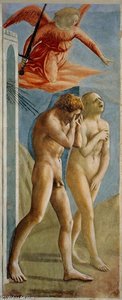
Den tunga tystnaden i Brancacci-kapellet i kyrkan Santa Maria del Carmine i Florens, Italien, bär på tyngden av en djup tragedi. Här andas väggarna berättelsen om Utdrivningen ur paradiset, en fresco målad av Masaccio omkring år 1425. Luften tycks förtätas kring gestalterna när de står inför sin plötsliga, oåterkalleliga utvisning från paradiset. Denna scen markerar början på ett större narrativ och fungerar som den första frescon i en serie tillägnad…

Rendering av Tribute Money (Detalj) av Masaccio
4

Rendering av Tribute Money (Detalj)

Fresko

Denna fängslande detalj härstammar från Masaccios banbrytande fresk, ”Tribute Money”, ett avgörande verk i Brancacci-kapellet i Florens. Verket, som utfördes omkring 1426, representerar en vändpunkt i den västerländska konsten genom att röra sig bort från den gotiska tidens stiliserade konventioner mot en ny era av naturalism och humanistiskt uttryck.

Predella panel from the Pisa Altar (1426) av Masaccio
5

Predella panel from the Pisa Altar

1426 · Oil On Panel · Staatliche Museen zu Berlin, Berlin

To stand before this Predella panel from the Pisa Altar is to encounter a moment frozen in time, yet vibrating with raw, undeniable human drama. Dating to 1426, this work captures Masaccio at the zenith of his revolutionary power. It is not merely a depiction of the Crucifixion; it is a profound meditation on sacrifice, community, and the weight of divine narrative rendered with startling immediacy. The composition draws the…

The Madonna of Humility (1424) av Masaccio
6

The Madonna of Humility

1424 · Tempera On Panel

In the quiet, profound stillness of Masaccio’s The Madonna of Humility, we encounter one of the most moving snapshots of the Early Italian Renaissance. Created around 1424, this masterpiece transcends mere religious iconography to offer a window into a moment of raw, maternal intimacy. The scene is set not upon a celestial throne, but on the earth itself, where the Virgin Mary sits upon a blue patterned cushion. This choice…

Trinity (detail) (1425) av Masaccio
7

Trinity (detail)

1425 · Fresco · Santa Maria Novella, Florens

The image presents a detail from a fresco painting created in 1425 by Masaccio. Within this specific view, a figure is depicted that appears to be Mary Magdalene, identified by the traditional iconography of her long hair and a head covering. She possesses a contemplative expression, directing her gaze slightly downwards toward an object held in her right hand, which may be interpreted as a symbol of faith or devotion.

Two panels from the Pisa Altarpiece (1426) av Masaccio
8

Two panels from the Pisa Altarpiece

1426 · Tempera On Panel · Staatliche Museen zu Berlin, Berlin

In the quiet, hallowed halls of art history, few works capture the dawn of a new era as poignantly as Masaccio’s Two Panels from the Pisa Altarpiece. Completed in 1426, these panels are far more than mere fragments of a lost polyptych; they are windows into a transformative moment when the rigid conventions of the Gothic period began to dissolve, giving way to the profound humanism of the Early Italian…

Trinity (1425) av Masaccio
9

Trinity

1425 · Fresco · Santa Maria Novella, Florens

To step before Masaccio’s Holy Trinity is to witness the exact moment when the flattened, symbolic world of the Middle Ages dissolved into the profound, breathing reality of the Renaissance. Painted between 1425 and 1427 within the hallowed walls of Santa Maria Novella in Florence, this fresco does not merely depict a religious scene; it carves a hole in the very wall of the chapel, inviting the viewer to step…

Trinity (detail) (1425) av Masaccio
10

Trinity (detail)

1425 · Acrylic On Canvas · Santa Maria Novella, Florens

Masaccio’s “Trinity (detail),” housed within the magnificent Santa Maria Novella in Florence, isn't merely a fresco; it’s a pivotal moment in art history – a visual manifesto declaring the arrival of the High Renaissance. Painted between 1425 and 1427, this intimate section captures the essence of Masaccio’s revolutionary approach to depicting reality, a departure from the stylized elegance of the preceding Gothic era and a profound influence on generations of…

Masaccio, målningar 11 till 97

Freskoer i Cappella Brancacci (högra vy) 1426-82 (1426) av Masaccio
#15

Freskoer i Cappella Brancacci (högra vy) 1426-82

1426 · Santa Maria del Carmine

Masaccio’s Frescoes in the Cappella Brancacci är ett verk som inte bara förändrade italiensk konst utan också satte standarden för hela västerländsk målning under renässansen. Detta mäktiga arbete,…

Ta hem den →
Madonna Casini (1426) av Masaccio
#16

Madonna Casini

1426

The Madonna Casini is a painting by the artist Masaccio. This intimate work carries several other names, including Madonna del Solletico, Madonna col bambino, Madonna con bambino, and…

Beställ en reproduktion →
Adam and Eve banished from Paradise (1427) av Masaccio
#17

Adam and Eve banished from Paradise

1427

Adam and Eve banished from Paradise by Masaccio is a single scene from a larger fresco cycle located in the Brancacci Chapel of Santa Maria del Carmine in…

Freskoer i Brancacci Kapellen (vänster vy) (1426) av Masaccio
#19

Freskoer i Brancacci Kapellen (vänster vy)

1426 · Santa Maria del Carmine

Masaccio’s Frescoes in the Cappella Brancacci är ett verk som inte bara förändrade måleriet utan också satte standarden för hela den italienska renässansens konstnärliga utveckling. Detta mästerverk, placerat…

Ta hem den →
Baptism of the Neophytes (1427) av Masaccio
#20

Baptism of the Neophytes

1427

In the quiet dimness of the Brancacci Chapel, within the Santa Maria del Carmine in Florence, Italy, a profound scene unfolds. This fresco, executed between 1426 and 1427,…

Crucifixion (1426) av Masaccio
#22

Crucifixion

1426 · Museo di Capodimonte

Masaccio’s Crucifixion, painted in 1426 during his tragically brief career, isn’t merely a depiction of a pivotal biblical event; it’s a foundational moment in Western art. Born in…

Beställ en reproduktion →
Distribution of Alms and Death of Ananias (1425) av Masaccio
#48

Distribution of Alms and Death of Ananias

1425

In the quiet, profound depths of Masaccio’s Distribution of Alms and Death of Ananias, we encounter a moment where the divine intersects with the earthly through the simple,…

Christ in the Garden of Gethsemane (1424) av Masaccio
#62

Christ in the Garden of Gethsemane

1424 · Lindenau-Museum

The painting Christ in the Garden of Gethsemane is a renowned work by the Italian artist Masaccio, created in 1424. This tempera painting, measuring 62 x 44 cm,…

Ta hem den →
Plate of Nativity (Berlin Tondo) (1427) av Masaccio
#77

Plate of Nativity (Berlin Tondo)

1427 · Staatliche Museen zu Berlin

In the quiet intimacy of the Plate of Nativity (Berlin Tondo), we witness one of the most profound transformations in the history of Western art. Painted in 1427…

Ta hem den →
Adoration of the Magi (1426) av Masaccio
#85

Adoration of the Magi

1426 · Staatliche Museen zu Berlin

To stand before Masaccio’s Adoration of the Magi is not merely to observe a painting; it is to step directly into the revolutionary atmosphere of the early Italian…

Beställ en reproduktion →
Predella panel from the Pisa Altar (1426) av Masaccio
#87

Predella panel from the Pisa Altar

1426 · Staatliche Museen zu Berlin

The world of 15th-century Florentine painting was undergoing a seismic shift, and at the heart of this transformation stood Masaccio – a name that resonates with an almost…

Ta hem den →
St. Andrew (1426) av Masaccio
#93

St. Andrew

1426 · J. Paul Getty Museum

A Revolutionary Vision of Faith: Masaccio’s St. Andrew Masaccio's *St. Andrew*, painted in 1426, is a landmark work of the Early Renaissance, embodying the seismic shift towards naturalism…

Ta hem den →
Crucifixion of St Peter (1426) av Masaccio
#97

Crucifixion of St Peter

1426 · Staatliche Museen zu Berlin

Masaccio's 1426 painting, *Crucifixion of St. Peter*, is not merely a depiction of a pivotal moment in Christian history; it’s a foundational cornerstone of the Early Italian Renaissance.…

Beställ en handmålad kopia →

Masaccios målningar per period

De motiv Masaccio målade mest av

De fyra motiv som förekommer oftast bland dessa mästerverk, med det främsta exemplet på varje.

Var du kan se Masaccios målningar

De 8 museer som innehar flest av målningarna på denna sida.

Museum Stad Verk av Masaccio Målningar från denna lista
Santa Maria del Carmine, FlorensSanta Maria del Carmine Florens 7 Vy över Cappella Brancacci (innan restaurering), Freskoer i Cappella Brancacci (högra vy) 1426-82, Freskoer i Brancacci Kapellen (vänster vy)
Staatliche Museen zu Berlin, BerlinStaatliche Museen zu Berlin Berlin 6 Predella panel from the Pisa Altar, Two panels from the Pisa Altarpiece, Plate of Nativity (Berlin Tondo)
Gemäldegalerie, BerlinGemäldegalerie Berlin 5 Martyrdom of San Giovanni Battista, A Bearded Carmelite Saint, San Agustín
Santa Maria Novella, FlorensSanta Maria Novella Florens 4 Trinity (detail), Trinity, Trinity (detail)
Lindenau-Museum, AltengauLindenau-Museum Altengau 3 Christ in the Garden of Gethsemane (detail), Christ in the Garden of Gethsemane (detail), Christ in the Garden of Gethsemane
National Gallery of Art, WashingtonNational Gallery of Art Washington 2 Profile Portrait of a Young Man, Madonna of Humility
National Gallery, LondonNational Gallery London 2 Madonna with Child and Angels, St.Girolamo end Giovanni Battista
Museo di Capodimonte, NeapelMuseo di Capodimonte Neapel 1 Crucifixion

Masaccios mest kända målningar, år för år

Masaccio målade i knappt 9 år, från 1420 till 1428: följ decenniet år för år, genom målningarna som skapade namnet.

  1. 1420
  2. 1422
  3. 1422
  4. 1422
    San Giovenale Triptych. Left panel (1422) av Masaccio
    Nr. 63 av 97

    San Giovenale Triptych. Left panel

    Ålder 21

    The San Giovenale Triptych, Left Panel by Masaccio is a seminal work of art that showcases the artist's innovative style and technique. Created in 1422, this painting is…

  5. 1422
  6. 1423
  7. 1423
  8. 1424
    The Madonna of Humility (1424) av Masaccio
    Nr. 6 av 97

    The Madonna of Humility

    Ålder 23

    In the quiet, profound stillness of Masaccio’s The Madonna of Humility, we encounter one of the most moving snapshots of the Early Italian Renaissance. Created around 1424, this…

  9. 1424
    Christ in the Garden of Gethsemane (detail) (1424) av Masaccio
    Nr. 21 av 97

    Christ in the Garden of Gethsemane (detail)

    Ålder 23 · Lindenau-Museum

    The garden holds a heavy stillness. In this detail from 1424, a single figure kneels upon the earth, hands clasped in a tight knot of devotion. The light…

  10. 1424
  11. 1424
    Christ in the Garden of Gethsemane (1424) av Masaccio
    Plats 62 av 97

    Christ in the Garden of Gethsemane

    Ålder 23 · Lindenau-Museum

    The painting Christ in the Garden of Gethsemane is a renowned work by the Italian artist Masaccio, created in 1424. This tempera painting, measuring 62 x 44 cm,…

  12. 1425
    Tiondet (1425) av Masaccio
    Nr. 2 av 97

    Tiondet

    Ålder 24

    Scenen utspelar sig i Brancacci-kapellet i basilikan Santa Maria del Carmine i Florens. Här ger fresken med titeln Tiondet av Masaccio ett bibliskt narrativ liv på kapellets väggar.…

  13. 1425
    Trinity (detail) (1425) av Masaccio
    #7 av 97

    Trinity (detail)

    Ålder 24 · Santa Maria Novella

    The image presents a detail from a fresco painting created in 1425 by Masaccio. Within this specific view, a figure is depicted that appears to be Mary Magdalene,…

  14. 1425
    Trinity (1425) av Masaccio
    #9 av 97

    Trinity

    Ålder 24 · Santa Maria Novella

    To step before Masaccio’s Holy Trinity is to witness the exact moment when the flattened, symbolic world of the Middle Ages dissolved into the profound, breathing reality of…

  15. 1425
    Trinity (detail) (1425) av Masaccio
    Nr. 10 av 97

    Trinity (detail)

    Ålder 24 · Santa Maria Novella

    Masaccio’s “Trinity (detail),” housed within the magnificent Santa Maria Novella in Florence, isn't merely a fresco; it’s a pivotal moment in art history – a visual manifesto declaring…

  16. 1426
    Utdrivningen ur paradiset (1426) av Masaccio
    Plats 3 av 97

    Utdrivningen ur paradiset

    Ålder 25

    Den tunga tystnaden i Brancacci-kapellet i kyrkan Santa Maria del Carmine i Florens, Italien, bär på tyngden av en djup tragedi. Här andas väggarna berättelsen om Utdrivningen ur…

  17. 1426
    Predella panel from the Pisa Altar (1426) av Masaccio
    Plats 5 av 97

    Predella panel from the Pisa Altar

    Ålder 25 · Staatliche Museen zu Berlin

    To stand before this Predella panel from the Pisa Altar is to encounter a moment frozen in time, yet vibrating with raw, undeniable human drama. Dating to 1426,…

  18. 1426
    Two panels from the Pisa Altarpiece (1426) av Masaccio
    #8 av 97

    Two panels from the Pisa Altarpiece

    Ålder 25 · Staatliche Museen zu Berlin

    In the quiet, hallowed halls of art history, few works capture the dawn of a new era as poignantly as Masaccio’s Two Panels from the Pisa Altarpiece. Completed…

  19. 1426
    Vy över Cappella Brancacci (innan restaurering) (1426) av Masaccio
    Plats 11 av 97

    Vy över Cappella Brancacci (innan restaurering)

    Ålder 25 · Santa Maria del Carmine

    Masaccios View of the Cappella Brancacci (before restoration), skapad mellan 1426 och 1428, är inte bara en kyrkofoto – det är ett monument över den tidiga renässansens genombrott.…

  20. 1427
    Adam and Eve banished from Paradise (1427) av Masaccio
    Plats 17 av 97

    Adam and Eve banished from Paradise

    Ålder 26

    Adam and Eve banished from Paradise by Masaccio is a single scene from a larger fresco cycle located in the Brancacci Chapel of Santa Maria del Carmine in…

  21. 1427
    Baptism of the Neophytes (1427) av Masaccio
    Nr. 20 av 97

    Baptism of the Neophytes

    Ålder 26

    In the quiet dimness of the Brancacci Chapel, within the Santa Maria del Carmine in Florence, Italy, a profound scene unfolds. This fresco, executed between 1426 and 1427,…

  22. 1427
    Plate of Nativity (Berlin Tondo) (1427) av Masaccio
    Plats 77 av 97

    Plate of Nativity (Berlin Tondo)

    Ålder 26 · Staatliche Museen zu Berlin

    In the quiet intimacy of the Plate of Nativity (Berlin Tondo), we witness one of the most profound transformations in the history of Western art. Painted in 1427…

  23. 1428
    Treenigheten (1428) av Masaccio
    #1 av 97

    Treenigheten

    Ålder 27

    The Trinity by Masaccio is a fresco painting that marked the beginning of the Renaissance in Italy. Created in 1425, it is considered one of the most important…

  24. 1428
  25. 1428

Frågor om Masaccios målningar

Vilken är Masaccios mest kända målning?Visa svaret

Treenigheten (1428). Därefter följer Tiondet (1425) och Utdrivningen ur paradiset (1426).

Hur gammal var Masaccio när Treenigheten målades?Visa svaret

27 år gammal: Treenigheten dateras från 1428 och Masaccio föddes 1401.

Vilka är de 10 främsta målningarna av Masaccio?Visa svaret

Treenigheten, Tiondet, Utdrivningen ur paradiset, Rendering av Tribute Money (Detalj), Predella panel from the Pisa Altar, The Madonna of Humility, Trinity (detail), Two panels from the Pisa Altarpiece, Trinity och Trinity (detail). Rankingen ovan visar år och museum för varje verk.

Hur många målningar har Masaccio skapat?Visa svaret

Vår katalog innehåller 97 verk av Masaccio, daterade från 1420 till 1428.

Var finns Masaccios mest kända målningar?Visa svaret

De flesta av dem finns i Santa Maria del Carmine (Florens), Staatliche Museen zu Berlin (Berlin) och Gemäldegalerie (Berlin). Tabellen ovan listar museerna ett efter ett.

När målade Masaccio sina mest kända verk?Visa svaret

Under 1426: 41 av de 97 verk som finns på denna sida härstammar från den tiden, däribland Utdrivningen ur paradiset.

Vilka är Masaccios tidigaste och senaste kända målningar?Visa svaret

Det tidigaste på denna sida är Madonna of Humility (1420), det senaste Treenigheten (1428).

Vad målade Masaccio oftast?Visa svaret

Saints (29), Religious (23) och Renaissance (15), av totalt 97 verk på denna sida.

Vilket medium använde Masaccio mest?Visa svaret

Fresco: 8 av 97 verk på denna sida.

Vilken konstinriktning tillhör Masaccio?Visa svaret

Tidig renässans, som målningarna på denna sida visar.

Vilka målningar av Masaccio kan jag se på Santa Maria del Carmine?Visa svaret

Vy över Cappella Brancacci (innan restaurering), Freskoer i Cappella Brancacci (högra vy) 1426-82 och Freskoer i Brancacci Kapellen (vänster vy) är bland de 7 verk på denna sida som innehas av Santa Maria del Carmine, Florens.

Kan jag köpa en reproduktion av en Masaccio-målning?Visa svaret

Ja. Varje målning på denna sida kan beställas som en handmålad oljereproduktion av museikvalitet eller som ett konsttryck i den storlek du väljer, direkt från målningens egen sida.

Om Masaccio

Masaccio (1401-1428): The Dawn of Renaissance Realism

Tommaso di Ser Giovanni di Simone Guidi Cassai, better known as Masaccio (meaning "clumsy Tom"), was a pivotal figure in the Early Italian Renaissance. Born on December 21, 1401, in San Giovanni Valdarno, Italy, and dying tragically young in 1428, his brief career revolutionized painting with groundbreaking realism, perspective, and chiaroscuro (the use of strong contrasts between light and dark). Despite his short life, Masaccio’s impact on subsequent generations of artists was profound, establishing a new standard for naturalism and influencing the course of Western art.

Early Life and Training

Masaccio's origins were humble; he descended from a family involved in cabinet making – Ser Giovanni di Simone Cassai, his father, was a notary, and Monna Iacopa di Martinozzo di Dino, his mother. Orphaned at age five when his father died unexpectedly, Masaccio’s brother, Giovanni (Lo Scheggia), also pursued artistic endeavors, though he signed only one painting – a testament to the secretive nature of Renaissance artists' lives. The details surrounding Masaccio’s formative years remain frustratingly sparse; no definitive master has been identified, which contributes to the enduring mystery surrounding his rapid ascent to artistic mastery and his revolutionary techniques. Despite this lack of documented training, scholars believe he likely apprenticed around 1415, absorbing influences from masters like Giotto di Bondone – a predecessor celebrated for his pioneering naturalism – and Filippo Brunelleschi, whose rediscovery of linear perspective fundamentally reshaped artistic representation.

Artistic Development and Major Works

Masaccio’s artistic journey began with an initial fascination for Giotto's expressive frescoes in Padua Cathedral, where he meticulously studied the artist’s masterful use of color and emotion. However, Masaccio swiftly surpassed Giotto’s achievements in perspective and anatomical accuracy, demonstrating a profound understanding of mathematical principles and human anatomy—skills honed through observation and experimentation. He was profoundly impacted by Brunelleschi's architectural innovations, particularly his groundbreaking application of linear perspective in the Duomo of Florence – an endeavor that inspired Masaccio to translate these spatial concepts into his paintings. His artistic breakthroughs centered around mastering linear perspective and chiaroscuro. Masaccio skillfully employed vanishing points and mathematical precision to create a convincing illusion of depth on a two-dimensional surface, mirroring Brunelleschi’s architectural vision. Simultaneously, he achieved unparalleled realism by manipulating light and shadow—a technique known as chiaroscuro—to sculpt forms and imbue his figures with palpable emotion. This dramatic interplay of light and dark elevated Masaccio's paintings beyond mere representation; they conveyed a sense of psychological depth previously unheard of in art. Masaccio’s most celebrated achievement was undoubtedly the Brancacci Chapel frescoes in Santa Maria del Carmine, Florence – a collaborative effort with Masolino—which remain among the finest examples of Early Renaissance painting. The frescoes depict scenes from Saint Peter's life, capturing dramatic narratives and conveying profound emotional resonance through masterful use of perspective and chiaroscuro. Particularly noteworthy is “The Tribute Money,” where Masaccio’s innovative depiction of spatial recession and anatomical detail established a new standard for naturalism—a standard that would inspire Leonardo da Vinci and Michelangelo centuries later. His influence extended beyond Florence, shaping the artistic sensibilities of artists across Italy and cementing his place as one of the foundational figures of Western art history.

Historical Significance and Legacy

Masaccio’s legacy transcends mere stylistic innovation; he fundamentally altered the intellectual landscape of Renaissance art. By rejecting medieval conventions and embracing humanist ideals—inspired by classical antiquity—he ushered in a new era of artistic exploration and creativity. Giorgio Vasari, the renowned biographer of artists, recognized Masaccio's genius as unparalleled, proclaiming him "the best painter of his generation" and highlighting his ability to imitate nature with breathtaking precision. Despite dying prematurely at the age of twenty-six – circumstances shrouded in mystery—Masaccio’s brief but brilliant career continues to captivate scholars and artists alike, serving as a poignant reminder of the transformative power of artistic talent and innovation. His work remains an enduring testament to the dawn of Renaissance realism and its profound impact on Western culture.

Alla 97 verk av Masaccio →