

Saint Louis Forgiving Pierre de Bretagne (1817) är det mest kända verket av Georges Rouget och finns i Musée des Beaux-Arts de Quimper i Quimper. Sketch for the church Saint Gervais "Ecce Homo" (1819) och Jean-Nicolas Houchard (1835) är de nästa två verk som världen känner till bäst. Av de 39 verk av Georges Rouget i vår katalog, här är de 39 som samlare och museum besökare tittar mest på, med årtal, museum och historien bakom varje verk.
Rankade efter vår popularitetspoäng, som kombinerar sökningar, besök och beställningar för varje verk. Uppdaterad oktober 2026. Varje mästerverk på denna sida kan beställas som en handmålad oljereproduktion av museikvalitet eller som ett konsttryck i den storlek du väljer.


A middle-aged man sits in a moment of profound stillness, his gaze drifting toward the upper right as if caught by a sudden, unspoken thought. He is draped in the heavy, dark navy blue of a jacket that absorbs the light, contrasting sharply against the crisp, creamy white of his cravat. The light strikes the left side of his face with a deliberate intensity, sculpting the sharp lines of his…


The canvas before you presents not merely a likeness, but an embodiment of the 19th century’s fascination with portraiture – a meticulously rendered study in dignity and quiet authority. Painted by Georges Rouget between 1803 and 1857, this depiction of Jean Pierre Thenot is more than just a representation; it's a window into a specific moment in French history, imbued with the formal elegance and restrained emotion characteristic of his…


Georges Rouget's "Mesdemoiselles Mollien," painted in 1811, is more than just a portrait; it’s a window into the refined world of early 19th-century French society and a testament…
Beställ en reproduktion →
FRANCOIS CHASSELOUP LAUBAT, GENERAL DE DIVISION (1754 1833) – En Pionjärs Verk Konstnärlig Stil och Symbolisk Vikt Georges Rouget är en konsthistoriker vars verk är ett testament till…
Beställ en handmålad kopia →
This striking portrait depicts Emmanuel de Grouchy, Colonel du 2e Dragon in 1792. Painted by Georges Rouget, a neoclassical French painter known for his historical scenes and association…
Beställ en reproduktion →De fyra motiv som förekommer oftast bland dessa mästerverk, med det främsta exemplet på varje.
De 8 museer som innehar flest av målningarna på denna sida.
| Museum | Stad | Verk av Georges Rouget | Målningar från denna lista |
|---|---|---|---|
 Opera House |
Versailles | 6 | Achille Alexandre Alphonse, Viscount de Cailleux (1788-1876), Director of the Musées royaux, ALEXANDRE FRANCOIS MARIE, VICOMTE DE BEAUHARNAIS, GENERAL EN CHEF DE L'ARMEE DU RHIN (1760 1794), VICTOR GUY BARON DUPERRE, MATELOT EN 1792 (1775 1846) |
 Louvre |
Paris | 2 | JEAN PIERRE THENOT (1803 1857), MESDEMOISELLES MOLLIEN |
 Musée des Beaux-Arts de Quimper |
Quimper | 1 | Saint Louis Forgiving Pierre de Bretagne |
 Petit Palais |
Paris | 1 | Sketch for the church Saint Gervais "Ecce Homo" |
 Musée de l’Armée |
Paris | 1 | Jean-Nicolas Houchard |
 Bavarian State Painting Collections |
München | 1 | Jacques-Louis David |
 Musée Fesch |
Aix-en-Provence | 1 | The King of Rome in the Tuileries Garden |
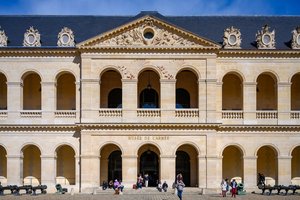 Ministère de la Défense Nationale |
Paris | 1 | FRANCOIS CHASSELOUP LAUBAT, GENERAL DE DIVISION |


Saint Louis Forgiving Pierre de Bretagne (1817), Musée des Beaux-Arts de Quimper, Quimper. Därefter följer Sketch for the church Saint Gervais "Ecce Homo" (1819) och Jean-Nicolas Houchard (1835).
34 år gammal: Saint Louis Forgiving Pierre de Bretagne dateras från 1817 och Georges Rouget föddes 1783.
Saint Louis Forgiving Pierre de Bretagne, Sketch for the church Saint Gervais "Ecce Homo", Jean-Nicolas Houchard, Jacques-Louis David, Achille Alexandre Alphonse, Viscount de Cailleux (1788-1876), Director of the Musées royaux, The King of Rome in the Tuileries Garden, JEAN PIERRE THENOT (1803 1857), DEBARQUEMENT DE SAINT LOUIS EN EGYPTE.4 JUIN 1249, ALEXANDRE FRANCOIS MARIE, VICOMTE DE BEAUHARNAIS, GENERAL EN CHEF DE L'ARMEE DU RHIN (1760 1794) och FRANCOIS CHRISTOPHE KELLERMAN, GENERAL EN CHEF DE L'ARMEE DE LA MOSELLE EN 1792 (1735 1820). Rankingen ovan visar år och museum för varje verk.
Vår katalog innehåller 39 verk av Georges Rouget, daterade från 1817 till 1850.
De flesta av dem finns i Opera House (Versailles), Louvre (Paris) och Musée des Beaux-Arts de Quimper (Quimper). Tabellen ovan listar museerna ett efter ett.
Under 1810s: 2 av de 39 verk som finns på denna sida härstammar från den tiden, däribland Saint Louis Forgiving Pierre de Bretagne.
Det tidigaste på denna sida är Saint Louis Forgiving Pierre de Bretagne (1817), det senaste The King of Rome in the Tuileries Garden (1850).
Portrait (4), Dignified (3) och Formal (2), av totalt 39 verk på denna sida.
Oil On Canvas: 3 av 39 verk på denna sida.
Neoclassicism, som målningarna på denna sida visar.
Achille Alexandre Alphonse, Viscount de Cailleux (1788-1876), Director of the Musées royaux, ALEXANDRE FRANCOIS MARIE, VICOMTE DE BEAUHARNAIS, GENERAL EN CHEF DE L'ARMEE DU RHIN (1760 1794) och VICTOR GUY BARON DUPERRE, MATELOT EN 1792 (1775 1846) är bland de 6 verk på denna sida som innehas av Opera House, Versailles.
Ja. Varje målning på denna sida kan beställas som en handmålad oljereproduktion av museikvalitet eller som ett konsttryck i den storlek du väljer, direkt från målningens egen sida.

