Agnolo Bronzino, 1503 – 1572

Agnolo Bronzinos målningar: De 100 mest kända verken, rankade

Agnolo Bronzinos mest kända målning är Venus, Cupid och Tid (Allegori över Lust) (1540), i National Gallery, London. Tillsammans med Portrait of Eleonora da Toledo (1555) och Venus, Cupido and Satyr utgör de de tre verk som alla känner igen. Vår katalog listar 189 verk av Agnolo Bronzino; de 100 nedan är de som världen betraktar mest, var och ett med sitt årtal, museet som förvarar det och varför det är betydelsefullt.

Rankade efter vår popularitetspoäng, som kombinerar sökningar, besök och beställningar för varje verk. Uppdaterad oktober 2026. Varje mästerverk på denna sida kan beställas som en handmålad oljereproduktion av museikvalitet eller som ett konsttryck i den storlek du väljer.

Porträtt av Agnolo Bronzino
Agnolo Bronzino · 1503 – 1572
Född · död
1503 – 1572, Florens
Rörelse
Manierism
Verk i vår katalog
189
Mest kända
Venus, Cupid och Tid (Allegori över Lust) (1540)
Flest verk på
Galleria degli Uffizi

De 10 mest kända målningarna av Agnolo Bronzino

Venus, Cupid och Tid (Allegori över Lust) (1540) av Agnolo Bronzino
1

Venus, Cupid och Tid (Allegori över Lust)

1540 · Olja på duk · National Gallery, London

Agnolo Bronzinos mästerverk “Venus, Cupid och Tiden (Allegori av Lust)” är en fascinerande resa in i det komplexa och ofta förföriska landskapet under 1500-talets Florens. Detta inte bara är ett konstverk utan en sofistikerad symbolisk skapelse som fångar essensen av den tidens estetik, filosofi och sociala dynamik. Bronzino, en ledande figur inom Mannerismen, lyckades skapa en bild som både förtrollar och utmanar betraktaren, och vars djupare mening fortsätter att diskuteras…

Portrait of Eleonora da Toledo (1555) av Agnolo Bronzino
2

Portrait of Eleonora da Toledo

1555 · Oil On Panel

To gaze upon Agnolo Bronzino's Portrait of Eleonora da Toledo is to step directly into the rarefied atmosphere of High Renaissance Florence. This painting, executed in 1555, transcends a mere likeness; it is a carefully constructed monument to status, power, and exquisite refinement. The subject, Eleonora da Toledo, radiates an almost palpable aura of aristocratic dignity. Bronzino captures her not just as a woman, but as a symbol of Medici…

Venus, Cupido and Satyr av Agnolo Bronzino
3

Venus, Cupido and Satyr

Oil

A pale, reclining figure occupies the center of the frame, her skin possessing the cool, polished sheen of marble. This is Venus, the goddess of love, draped in a way that emphasizes the tension between soft flesh and the hard edges of the composition. Beside her, Cupid clings to her form, a small, fleshy presence that embodies the sudden, sharp sting of passion. Their limbs are elongated, stretching toward one…

Portrait of Andrea Doria as Neptune (1550) av Agnolo Bronzino
4

Portrait of Andrea Doria as Neptune

1550 · Oil On Canvas · Pinacoteca di Brera, Milano

In the grand theater of the Italian Mannerist period, few images command the eye with such authoritative grace as Agnolo Bronzino’s Portrait of Andrea Doria as Neptune. This is not merely a portrait of a man, but a profound exercise in political allegory and divine projection. The subject, the legendary Genoese admiral Andrea Doria, is stripped of the heavy silks and velvet doublets typical of sixteenth-century aristocratic portraiture. Instead, Bronzino…

St. John the Baptist (1542) av Agnolo Bronzino
5

St. John the Baptist

1542 · Oil On Panel · J. Paul Getty Museum, Los Angeles

The figure of St. John the Baptist emerges from the shadows, rendered with a muscular intensity by the Florentine master Bronzino. This depiction captures the patron saint of Florence in a moment of profound spiritual tension. Created about 1542 - 1545, the work possesses a striking verticality that speaks to its original purpose. It does not exist in isolation but remains a fragment of a larger sacred narrative, having once…

Deposition (1565) av Agnolo Bronzino
6

Deposition

1565 · Oil On Canvas · Galleria dell'Accademia di Firenze, Florens

“Deposition,” painted in 1565 by the Florentine master Agnolo Bronzino, is not merely a religious scene; it's a meticulously crafted tableau of restrained emotion and profound psychological depth. Commissioned for the Observant Monastery in Cosmopoli, this work transcends simple narrative to become a meditation on grief, loss, and the delicate balance between earthly sorrow and divine grace. Bronzino, renowned for his “reserved elegance,” achieved this through an almost unnervingly controlled…

Portrait of a Young Man (1555) av Agnolo Bronzino
7

Portrait of a Young Man

1555 · Oil On Canvas · Nelson-Atkins Museum of Art, Kansas City

To gaze upon this portrait is to step directly into the rarefied atmosphere of mid-sixteenth-century Florence, a world governed by the subtle power plays and exquisite tastes of the Medici court. Agnolo Bronzino, the master chronicler of such elite circles, captured not merely a likeness, but an entire social stratum. The sitter, though anonymous to us today, embodies the controlled elegance expected of those who moved within the gilded cage…

Cosimo de Medici in Armour (1545) av Agnolo Bronzino
8

Cosimo de Medici in Armour

1545 · Oil On Panel · Thyssen-Bornemisza-museet, Madrid

The gaze of the Grand Duke of Tuscany, Cosimo I de' Medici, meets the viewer through the work titled Cosimo de Medici in Armour. Created by the Florentine artist Bronzino, this portrait captures the ruler in a moment of poised authority. The image emerges from the mid-16th century, dated about 1545, and presents a commanding presence through its structured composition. It exists as a significant version of the painting held…

Portrait of Cosimo I de' Medici as Orpheus (1537) av Agnolo Bronzino
9

Portrait of Cosimo I de' Medici as Orpheus

1537 · Oil On Panel · Philadelphia Museum of Art, Philadelphia

In this portrait, we encounter Cosimo I de' Medici, not merely as a ruler, but as the mythological musician Orpheus. He is positioned in a three-quarter view from behind, turning his gaze back toward us with a sense of psychological alertness. His body, rendered with a polished, marble-like texture, possesses an idealized beauty that speaks to the High Mannerist style. A single splash of crimson red drapery provides a sharp…

Portrait of Eleonora of Toledo and Her Son, Francesco de'Medici (1549) av Agnolo Bronzino
10

Portrait of Eleonora of Toledo and Her Son, Francesco de'Medici

1549 · Oil On Panel · Cincinnati Art Museum, Cincinnati

In this vertical half-length portrait, we encounter the Duchess of Florence, Eleonora of Toledo, and her son, Francesco de' Medici. The composition is defined by a controlled, almost sculptural stillness. Eleonora stands slightly behind the young boy, her hand resting upon his shoulder in a gesture that is both protective and formal. There is a certain aristocratic detachment in their expressions, a cool composure that characterizes the Florentine Mannerist style.…

Agnolo Bronzino, målningar 11 till 100

Portrait of Eleonora di Toledo, Bust (1560) av Agnolo Bronzino
#11

Portrait of Eleonora di Toledo, Bust

1560 · Staatliche Kunstsammlungen Dresden

This oil on panel portrait presents a three-quarter view of Eleonora di Toledo, focusing on the head, shoulders, and upper chest. The subject is positioned against a neutral…

Ta hem den →
Eleonora di Toledo (1560) av Agnolo Bronzino
#12

Eleonora di Toledo

1560 · National Gallery of Art

A woman stands in a red dress, her hand resting upon her hip with a quiet, unyielding confidence. The fabric of her gown is a heavy, structured thing,…

Ta hem den →
Venus cupid time av Agnolo Bronzino
#13

Venus cupid time

National Gallery

The painting depicts a bedroom setting centered on two naked figures, Venus and Cupid. One woman lies down while another stands over her; they are holding hands and…

Ta hem den →
Pierantonio Bandini (1555) av Agnolo Bronzino
#14

Pierantonio Bandini

1555 · National Gallery of Canada

Agnolo Bronzino’s “Portrait of Pierantonio Bandini,” painted circa 1550-1555, is not merely a likeness; it's an exquisitely crafted distillation of Renaissance ideals – a study in dignified composure…

Beställ en handmålad kopia →
Holy Family (1540) av Agnolo Bronzino
#16

Holy Family

1540 · Galleria degli Uffizi

Agnolo Bronzino's "Holy Family," painted around 1540, isn’t merely a depiction of a biblical scene; it’s a carefully constructed tableau of serenity and profound familial love. Emerging from…

Beställ en handmålad kopia →
Eleonora di Toledo (1543) av Agnolo Bronzino
#17

Eleonora di Toledo

1543 · Nationalgalleri i Prag

In the quiet corridors of the Národní Galerie in Prague, there exists a window into the opulent heart of the sixteenth century. Agnolo Bronzino’s Eleonora di Toledo is…

Beställ en reproduktion →
Ugolino Martelli (1535) av Agnolo Bronzino
#20

Ugolino Martelli

1535

To stand before Agnolo Bronzino's Ugolino Martelli is to encounter the very essence of High Renaissance self-possession. Painted in 1535, this portrait transcends a mere likeness; it is…

Ta hem den →
Cosimo I de' Medici in Armour (1550) av Agnolo Bronzino
#21

Cosimo I de' Medici in Armour

1550 · Museo degli Argenti

In the heart of the Florentine Mannerist tradition, Agnolo Bronzino’s Cosimo I de' Medici in Armour emerges as more than a mere portrait; it is a profound psychological…

Ta hem den →
Pope Leo X (1555) av Agnolo Bronzino
#22

Pope Leo X

1555 · Galleria degli Uffizi

To gaze upon this portrait of Pope Leo X is to encounter a moment suspended in the opulent grandeur of the Italian Renaissance. Agnolo Bronzino, master chronicler of…

Ta hem den →
Saint Sebastian (1533) av Agnolo Bronzino
#23

Saint Sebastian

1533 · Salvador Dalí-museet

To stand before Agnolo Bronzino's depiction of Saint Sebastian is to encounter an embodiment of refined restraint—a hallmark of the High Renaissance transitioning into the sophisticated drama of…

Beställ en handmålad kopia →
Venus, Cupid and Jealousy (1550) av Agnolo Bronzino
#24

Venus, Cupid and Jealousy

1550 · Szépművészeti Múzeum

The world of Renaissance Florence was a crucible of artistic innovation, yet within its vibrant heart resided a figure renowned for his profound restraint – Agnolo di Cosimo,…

Ta hem den →
Venus, Cupid and Time (detail) (1540) av Agnolo Bronzino
#26

Venus, Cupid and Time (detail)

1540 · National Gallery

Agnolo Bronzino's "Venus, Cupid, and Time," painted in 1540, isn’t merely a depiction of mythological figures; it’s an exquisitely crafted allegory—a visual poem brimming with ambiguity and profound…

Ta hem den →
Don Garcia de' Medici (1550) av Agnolo Bronzino
#27

Don Garcia de' Medici

1550 · Museo del Prado

To gaze upon Agnolo Bronzino’s portrait, Don Garcia de' Medici, is to encounter an exquisite moment suspended in the amber glow of the Italian Renaissance. This depiction of…

Ta hem den →
Eleonora da Toledo (1543) av Agnolo Bronzino
#28

Eleonora da Toledo

1543 · National Gallery Prague

To gaze upon Agnolo Bronzino's depiction of Eleonora da Toledo is to encounter a moment suspended in the rarefied air of Renaissance aristocracy. This portrait, executed in 1543,…

Beställ en handmålad kopia →
Portrait of Eleanora di Toledo (1560) av Agnolo Bronzino
#29

Portrait of Eleanora di Toledo

1560 · National Gallery of Art

In the heart of the Italian Renaissance, where power was as much about visual splendor as it was about political maneuvering, Agnolo Bronzino captured a moment of eternal…

Ta hem den →
Miracle of the Brazen Serpent (1542) av Agnolo Bronzino
#30

Miracle of the Brazen Serpent

1542 · Palazzo Vecchio

In the heart of Florence’s Palazzo Vecchio, tucked within the sacred stillness of the Cappella di Eleonora, resides one of the most arresting spectacles of the Mannerist era:…

Portrait of a Young Man (1540) av Agnolo Bronzino
#32

Portrait of a Young Man

1540 · Metropolitan Museum of Art

Agnolo Bronzino's “Portrait of a Young Man,” painted circa 1540, stands as an emblem of Florentine Mannerism—a stylistic movement that prioritized elegance and restraint over the exuberant naturalism…

Beställ en reproduktion →
Martyrdom of St Lawrence (1569) av Agnolo Bronzino
#33

Martyrdom of St Lawrence

1569 · Basilica di San Lorenzo

Agnolo Bronzino’s “Martyrdom of St. Lawrence,” painted in 1569, isn't merely a depiction of a historical event; it’s a profound meditation on faith, suffering, and the enduring spirit…

Adoration of the Shepherds (1539) av Agnolo Bronzino
#34

Adoration of the Shepherds

1539 · Szépművészeti Múzeum

Agnolo Bronzino's "Adoration of the Shepherds," painted in 1539, isn’t merely a depiction of a biblical scene; it’s a meticulously crafted distillation of Renaissance ideals – a testament…

Beställ en handmålad kopia →
Gathering of the Manna (1543) av Agnolo Bronzino
#37

Gathering of the Manna

1543 · Palazzo Vecchio

Agnolo Bronzino’s “Gathering of the Manna,” a monumental fresco within the Cappella di Eleonora in Florence’s Palazzo Vecchio, isn’t merely a depiction of a biblical event; it's a…

Beställ en handmålad kopia →
Galatea and Pygmalion (1530) av Agnolo Bronzino
#38

Galatea and Pygmalion

1530

A sculptor’s hands once held a dream of stone. In this work from c.1530, the boundary between the inanimate and the living dissolves under a soft, transformative light.…

Ta hem den →
Portrait of Cosimo I de' Medici (1545) av Agnolo Bronzino
#40

Portrait of Cosimo I de' Medici

1545 · Galleria degli Uffizi

A Portrait of Regal Dignity: Agnolo Bronzino’s Emblematic Representation of Cosimo I Agnolo di Cosimo, universally recognized as Bronzino, stands as a cornerstone of Mannerist art—a movement that…

Ta hem den →
Costanza da Sommaia (1540) av Agnolo Bronzino
#41

Costanza da Sommaia

1540 · Detroit Institute of Arts

A young woman emerges from a deep, blue shadow, her presence defined by a stillness that feels almost sculptural. She is turned in a three-quarter view, her skin…

Beställ en reproduktion →
Crossing of the Red Sea (1542) av Agnolo Bronzino
#42

Crossing of the Red Sea

1542 · Palazzo Vecchio

The fresco titled Crossing of the Red Sea was executed by the Florentine artist Agnolo Bronzino. This work, completed around 1542, utilizes the fresco technique to depict a…

St John the Baptist (1550) av Agnolo Bronzino
#43

St John the Baptist

1550 · Galleria Borghese

Agnolo Bronzino's "St. John the Baptist," painted in 1550 and currently residing within the Galleria Borghese in Rome, is a masterful embodiment of Mannerist artistry—a period characterized by…

Beställ en handmålad kopia →
Portrait of a Lady in Red (detail) (1530) av Agnolo Bronzino
#44

Portrait of a Lady in Red (detail)

1530 · Städel Museum

The year is 1530, and Florence pulses with the vibrant energy of the High Renaissance. Amidst this flourishing artistic landscape emerges Agnolo Bronzino – not merely a painter,…

Ta hem den →
Portrait of a boy (1540) av Agnolo Bronzino
#45

Portrait of a boy

1540 · Bode Museum

This painting, titled Portrait of a boy, is a work by the Florentine artist Bronzino. It belongs to the genre of portraiture, capturing a singular youthful figure with…

Ta hem den →
Don Giovanni de’Medici (1551) av Agnolo Bronzino
#49

Don Giovanni de’Medici

1551 · Toledo Museum of Art

This portrait of Don Giovanni de’Medici offers a quiet glimpse into the lineage of the Medici family. Executed by the Florentine master Bronzino, the work captures a young…

Ta hem den →
Portrait of an Elderly Lady (1540) av Agnolo Bronzino
#50

Portrait of an Elderly Lady

1540 · Fine Arts Museums of San Francisco

The artwork is titled Portrait of an Elderly Lady. It was executed by the artist Bronzino, who was born in Florence, Italy, in 1503. This oil on poplar…

Ta hem den →
Portrait of a Young Man (1550) av Agnolo Bronzino
#52

Portrait of a Young Man

1550 · National Gallery

A young man sits with a stillness that feels carved from stone. His face, smooth and pale as fine porcelain, meets the viewer with a gaze that is…

Ta hem den →
Guidobaldo della Rovere (1531) av Agnolo Bronzino
#60

Guidobaldo della Rovere

1531

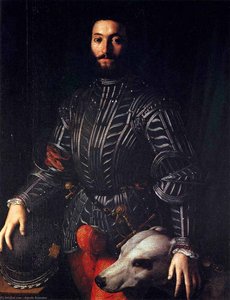
The portrait presents a man positioned in the center of the composition, viewed from the waist up. He wears highly detailed armor that reflects light in sharp, localized…

Ta hem den →
View of the Chapel of Eleonora da Toledo (1440) av Agnolo Bronzino
#64

View of the Chapel of Eleonora da Toledo

1440 · Palazzo Vecchio

The painting presents a view of a chapel featuring a fresco that depicts the life of Christ. Within this sacred setting, the scene is populated by numerous figures,…

Portrait of Bartolomeo Panciatichi (1540) av Agnolo Bronzino
#73

Portrait of Bartolomeo Panciatichi

1540 · Galleria degli Uffizi

Agnolo Bronzino’s “Portrait of Bartolomeo Panciatichi,” painted in 1540, is more than just a likeness; it's a meticulously crafted distillation of Renaissance ideals – a testament to the…

Ta hem den →
Moses strikes water from the wall rocks (1544) av Agnolo Bronzino
#75

Moses strikes water from the wall rocks

1544

The air feels heavy with anticipation as Moses raises his staff against the rugged, unyielding face of the rock. In this mid-sixteenth century fresco, a sudden, life-giving force…

Altarpiece (1540) av Agnolo Bronzino
#76

Altarpiece

1540 · Palazzo Vecchio

The year is 1540, and Florence pulses with the ambition of the Medici court. Within the private chapel of Eleonora di Toledo, Duchess of Florence, a masterpiece emerges…

Ta hem den →
Venus, Cupid and Envy (1548) av Agnolo Bronzino
#78

Venus, Cupid and Envy

1548 · Szépművészeti Múzeum

Painted in 1548 by the Florentine master Agnolo Bronzino, *Venus, Cupid and Envy* is a captivating embodiment of Mannerist aesthetics – a style characterized by its deliberate artifice,…

Beställ en reproduktion →
Portrait of Pope Clement VII (1564) av Agnolo Bronzino
#81

Portrait of Pope Clement VII

1564 · Galleria degli Uffizi

A Portrait of Dignified Majesty: Agnolo Bronzino’s Pope Clement VII The Portrait of Pope Clement VII, executed by Agnolo Bronzino in 1564, stands as a cornerstone of Mannerist…

Ta hem den →
untitled (4490) (1532) av Agnolo Bronzino
#82

untitled (4490)

1532

In the quiet, commanding presence of Agnolo Bronzino’s "untitled (4490)", we are transported back to the height of the Italian Renaissance, a period where portraiture served as both…

Beställ en reproduktion →
The Holy Family (1545) av Agnolo Bronzino
#83

The Holy Family

1545

The Holy Family by Agnolo Bronzino is a renowned oil painting that showcases the artist's skill in capturing dramatic scenes with incredible detail. Created in 1545, this tempera…

Ta hem den →
Lucrezia Panciatichi (1540) av Agnolo Bronzino
#85

Lucrezia Panciatichi

1540

In the grand tapestry of the Italian Renaissance, few portraits capture the poised sophistication of the Mannerist era as exquisitely as Agnolo Bronzino’s Lucrezia Panciatichi. Painted around 1540,…

Beställ en reproduktion →
Portrait of Guidubaldo della Rovere (1532) av Agnolo Bronzino
#99

Portrait of Guidubaldo della Rovere

1532 · Galleria Palatina

In the quiet, commanding presence of Agnolo Bronzino’s Portrait of Guidubaldo della Rovere, we encounter the very essence of the High Renaissance transitioning into the sophisticated artifice of…

Ta hem den →

Agnolo Bronzinos målningar per period

De motiv Agnolo Bronzino målade mest av

De fyra motiv som förekommer oftast bland dessa mästerverk, med det främsta exemplet på varje.

Var du kan se Agnolo Bronzinos målningar

De 8 museer som innehar flest av målningarna på denna sida.

Museum Stad Verk av Agnolo Bronzino Målningar från denna lista
Galleria degli Uffizi, FlorensGalleria degli Uffizi Florens 18 Holy Family, Portrait of Lucrezia Panciatichi, Pope Leo X
Palazzo Vecchio, FlorensPalazzo Vecchio Florens 11 Miracle of the Brazen Serpent, The Miracle of the Spring, Gathering of the Manna
Szépművészeti Múzeum, BudapestSzépművészeti Múzeum Budapest 8 Venus, Cupid and Jealousy, Adoration of the Shepherds, Venus, Cupid and Envy
National Gallery, LondonNational Gallery London 5 Venus, Cupid och Tid (Allegori över Lust), Venus cupid time, Venus, Cupid and Time (detail)
National Gallery of Art, WashingtonNational Gallery of Art Washington 4 Eleonora di Toledo, Portrait of Eleanora di Toledo, A Young Woman and Her Little Boy
Detroit Institute of Arts, DetroitDetroit Institute of Arts Detroit 2 Costanza da Sommaia, Madonna and Child with Saint John the Baptist
Walters Art Museum, BaltimoreWalters Art Museum Baltimore 2 The Feast Given by Joseph for His Brothers, Portrait of a Baby Boy
Royal Collection, LondonRoyal Collection London 2 Portrait of a Lady in Green, Portrait of a Lady in Green

Agnolo Bronzinos mest kända målning för varje decennium

  1. 1520s
    Virgin and Child with the Young Saint John the Baptist (1528) av Agnolo Bronzino
    #55 av 100

    Virgin and Child with the Young Saint John the Baptist

    Ålder 17 – 26 · Art Institute of Chicago

    In this Mannerist oil painting, three figures occupy a vertical, tightly cropped arrangement against a dark, near-black background. The Virgin Mary is positioned centrally, her form defined by…

  2. 1530s
    Portrait of Cosimo I de' Medici as Orpheus (1537) av Agnolo Bronzino
    Plats 9 av 100

    Portrait of Cosimo I de' Medici as Orpheus

    Ålder 27 – 36 · Philadelphia Museum of Art

    In this portrait, we encounter Cosimo I de' Medici, not merely as a ruler, but as the mythological musician Orpheus. He is positioned in a three-quarter view from…

  3. 1540s
    Venus, Cupid och Tid (Allegori över Lust) (1540) av Agnolo Bronzino
    #1 av 100

    Venus, Cupid och Tid (Allegori över Lust)

    Ålder 37 – 46 · National Gallery

    Agnolo Bronzinos mästerverk “Venus, Cupid och Tiden (Allegori av Lust)” är en fascinerande resa in i det komplexa och ofta förföriska landskapet under 1500-talets Florens. Detta inte bara…

  4. 1550s
    Portrait of Eleonora da Toledo (1555) av Agnolo Bronzino
    Nr. 2 av 100

    Portrait of Eleonora da Toledo

    Ålder 47 – 56

    To gaze upon Agnolo Bronzino's Portrait of Eleonora da Toledo is to step directly into the rarefied atmosphere of High Renaissance Florence. This painting, executed in 1555, transcends…

  5. 1560s
    Deposition (1565) av Agnolo Bronzino
    #6 av 100

    Deposition

    Ålder 57 – 66 · Galleria dell'Accademia di Firenze

    “Deposition,” painted in 1565 by the Florentine master Agnolo Bronzino, is not merely a religious scene; it's a meticulously crafted tableau of restrained emotion and profound psychological depth.…

Frågor om Agnolo Bronzinos målningar

Vilken är Agnolo Bronzinos mest kända målning?Visa svaret

Venus, Cupid och Tid (Allegori över Lust) (1540), National Gallery, London. Därefter följer Portrait of Eleonora da Toledo (1555) och Venus, Cupido and Satyr.

Hur gammal var Agnolo Bronzino när Venus, Cupid och Tid (Allegori över Lust) målades?Visa svaret

37 år gammal: Venus, Cupid och Tid (Allegori över Lust) dateras från 1540 och Agnolo Bronzino föddes 1503.

Vilka är de 10 främsta målningarna av Agnolo Bronzino?Visa svaret

Venus, Cupid och Tid (Allegori över Lust), Portrait of Eleonora da Toledo, Venus, Cupido and Satyr, Portrait of Andrea Doria as Neptune, St. John the Baptist, Deposition, Portrait of a Young Man, Cosimo de Medici in Armour, Portrait of Cosimo I de' Medici as Orpheus och Portrait of Eleonora of Toledo and Her Son, Francesco de'Medici. Rankingen ovan visar år och museum för varje verk.

Hur många målningar har Agnolo Bronzino skapat?Visa svaret

Vår katalog innehåller 189 verk av Agnolo Bronzino, daterade från 1525 till 1569.

Var finns Agnolo Bronzinos mest kända målningar?Visa svaret

De flesta av dem finns i Galleria degli Uffizi (Florens), Palazzo Vecchio (Florens) och Szépművészeti Múzeum (Budapest). Tabellen ovan listar museerna ett efter ett.

När målade Agnolo Bronzino sina mest kända verk?Visa svaret

Under 1540s: 36 av de 100 verk som finns på denna sida härstammar från den tiden, däribland Venus, Cupid och Tid (Allegori över Lust).

Vilka är Agnolo Bronzinos tidigaste och senaste kända målningar?Visa svaret

Det tidigaste på denna sida är St Matthew (1525), det senaste Martyrdom of St Lawrence (1569).

Vad målade Agnolo Bronzino oftast?Visa svaret

Renaissance (34), Portrait (17) och Woman (13), av totalt 100 verk på denna sida.

Vilket medium använde Agnolo Bronzino mest?Visa svaret

Oil On Panel: 28 av 100 verk på denna sida.

Vilken konstinriktning tillhör Agnolo Bronzino?Visa svaret

Manierism, som målningarna på denna sida visar.

Vilka målningar av Agnolo Bronzino kan jag se på Galleria degli Uffizi?Visa svaret

Holy Family, Portrait of Lucrezia Panciatichi och Pope Leo X är bland de 8 verk på denna sida som innehas av Galleria degli Uffizi, Florens.

Kan jag köpa en reproduktion av en Agnolo Bronzino-målning?Visa svaret

Ja. Varje målning på denna sida kan beställas som en handmålad oljereproduktion av museikvalitet eller som ett konsttryck i den storlek du väljer, direkt från målningens egen sida.

Om Agnolo Bronzino

Agnolo Bronzino – Florentine Mannerist Master & Court Painter

Agnolo di Cosimo, known to history as Bronzino, emerged from the vibrant artistic landscape of Renaissance Florence in 1503, a period already brimming with genius. Born the son of a butcher, his path diverged sharply from familial trade, guided instead by an innate talent that would see him become one of the most sought-after portraitists of his era and a defining figure of Mannerism. His early training began with Raffaellino del Garbo, but it was under the tutelage of Jacopo da Pontormo that Bronzino’s artistic sensibilities truly took shape. While absorbing Pontormo's innovative style, he ultimately forged his own distinct voice—one characterized by a cool composure and refined detail markedly different from his teacher’s often emotionally charged works. This early period was also influenced by studies with Andrea del Sarto, exposing him to the legacies of Michelangelo and Leonardo da Vinci, foundational influences that would subtly permeate his mature style. The young Bronzino quickly demonstrated an aptitude for capturing not just physical likeness but a certain psychological depth, even in his earliest commissions.

Early Influences & Artistic Formation

Bronzino’s formative years were marked by exposure to the artistic currents of Florence under Pontormo and Sarto. Pontormo's expressive style—characterized by swirling draperies, distorted perspectives, and emotionally charged figures—challenged the prevailing conventions of High Renaissance art. Bronzino absorbed these innovations, adapting them into his own distinctive aesthetic. Simultaneously, he studied Michelangelo’s monumental sculptures and Leonardo da Vinci’s meticulous anatomical drawings, imbibing their mastery of form and observation. These influences instilled in him a profound respect for technical precision and an unwavering commitment to conveying psychological complexity—traits that would become hallmarks of his artistic practice. His early portraits already hinted at the stylistic refinements that would characterize his later oeuvre.

Ascension at the Medici Court

Bronzino’s career ascended dramatically with the patronage of Cosimo I de’ Medici, Duke of Tuscany. This relationship, solidified after Bronzino contributed to the lavish decorations celebrating Cosimo’s wedding to Eleonora di Toledo in 1539—a spectacle designed to impress both domestic and foreign dignitaries—cemented his position as the official court painter for much of his life. It was a role he fulfilled with unwavering dedication and remarkable skill. The portraits emanating from this period are not merely likenesses; they are carefully constructed statements of power, status, and dynastic ambition. Cosimo and Eleonora themselves became frequent subjects, immortalized in paintings that exude an aristocratic aloofness and polished elegance. These works weren’t simply about capturing physical resemblance but crafting enduring symbols of Medici authority—visual representations intended to convey prestige and reinforce the ruler's dominion. He skillfully utilized techniques such as sfumato (a subtle blending of colors) and chiaroscuro (the dramatic interplay of light and shadow) to heighten emotional impact and create an illusionistic depth that captivated viewers.

The Mannerist Style – Refinement & Innovation

Bronzino’s artistic style is quintessentially Mannerist—a movement that flourished in Italy during the mid-16th century as a reaction against the High Renaissance's emphasis on naturalism and harmonious balance. He embraced elongated forms, stylized poses, and an often cool, detached emotionality. His figures are rarely caught in moments of spontaneous action; instead, they appear carefully posed, almost sculptural in their stillness. This deliberate distancing from naturalistic representation—a hallmark of Mannerist aesthetics—was achieved through meticulous attention to detail and a masterful manipulation of visual illusion. Bronzino’s palette was subdued compared to the vibrant hues favored by his predecessors, prioritizing tonal harmonies and subtle gradations of color. He employed techniques such as glazing—applying thin layers of translucent pigment over underlying colors—to create luminous surfaces and enhance textural richness. His portraits are renowned for their meticulous attention to detail—the textures of fabrics, the gleam of jewels, the subtle nuances of expression—all rendered with an almost enamel-like precision. This dedication to surface refinement and intellectual complexity distinguishes Bronzino’s work from that of his contemporaries. He wasn't interested in simply replicating reality; he sought to elevate it through artifice and stylistic control.

Legacy & Enduring Influence

Bronzino’s influence extended far beyond Florence, impacting court portraiture throughout Europe for generations. The cool elegance and refined technique he championed became hallmarks of aristocratic representation—a deliberate departure from the emotional fervor of earlier artistic traditions. His masterful compositions and meticulous rendering of detail continue to inspire admiration among art historians and collectors alike. Though his style fell somewhat out of favor during periods that prioritized more emotive or naturalistic approaches, Bronzino’s work has experienced a resurgence in appreciation in recent decades. Scholars now recognize the intellectual depth and stylistic innovation inherent in his art—a testament to his enduring contribution to Renaissance painting and a symbol of Florentine artistic excellence. He passed away in Florence in 1572, leaving behind a legacy as one of the most important Mannerist painters—a master of reserved elegance whose portraits continue to captivate and intrigue viewers centuries later.

Alla 189 verk av Agnolo Bronzino →