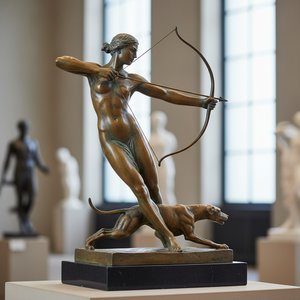
Risto Stijović: A Life in Sculpture
- Born: Podgorica, Montenegro (1894)
- Died: 1974
- Nationality: Yugoslav & Serbian
Risto Stijović was a highly original and significant sculptor from Yugoslavia, widely regarded as the most important artist from Montenegro. His work, deeply rooted in Yugoslav nature and culture, established him as a master of sculpting animal figures and a key figure in modernist sculpture.
Early Life and Education
- Stijović's artistic journey began in 1912 when he enrolled at the Serbian School of Fine Arts under the tutelage of Đorđe Jovanović.
- His education was interrupted by World War I, during which he served in the Serbian Army. He endured a harrowing experience being imprisoned in Banjica concentration camp during World War II – an event that profoundly impacted his life and artistic expression.
- Following the war, Stijović continued his studies in France, first at Marseille art school with a French government scholarship, then at the École des Beaux-Arts in Paris. He married Jeanette in 1922 while living in Paris.
Artistic Career and Style
- Stijović's artistic career is characterized by his unique modernist style, influenced by contemporary movements and artists like Picasso, Matisse, Pompon, and Maillol. He exhibited alongside these masters in the early 1920s.
- He is particularly celebrated for his sculptures of animal figures, demonstrating a remarkable mastery of form and detail. His work also encompasses female nudes, portraits, reliefs, architectural decorative sculptures, and monumental public sculptures.
- Stijović’s preferred materials included wood, bronze, marble, and gypsum. He developed a distinctive plastic style, carefully shaping the material while respecting its inherent structure.
- A notable work is Caryatid (1931), a wooden sculpture housed at the Pavle Beljanski Memorial Collection in Novi Sad, Serbia.
Major Achievements and Legacy
- Stijović’s contributions to art were recognized internationally, notably with the Grand Prix – a gold medal at the World Exhibition in Paris in 1937, where he represented Yugoslav sculpture.
- He held professorship at Third Male Gymnasium in Belgrade and became a regular member of the Serbian Academy of Sciences and Arts (SANU) in 1965.
- His legacy extends beyond his individual works; Stijović is credited with founding the modernist expression in sculpture within Montenegro, inspiring generations of artists.
- The Gallery Risto Stijović in Podgorica preserves and showcases his work, highlighting his significant contribution to Montenegrin art.
Collections and Recognition
- Narodni Muzej, Belgrade, Serbia
- Museo del Novecento, Milan, Italy
- Pavle Beljanski Memorial Collection, Novi Sad, Serbia
- Numerous private collections worldwide