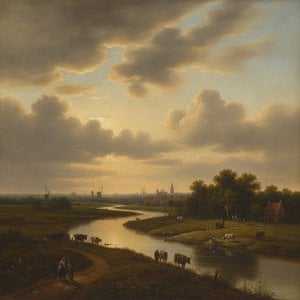
A Refined Vision of the Dutch Golden Age: Pieter van der Werff
Pieter van der Werff, a name perhaps less immediately recognized than those of Rembrandt or Vermeer, nevertheless occupies a significant and fascinating niche within the pantheon of Dutch Golden Age painters. Born in The Hague in 1665 and passing away in Rotterdam in 1722, his career unfolded during a period of immense artistic flourishing in the Netherlands, yet he carved out a distinctive style characterized by elegance, meticulous detail, and an early embrace of innovative pigments. His life was deeply intertwined with that of his brother, Adriaen van der Werff, who served as both mentor and foundational influence, shaping Pieter’s trajectory from its earliest stages. While Adriaen achieved considerable renown – even securing a prestigious position at the court of the Elector Palatine – Pieter established himself primarily in Rotterdam, becoming the favored portraitist of the city's affluent citizenry and leaving behind a legacy that offers invaluable insights into the social fabric and aesthetic sensibilities of his time.Formative Years and Artistic Development
The artistic education received by Pieter van der Werff was profoundly shaped by familial ties. His older brother, Adriaen, already an established painter, provided not only technical instruction but also a crucial introduction to the prevailing artistic currents of the day. This early tutelage instilled in Pieter a commitment to precision and refinement, qualities that would become hallmarks of his mature style. He quickly distinguished himself through a remarkable ability to capture likenesses with both accuracy and psychological depth. His portraits weren’t merely representations of physical appearance; they were carefully constructed portrayals of status, personality, and social standing. The Baroque aesthetic, dominant during this era, profoundly influenced his work, manifesting in dramatic compositions, rich color palettes, and a heightened sense of emotional intensity. However, Pieter tempered the grandiosity often associated with Baroque art with a distinctly Dutch sensibility – a focus on realism, intimate detail, and a subtle psychological nuance that set him apart from many of his contemporaries. He diligently studied under Adriaen’s guidance, absorbing not only artistic techniques but also a deep understanding of humanist ideals prevalent during the period.Portraits, Mythological Scenes, and a Pioneering Spirit
Van der Werff’s artistic output was diverse, encompassing portraiture, mythological scenes, historical narratives, and occasional forays into genre painting. However, it is in the realm of portraiture that he truly excelled. He immortalized prominent figures such as Paulus Verschuur, a Burgomaster of Rotterdam, and even Peter the Great of Russia, demonstrating his ability to convey power and authority through masterful brushwork and astute observation. These portraits are not simply historical records; they are compelling studies in character, revealing the inner lives of those who commissioned them. Beyond portraiture, Van der Werff engaged with classical mythology and history, creating works like “Expulsion of Adam and Eve” and “Granida and Diafilo,” which showcase his skill in depicting dramatic narratives and complex compositions. He also explored more intimate scenes of everyday life, as seen in paintings such as “Bellen blazen (Bubble Blowing),” revealing a sensitivity to the nuances of human interaction. His artistic vision extended beyond mere representation; he sought to capture the essence of his subjects—their dignity, ambition, and inner turmoil—with remarkable empathy.A Masterstroke: The Use of Prussian Blue
Perhaps one of Van der Werff’s most significant contributions was his pioneering use of Prussian blue, a newly discovered pigment in the early 18th century. He was among the first Dutch painters to extensively incorporate this vibrant hue into his work, recognizing its potential to add depth, richness, and luminosity to his compositions. This innovative approach became a defining characteristic of his style, setting him apart from other artists of his generation. The introduction of Prussian blue revolutionized painting techniques, allowing for unprecedented tonal ranges and creating an ethereal quality that captivated audiences. It exemplifies Van der Werff’s willingness to embrace new artistic possibilities—a testament to his intellectual curiosity and creative spirit.Legacy and Historical Significance
Pieter van der Werff’s importance extends beyond the aesthetic qualities of his paintings. His work serves as a valuable historical document, offering insights into the lives, fashions, and cultural values of Rotterdam's elite during the Dutch Golden Age. His portraits provide a visual record of the individuals who shaped the city’s political, economic, and social landscape. He remains an influential figure in art history, remembered for his refined technique, innovative pigment use, and unwavering dedication to capturing the human spirit. His paintings continue to be admired for their elegance, precision, and psychological depth, offering a compelling glimpse into a bygone era—a period marked by artistic brilliance and societal transformation. His enduring legacy resides in his contribution to Dutch Baroque painting and his role as a chronicler of an extraordinary moment in European culture.Frågor & svar
Var kan jag se Pieter van der Werffs konstverk i kronologisk ordning?
En tidslinje över Pieter van der Werffs verk finns tillgänglig: på artistens Tidslinje för konstverk-sida sorteras verken efter skapelsedatum.
Hur hittar jag verk av Pieter van der Werff inom ett specifikt tema?
Pieter van der Werffs verk kan utforskas via nyckelord på artistens Efter nyckelord-sida. Varje nyckelord grupperar de relaterade konstverken.
Hur många konstverk av Pieter van der Werff finns tillgängliga att bläddra bland?
Du kan bläddra bland 64 konstverk verk av Pieter van der Werff på sidan Alla konstverk.