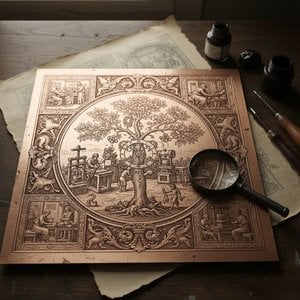
Oleksandr Aksinin: A Master of Soviet Printmaking
Oleksandr Aksinin emerged as a pivotal figure within the Soviet art scene, born in Lviv, Ukraine, in 1949. Details concerning his formative years remain somewhat elusive, yet his unwavering commitment to artistic pursuits was palpable from an early age—a dedication that would ultimately define his extraordinary career. He swiftly embraced etching, a printmaking technique that transcended mere craftsmanship and became inextricably linked with his artistic identity and enduring legacy.Artistic Development and Style
Aksinin’s distinctive style is characterized by an unparalleled level of meticulousness and precision. This exacting approach earned him the moniker ‘Dürer of Lviv,’ a poignant acknowledgment of his exceptional technical prowess and visionary artistic vision—a comparison that speaks volumes about his mastery of form and execution. His oeuvre predominantly portrays scenes from Ukrainian life, particularly serene winter landscapes and evocative rural vistas, rendered with breathtaking realism and imbued with palpable atmospheric depth. He skillfully manipulated complex compositions and subtle tonal variations within his etchings, demonstrating a profound understanding of light and shadow—elements he treated as instruments of expressive power.Notable Works and Contributions
“The End of Winter” stands as one of Aksinin’s most celebrated achievements, encapsulating his remarkable ability to distill the very essence of Ukrainian winter into an image of breathtaking detail and emotional resonance. Similarly, “Haymaking,” a cornerstone of his artistic output, captures the rhythmic beauty of rural labor—offering viewers a poignant glimpse into Ukraine's traditions and cultural heritage. Beyond these iconic pieces, Aksinin produced a remarkably diverse body of work encompassing portraits, landscapes, and abstract compositions—all united by his singular etching technique. This technique allowed him to convey profound philosophical ideas through visual metaphors, mirroring the influence of thinkers like Albert Einstein and Mikhail Bakhtin.Influences and Artistic Context
Although specific artistic influences remain sparsely documented, Aksinin’s work undeniably reflects a deep connection with the traditions of printmaking—drawing inspiration from masters such as Albrecht Dürer, Hieronymus Bosch, and Giovanni Battista Piranesi. His oeuvre navigates the complexities inherent in socialist realism while simultaneously maintaining a distinctive artistic voice—a testament to his ability to reconcile ideological imperatives with personal creative expression. The cultural landscape of Ukraine during Aksinin’s lifetime profoundly shaped his subject matter and aesthetic sensibilities—providing fertile ground for exploring themes of solitude, existential anxiety, and the search for meaning.Legacy and Historical Significance
Despite a tragically premature demise in 1985, Oleksandr Aksinin cemented his place as a monumental figure within Soviet printmaking history. Art historians recognize him as a true innovator—a visionary artist who elevated etching to new heights of expressive sophistication. His works are housed in prestigious museum collections across Europe—including the Kharkov Museum of Art and the Lugansk Regional Art Museum (Ukraine)—ensuring that his artistic legacy continues to inspire future generations of artists. Aksinin’s oeuvre serves as a valuable chronicle of Ukrainian culture during the Soviet era—illuminating both its triumphs and tribulations—and remains an enduring symbol of artistic excellence and intellectual curiosity.Frågor & svar
Kan jag bläddra i Oleksandr Aksinins verk efter konststil?
Sidan Alla epoker grupperar Oleksandr Aksinins konstverk efter konstinriktning.
Var och när föddes Oleksandr Aksinin?
Oleksandr Aksinin föddes i Lviv år 1949.
I vilken stad och vilket land föddes Oleksandr Aksinin?
Oleksandr Aksinin föddes i Lviv i Ukraina.
Finns det en översikt över alla de motiv som Oleksandr Aksinin målade?
Oleksandr Aksinins verk kan utforskas efter motiv på artistens Ämnesatlas-sida.
Var kommer Oleksandr Aksinin ifrån?
Oleksandr Aksinin föddes i Ukraina.
Hur kan jag se alla konstverk skapade av Oleksandr Aksinin?
Varje verk av Oleksandr Aksinin på denna webbplats kan utforskas via artistens Alla konstverk-sida.
Vilka stämningar uttrycker Oleksandr Aksinins konstverk?
Känslomässigt rum för Oleksandr Aksinin är en sida som sorterar konstnärens verk efter stämning.