Ludovic Piette (1826–1878): A Quiet Observer of Impressionist Landscapes
Ludovic Piette, born in Niort, Deux-Sèvres, France, on May 11th, 1826, was a French Impressionist painter whose artistic journey unfolded amidst the vibrant intellectual and aesthetic currents of late nineteenth-century Paris. Though often overshadowed by his more flamboyant contemporaries like Monet and Renoir, Piette possessed a distinctive vision—one rooted in meticulous observation of nature and imbued with a subtle sensitivity to light and color—that nonetheless contributed significantly to the burgeoning Impressionist movement. His life was marked by both personal hardship and artistic dedication, culminating in a tragically premature death at Montfoucault, Brittany, on April 14th, 1878.Early Influences and Artistic Training
Piette’s formative years were shaped by his familial background—he descended from a family of minor nobility—and benefited from the guidance of influential educators like Isidore Pils and Thomas Couture at the École des Beaux-Arts in Paris. Couture, particularly, instilled in Piette a foundational understanding of academic painting techniques, yet it was Manet’s pioneering experimentation with new styles that ignited Piette's creative spirit. This encounter proved pivotal, propelling him toward a path diverging from traditional artistic conventions and fostering an appreciation for capturing fleeting moments of visual experience.Friendship with Camille Pissarro: The Dawn of Impressionism
A defining relationship in Piette’s artistic life was his enduring friendship with Camille Pissarro. Their collaboration began in 1861, when Pissarro painted Piette's portrait—a testament to their mutual admiration and shared commitment to exploring the transformative potential of plein air painting. This connection extended beyond mere companionship; Pissarro actively encouraged Piette’s embrace of Impressionist principles, guiding him toward a looser brushstroke style and prioritizing the depiction of natural light as it shifted throughout the day. Their correspondence from 1863 to 1877 provides invaluable insight into the formative years of Impressionism—a period characterized by intellectual debate and artistic innovation.The Landscape Painter's Vision: Exploring Brittany and Beyond
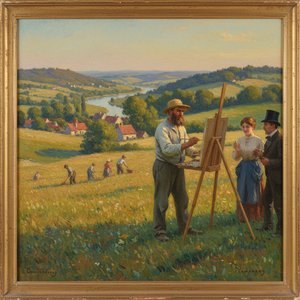
Piette’s artistic focus centered predominantly on landscape painting, particularly scenes from Brittany—where he established a rural retreat at Monfoucault—and Louveciennes. Unlike many of his peers who sought grand vistas or dramatic compositions, Piette favored quieter landscapes populated by figures—often rendered with understated realism—capturing the subtle nuances of atmosphere and color. His paintings convey a profound respect for the natural world, reflecting a humanist sensibility that resonated deeply with the spirit of Impressionism. Notable works include “Hay Moving at Montfoucault” (1876), "The Grove" and "Riverside Scene," which exemplify his distinctive aesthetic approach.Legacy and Recognition
Though Piette’s output remained modest compared to some of his contemporaries, his contribution to the Impressionist movement is undeniable. His paintings—characterized by their luminous color palettes and meticulous attention to detail—stand as emblems of a particular artistic sensibility—one prioritizing observation and capturing ephemeral beauty. Following his death in 1878, Piette’s work was honored at the fourth Impressionist exhibition in 1879, cementing his place within art history. Furthermore, a street in Pontoise bears his name—a lasting tribute to an artist who quietly persisted in pursuing his vision of Impressionism.- Notable Works: Hay Moving at Montfoucault (1876), The Grove, Riverside Scene
- Influences: Isidore Pils, Thomas Couture, Camille Pissarro
- Location: Monfoucault, Brittany