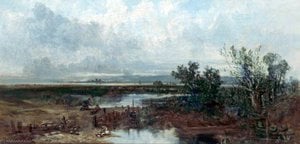
John Wright Oakes, 1820 – 1887

John Wright Oakess målningar: De 25 mest kända verken, rankade

John Wright Oakess mest kända målning är Moonlight, Near Cemmaes, Anglesea (1871). Tillsammans med A North Devon Glen, Autumn (1870) och Slate Quarries, Llanberis (1847) utgör de de tre verk som alla känner igen. Vår katalog listar 25 verk av John Wright Oakes; de 25 nedan är de som världen betraktar mest, var och ett med sitt årtal, museet som förvarar det och varför det är betydelsefullt.

Rankade efter vår popularitetspoäng, som kombinerar sökningar, besök och beställningar för varje verk. Uppdaterad november 2026. Varje mästerverk på denna sida kan beställas som en handmålad oljereproduktion av museikvalitet eller som ett konsttryck i den storlek du väljer.

Porträtt av John Wright Oakes
John Wright Oakes · 1820 – 1887
Född · död
1820 – 1887, Cheshire West and Chester
Verk i vår katalog
25
Mest kända
Moonlight, Near Cemmaes, Anglesea (1871)
Flest verk på
Walker Art Gallery

De 10 mest kända målningarna av John Wright Oakes

Moonlight, Near Cemmaes, Anglesea (1871) av John Wright Oakes
1

Moonlight, Near Cemmaes, Anglesea

1871 · Oil

In Moonlight, Near Cemmaes, Anglesea, John Wright Oakes captures a moment of profound stillness as the sun begins its descent or perhaps prepares to rise, casting warm, glowing hues across the sky. A tranquil landscape unfolds, centered around a quiet body of water that mirrors the shifting colors of the heavens. Upon this liquid surface, a small boat carries a single figure, a solitary presence that provides a sense of…

Handmålad oljereproduktion från $181 35 × 29 cm
Slate Quarries, Llanberis (1847) av John Wright Oakes
3

Slate Quarries, Llanberis

1847 · Oil On Canvas · Harris Museum - Art Gallery, Preston

is an oil painting by John Wright Oakes, executed in 1847. The artist, born in 1820 in Cheshire West and Chester, United Kingdom, transitioned from the precise study of still-life fruit pieces to the direct observation of the natural landscape. This work emerged during a period of significant industrial expansion and a simultaneous romantic interest in the untouched natural world.

Handmålad oljereproduktion från $181 35 × 28 cm Samma storlek som originalet $255 66 × 52 cm Beställ i originalstorlek →
The Mouth of the River Derwent (1848) av John Wright Oakes
4

The Mouth of the River Derwent

1848 · Oil On Canvas · Nottingham Castle Museum And Art Gallery, Nottingham

The landscape captures the confluence of the River Derwent, where the water meets the horizon under a vast, shifting sky. Mountains rise in the background, their forms softened by the heavy, moisture-laden air characteristic of the British Isles. A single boat floats upon the surface, a small, solitary presence amidst the expanse of the river. Scattered figures populate the banks, their scale emphasizing the quiet magnitude of the natural environment.…

Handmålad oljereproduktion från $181 39 × 25 cm Samma storlek som originalet $507 125 × 94 cm Beställ i originalstorlek →
Landscape, Woman by River (1850) av John Wright Oakes
5

Landscape, Woman by River

1850 · Oil

A single figure stands at the river's edge, a silent witness to the slow movement of the current. The water flows past stones smoothed by time, its surface catching the pale light of a day governed by shifting clouds. In the distance, mountains rise like heavy shadows against a sky filled with soft, drifting shapes. The air feels still, held in the balance between the solid earth and the moving…

Handmålad oljereproduktion från $181 39 × 26 cm Samma storlek som originalet $195 47 × 31 cm Beställ i originalstorlek →
Barmouth (1870) av John Wright Oakes
6

Barmouth

1870 · Oil On Canvas

The salt air seems to drift from the canvas as a group of riders moves through a lush field near the ocean. Horses carry their passengers across the verdant expanse, their movement suggesting a slow, rhythmic pace under the wide sky. In the distance, a solitary boat rests upon the water, a small detail that anchors the vastness of the sea against the land. Birds scatter through the air, their…

Handmålad oljereproduktion från $181 37 × 27 cm Samma storlek som originalet $776 170 × 122 cm Beställ i originalstorlek →
Malltreath Bay (1864) av John Wright Oakes
7

Malltreath Bay

The canvas depicts a group of individuals engaged in the manual task of stacking hay within a field. At least six figures are positioned throughout the scene, some situated in the immediate foreground while others are placed further back in the midground. The hay is gathered into various piles of differing sizes, suggesting the systematic collection of material from across the expanse of the field. In the distance, the landscape…

Handmålad oljereproduktion från $181 38 × 26 cm Samma storlek som originalet $720 160 × 118 cm Beställ i originalstorlek →
Loch Muick, Aberdeenshire (1867) av John Wright Oakes
8

Loch Muick, Aberdeenshire

1867 · Oil On Canvas · Laing Art Gallery, Newcastle upon Tyne

Loch Muick, Aberdeenshire by John Wright Oakes presents a landscape centered on a lake situated beneath a series of mountains and hills. The composition includes a rocky shore in the foreground, where the terrain meets the water's edge. The arrangement of the landforms creates a sense of depth, leading the eye from the immediate shoreline toward the rising elevations in the distance. The scene is populated by several birds scattered…

Handmålad oljereproduktion från $181 37 × 27 cm Samma storlek som originalet $774 168 × 123 cm Beställ i originalstorlek →
Morning at Angera, Lago Maggiore (1865) av John Wright Oakes
9

Morning at Angera, Lago Maggiore

1865 · Oil On Canvas · Walker Art Gallery, Liverpool

In Morning at Angera, Lago Maggiore, John Wright Oakes captures a lively scene unfolding along the water's edge. The shore is alive with a group of people gathered on the beach, their presence suggesting a leisurely day spent in the company of friends or family. Some figures hold umbrellas aloft, perhaps to shield themselves from the sun or to ward off a sudden light rain. Near the center of the…

Handmålad oljereproduktion från $181 39 × 26 cm Samma storlek som originalet $493 127 × 89 cm Beställ i originalstorlek →
Picking up Wreckage on a Rocky Shore (1864) av John Wright Oakes
10

Picking up Wreckage on a Rocky Shore

1864 · Oil · New Walk Museum - Art Gallery, Leicester

Picking up Wreckage on a Rocky Shore by John Wright Oakes presents a realistic depiction of a dramatic coastal scene. Painted about 1864, the work captures a tumultuous maritime environment where the sea crashes against a rugged, rocky shoreline. The atmosphere is defined by a heavy, overcast sky filled with dark clouds, suggesting the immediate aftermath of a storm or the onset of tempestuous weather.

Handmålad oljereproduktion från $181 42 × 24 cm Samma storlek som originalet $289 87 × 52 cm Beställ i originalstorlek →

John Wright Oakes, målningar 11 till 25

Glen Muick, Aberdeenshire (1872) av John Wright Oakes

John Wright Oakes presents a mountainous landscape in Glen Muick, Aberdeenshire, created about 1872. The composition centers on a river flowing through the rugged terrain, cutting through the…

Ta hem den från $181 →

De motiv John Wright Oakes målade mest av

De fyra motiv som förekommer oftast bland dessa mästerverk, med det främsta exemplet på varje.

Var du kan se John Wright Oakess målningar

De 7 museer som innehar flest av målningarna på denna sida.

Museum Stad Verk av John Wright Oakes Målningar från denna lista
Walker Art Gallery, LiverpoolWalker Art Gallery Liverpool 3 A North Devon Glen, Autumn, Morning at Angera, Lago Maggiore, The Tivey at Newcastle Emlyn, Cardiganshire
Nottingham Castle Museum And Art Gallery, NottinghamNottingham Castle Museum And Art Gallery Nottingham 2 The Mouth of the River Derwent, A Sandy Bit of Road
Harris Museum - Art Gallery, PrestonHarris Museum - Art Gallery Preston 1 Slate Quarries, Llanberis
Ludlow Library - Museum Resource Centre, LudlowLudlow Library - Museum Resource Centre Ludlow 1 Malltreath Bay
Laing Art Gallery, Newcastle upon TyneLaing Art Gallery Newcastle upon Tyne 1 Loch Muick, Aberdeenshire
New Walk Museum - Art Gallery, LeicesterNew Walk Museum - Art Gallery Leicester 1 Picking up Wreckage on a Rocky Shore
Touchstones Rochdale, RochdaleTouchstones Rochdale Rochdale 1 Mountain Stream, Glen Derry, Aberdeenshire, 'Like time the restless waters rush along'

John Wright Oakess mest kända målning för varje decennium

  1. 1840s
    Slate Quarries, Llanberis (1847) av John Wright Oakes
    Nr. 3 av 25

    Slate Quarries, Llanberis

    Ålder 20 – 29 · Harris Museum - Art Gallery

    is an oil painting by John Wright Oakes, executed in 1847. The artist, born in 1820 in Cheshire West and Chester, United Kingdom, transitioned from the precise study…

  2. 1850s
    Landscape, Woman by River (1850) av John Wright Oakes
    #5 av 25

    Landscape, Woman by River

    Ålder 30 – 39

    A single figure stands at the river's edge, a silent witness to the slow movement of the current. The water flows past stones smoothed by time, its surface…

  3. 1860s
    Malltreath Bay (1864) av John Wright Oakes
    #7 av 25

    Malltreath Bay

    Ålder 40 – 49 · Ludlow Library - Museum Resource Centre

    The canvas depicts a group of individuals engaged in the manual task of stacking hay within a field. At least six figures are positioned throughout the scene, some…

  4. 1870s
    Moonlight, Near Cemmaes, Anglesea (1871) av John Wright Oakes
    #1 av 25

    Moonlight, Near Cemmaes, Anglesea

    Ålder 50 – 59

    In Moonlight, Near Cemmaes, Anglesea, John Wright Oakes captures a moment of profound stillness as the sun begins its descent or perhaps prepares to rise, casting warm, glowing…

  5. 1880s

Frågor om John Wright Oakess målningar

Vilken är John Wright Oakess mest kända målning?Visa svaret

Moonlight, Near Cemmaes, Anglesea (1871). Därefter följer A North Devon Glen, Autumn (1870) och Slate Quarries, Llanberis (1847).

Hur gammal var John Wright Oakes när Moonlight, Near Cemmaes, Anglesea målades?Visa svaret

51 år gammal: Moonlight, Near Cemmaes, Anglesea dateras från 1871 och John Wright Oakes föddes 1820.

Vilka är de 10 främsta målningarna av John Wright Oakes?Visa svaret

Moonlight, Near Cemmaes, Anglesea, A North Devon Glen, Autumn, Slate Quarries, Llanberis, The Mouth of the River Derwent, Landscape, Woman by River, Barmouth, Malltreath Bay, Loch Muick, Aberdeenshire, Morning at Angera, Lago Maggiore och Picking up Wreckage on a Rocky Shore. Rankingen ovan visar år och museum för varje verk.

Hur många målningar har John Wright Oakes skapat?Visa svaret

Vår katalog innehåller 25 verk av John Wright Oakes, daterade från 1847 till 1887.

Var finns John Wright Oakess mest kända målningar?Visa svaret

De flesta av dem finns i Walker Art Gallery (Liverpool), Nottingham Castle Museum And Art Gallery (Nottingham) och Harris Museum - Art Gallery (Preston). Tabellen ovan listar museerna ett efter ett.

När målade John Wright Oakes sina mest kända verk?Visa svaret

Under 1870s: 10 av de 25 verk som finns på denna sida härstammar från den tiden, däribland Moonlight, Near Cemmaes, Anglesea.

Vilka är John Wright Oakess tidigaste och senaste kända målningar?Visa svaret

Det tidigaste på denna sida är Slate Quarries, Llanberis (1847), det senaste A coastal scene with figures by beached fishing boats in the foreground (1887).

Vad målade John Wright Oakes oftast?Visa svaret

Water (8), People (7) och Mountains (6), av totalt 25 verk på denna sida.

Vilket medium använde John Wright Oakes mest?Visa svaret

Oil On Canvas: 10 av 25 verk på denna sida.

Vilka målningar av John Wright Oakes kan jag se på Walker Art Gallery?Visa svaret

A North Devon Glen, Autumn, Morning at Angera, Lago Maggiore och The Tivey at Newcastle Emlyn, Cardiganshire är bland de 3 verk på denna sida som innehas av Walker Art Gallery, Liverpool.

Kan jag köpa en reproduktion av en John Wright Oakes-målning?Visa svaret

Ja. Varje målning på denna sida kan beställas som en handmålad oljereproduktion av museikvalitet eller som ett konsttryck i den storlek du väljer, direkt från målningens egen sida.

Om John Wright Oakes

The Soul of the Welsh Landscape: The Life and Art of John Wright Oakes

In the heart of the Victorian era, a period defined by both industrial expansion and a profound romantic longing for the untouched natural world, the works of John Wright Oakes emerged as a poignant bridge between reality and imagination. Born in 1820 at Sproston House near Middlewich, Cheshire, Oakes was a man whose lineage and upbringing provided a stable foundation for a life dedicated to the pursuit of aesthetic truth. While his early years were rooted in the English countryside, his artistic spirit found its true home amidst the rugged, mist-shrouded peaks and dramatic coastlines of Wales. His journey from a student of fine details to a master of atmospheric grandeur represents one of the most compelling narratives of nineteenth-century British landscape painting.

Oakes’s formal training began in Liverpool, where he studied under the guidance of John Bishop at the school attached to the Liverpool Mechanics’ Institution. This early education instilled in him a meticulous discipline that would later serve as the bedrock for his more expansive works. Interestingly, his initial foray into the art world was not through the sweeping vistas for which he is now celebrated, but through the delicate and precise genre of fruit paintings. These early still lifes, exhibited at the Liverpool Academy—where he eventually served as an honorary secretary—demonstrated a profound understanding of texture, light, and form. However, around 1843, a transformative shift occurred; drawn by the raw power of nature, Oakes began painting directly from the landscape, trading the controlled environment of the studio for the unpredictable beauty of the outdoors.

A Mastery of Light and Romantic Grandeur

The transition from still life to landscape allowed Oakes to explore the tenets of Romanticism, an art movement that prioritized emotion, the sublime, and the awe-inspiring power of the natural world. Influenced by the legendary techniques of masters like Turner and Constable, Oakes developed a signature style characterized by masterful tonal modulation and atmospheric perspective. He possessed a rare ability to capture the fleeting, ephemeral qualities of light—the way a sudden sunbeam pier sculpting through heavy clouds, or the soft, melancholic glow of twilight over a mountain glen. His canvases were not merely topographical records but emotional landscapes that invited the viewer to feel the dampness of the mist and the chill of the wind.

His technical prowess was particularly evident in his treatment of diverse terrains:

  • Mountainous Vistas: In works inspired by Snowdonia, he utilized rugged textures and dramatic shadows to convey the intimidating majesty of the Welsh peaks.
  • Coastal Scenes: His depictions of places like Aberffraw Bay and Malldraeth Sands showcased a fluid command of water, capturing the turbulent energy of the sea meeting the shore.
  • Rural Serenity: In pieces such as A North Devon Glen, Autumn, he employed warm palettes and soft brushstrokes to evoke a sense of pastoral peace and seasonal transition.

Legacy and Artistic Triumph

The trajectory of Oakes’s career was marked by consistent recognition from the most prestigious institutions of his time. His debut in London at the Royal Academy in 1847, featuring On the River Greta, Keswick, signaled his arrival as a significant force in British art. Throughout his prolific life, he became a regular contributor to the Society of British Artists, the Dudley Gallery, and the Portland Gallery. His accolades were numerous, including being elected an Associate of the Royal Academy in 1876 and receiving honorary membership in the Royal Scottish Academy in 1883. Even as ill health began to impede his physical practice in his final years, his dedication to the craft remained unshaken, continuing to exhibit at the Royal Academy until the very end.

Today, the historical significance of John Wright Oakes lies in his ability to have captured the vanishing essence of the nineteenth-century landscape. His works, now held in esteemed collections such as the Walker Art Gallery and the Nottingham Castle Museum, serve as windows into a world of sublime beauty and quiet contemplation. He remains a vital figure for anyone seeking to understand the Victorian fascination with the wild, untamed corners of the British Isles, leaving behind a legacy of over 300 canvases that continue to resonate with visual splendor and psychological depth.