John Henry Lorimer: A Scottish Painter of Domestic Life and Architectural Legacy
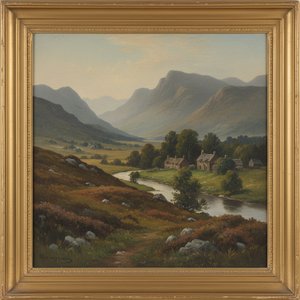
John Henry Lorimer (1856 – 1936) was a Scottish painter whose artistic output primarily focused on capturing the nuances of everyday life—particularly domestic scenes—and celebrating the grandeur of Kellie Castle, a project inextricably linked to his brother’s architectural endeavors. Born in Edinburgh, Lorimer descended from a family steeped in intellectual pursuits; his father, James Lorimer, held a prestigious professorship at Edinburgh University, shaping young John's academic foundation. Educated at Edinburgh Academy and subsequently Edinburgh University, he honed his artistic skills further through studies at the Royal Scottish Academy, mentored by influential figures like Frank McTaggart and William Chalmers. This formative period instilled in him a deep appreciation for Impressionistic techniques and compositional considerations—a stylistic choice that would define much of his oeuvre. Lorimer’s early artistic explorations were marked by an unwavering dedication to realism, mirroring the prevailing aesthetic sensibilities of Victorian Britain. He diligently rendered portraits of prominent individuals – including Lyon Playfair, Joseph Lister, Peter Hately Waddell – capturing their likenesses with remarkable accuracy while subtly conveying their personalities and inner lives. These commissions underscored Lorimer’s mastery of technique and his ability to distill complex character traits into visually compelling representations. His landscapes, notably “A Peaceful Art and Kellie Castle Garden,” exemplify the Romantic tradition's fascination with sublime beauty and emotional resonance—a testament to his artistic sensitivity and understanding of the human condition. Sold at auction in 2000 for £32,900, this artwork remains a captivating glimpse into Victorian Scotland. Between 1877 and 1891, Lorimer embarked on extensive travels across Europe – Spain, Italy, and Algeria – experiences that profoundly broadened his visual vocabulary and fueled his artistic imagination. These journeys exposed him to diverse cultural traditions and artistic influences, shaping his stylistic evolution and enriching his compositional repertoire. He recognized the power of observation and experimentation as crucial components of artistic growth—principles he consistently applied throughout his career. A cornerstone of Lorimer’s artistic legacy resides in his collaborative partnership with Robert Lorimer, his brother – a celebrated architect who spearheaded the ambitious restoration of Kellie Castle. Transforming it from a dilapidated ruin into a magnificent Victorian holiday home demanded meticulous planning and unwavering commitment; Lorimer’s involvement ensured that the architectural vision resonated harmoniously with artistic sensibilities. This familial bond exemplifies not only shared heritage but also reciprocal influence on each other’s creative pursuits—a dynamic relationship that produced enduring results. Kellie Castle, now cared for by the National Trust for Scotland, stands as a tangible embodiment of this collaborative spirit and Lorimer's contribution to Scottish architectural history. Lorimer’s artistic achievements solidified his position as an Associate Academician of the Royal Scottish Academy in 1882 and Full Academician in 1900—honors reflecting his enduring contribution to British art history. He continued to produce artwork until his death at Gyles House, Pittenweem, Fife, on November 4th, 1936 – leaving behind a remarkable body of work that continues to inspire admiration and scholarly study. His final residence was at 1 Bruntsfield Crescent in Edinburgh, where he lived alongside Antony Gibbs, fostering an environment rich in artistic inspiration.Frågor & svar
Var kan man hitta John Henry Lorimers konstverk kategoriserade efter motiv?
Sidan Ämnesatlas visar John Henry Lorimers konstverk kategoriserade efter motiv.
Kan jag sortera John Henry Lorimers konstverk efter färg?
Färgindex för John Henry Lorimer är en sida som organiserar konstnärens verk efter deras färger.
Hur många konstverk av John Henry Lorimer finns tillgängliga att bläddra bland?
Du kan bläddra bland 57 konstverk verk av John Henry Lorimer på sidan Alla konstverk.