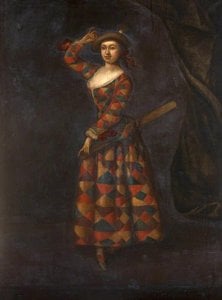
John Ellys: Bridging the Gap Between Court and Canvas
The name John Ellys, though perhaps less celebrated than some of his contemporaries, represents a pivotal figure in 18th-century English portraiture – a painter who skillfully navigated the demanding world of royal commissions, academic training, and evolving artistic styles. Born in March 1701, Ellys’s life unfolded against a backdrop of significant shifts within the British art scene, marked by the rise of Hogarth and Vanderbank, and ultimately shaped by his close association with Sir Robert Walpole. His career wasn't defined by radical innovation but rather by a remarkable ability to synthesize influences, adapt techniques, and consistently deliver elegant, refined portraits that catered to the tastes of both the court and the burgeoning art market.
Ellys’s early artistic development was rooted in formal instruction. He began his training under Johann Rudolph Schmutz, a German painter known for his meticulous draftsmanship, before transitioning to the tutelage of Sir James Thornhill and later, the influential John Vanderbank. This diverse exposure proved invaluable, providing him with a solid foundation in classical techniques while simultaneously exposing him to the more dynamic and satirical approaches championed by Hogarth. Crucially, Ellys’s early years were spent copying works by masters like Anthony van Dyck and Godfrey Kneller – an essential practice for any aspiring portraitist of the era, allowing him to internalize the nuances of composition, color palette, and figure rendering.
Royal Patronage and Artistic Evolution
Ellys’s career truly took flight when he secured a warrant to copy pictures in the royal palaces for study – an opportunity that afforded him unparalleled access to some of the most treasured artworks in the collection. This experience profoundly influenced his style, imbuing his portraits with a sense of gravitas and refinement. He quickly established himself as a favored painter within the Walpole circle, undertaking numerous commissions for Sir Robert Walpole, who served as First Lord of the Treasury and oversaw much of England’s foreign policy during the early 18th century. Walpole's patronage wasn’t merely about acquiring beautiful portraits; it was about projecting an image of stability and power – a role Ellys skillfully fulfilled.
A particularly notable commission involved the acquisition of *The Virgin and Angels* by Anthony van Dyck from the Princess of Friesland. Walpole, recognizing the painting’s significance, entrusted Ellys with the task of procuring it for the Hermitage Gallery – a testament to his reputation as a discerning art buyer and a skilled negotiator. This undertaking demonstrated not only Ellys's connections within the royal court but also his understanding of the value and prestige associated with acquiring masterpieces.
The St. Martin’s Lane Academy and Artistic Leadership
Following in the footsteps of Vanderbank, Ellys and William Hogarth succeeded to the directorship of the St. Martin's Lane Academy in 1736 – a prestigious institution that served as a hub for artistic innovation and debate. Their tenure at the academy spanned nearly three decades, during which they fostered a vibrant community of artists while simultaneously navigating the complex dynamics of academic leadership. Ellys’s approach differed somewhat from Hogarth's more overtly critical stance; he maintained a greater degree of decorum and focused on providing practical instruction rather than engaging in polemical arguments about artistic merit.
Despite their shared leadership, Ellys held a distinct perspective on the prevailing trends within portrait painting. He expressed reservations about Sir Joshua Reynolds’s innovations, particularly his emphasis on classical ideals and theatrical poses. While acknowledging Reynolds's talent, Ellys favored a more restrained and elegant style – one that prioritized accuracy of likeness and subtle nuances of expression. This difference in aesthetic sensibilities ultimately shaped the distinct character of their respective artistic practices.
Legacy and Artistic Style
John Ellys died on September 14, 1757, leaving behind a substantial body of work that reflects his diverse influences and his commitment to delivering portraits of exceptional quality. His style is characterized by its meticulous draftsmanship, refined color palette, and understated elegance – qualities that resonated with the tastes of his aristocratic clientele. He was particularly adept at capturing the likenesses of his subjects, imbuing each portrait with a sense of dignity and composure.
Ellys’s legacy extends beyond his individual paintings. He played a crucial role in shaping the landscape of 18th-century English portraiture, bridging the gap between academic training and contemporary artistic trends. His association with Hogarth and Vanderbank exposed him to the latest innovations while simultaneously preserving a sense of tradition and refinement. Furthermore, his service as master keeper of the lions at the Tower – a seemingly minor appointment – underscored his connections within the highest echelons of British society.
Notable Works
- Portrait of Lord Whitworth and his nephew (1727)
- Portraits of numerous members of the aristocracy, including Lavinia Fenton, Duchess of Bolton, James Figg, and Frederick, Prince of Wales.
- Numerous engravings based on his portraits, notably those by John Faber the Younger.
Ellys’s work continues to be studied and appreciated for its technical skill, understated elegance, and its reflection of a pivotal moment in British art history.
Frågor och svar
Var kan jag hitta John Ellyss konstverk sorterade efter färgpalett?
För att hitta verk av John Ellys i en specifik färgpalett, besök artistens sida för sortering efter färg: Efter färgpalett.
Var kan man hitta John Ellyss konstverk sorterade efter konststil?
Sidan Alla konststilar grupperar John Ellyss konstverk efter konstinriktning.
Hur hittar jag alla verk av John Ellys sorterade efter teknik?
Bläddra bland John Ellyss verk efter medium på John Ellyss Alla tekniker-sida.