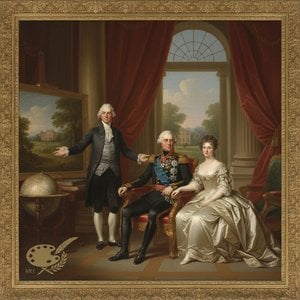
A Welsh Visionary: John Downman (1750-1824)
John Downman ARA, born in Denbighshire around 1750, stands as a prominent figure within the landscape of British portraiture and subject painting during the Regency era. His artistic journey began with foundational education at Chester and Liverpool before culminating in formal training at the Royal Academy Schools—institutions that would profoundly shape his stylistic sensibilities and contribute to his enduring legacy. Notably, he benefited from mentorship under Benjamin West, a celebrated neoclassical painter whose influence extended far beyond their studio collaboration.
- Early Influences: Downman’s formative years were marked by exposure to the artistic currents of his time, particularly the burgeoning Neoclassical movement championed by West and its emphasis on classical ideals and heroic narratives.
- The Italian Expedition (1773-1775): Driven by a fervent desire for artistic advancement, Downman embarked upon an ambitious expedition to Italy alongside Joseph Wright of Derby, his pregnant wife Anne Wright, and Richard Hurleston. This voyage wasn’t merely a quest for inspiration; it represented a deliberate immersion into the heart of European artistic innovation—a period characterized by groundbreaking experimentation in technique and subject matter.
Downman's artistic output was remarkably prolific during his lifetime, producing over 148 works exhibited at the Royal Academy between 1769 and 1819. While portraits constituted the core of his oeuvre—capturing the likenesses of prominent figures from British society—he possessed a remarkable versatility in tackling diverse subjects, ranging from mythological scenes imbued with symbolic resonance to theatrical representations that skillfully blended artifice and emotion. Pieces like ‘Rosalind,’ painted for Shakespeare’s Gallery, exemplify his masterful command of composition and color, reflecting the aesthetic principles prevalent during his era. Furthermore, works such as 'The Death of Lucretia;' 'The Priestess of Bacchus;' 'Tobias;' 'Fair Rosamond;' 'The Return of Orestes;' and ‘Duke Robert,’ stand as testaments to his ability to convey complex narratives with striking visual clarity.
Technique & Style
Downman’s artistic technique was characterized by meticulous attention to detail—a hallmark of Neoclassical painting—combined with a sensitivity to tonal gradation that achieved remarkable atmospheric effects. He skillfully employed oil paint and chalk, often layering textures and hues to create luminous surfaces and imbue his canvases with palpable emotion. His portraits were distinguished by their understated elegance and psychological depth, capturing not merely physical appearance but also the inner character of his subjects—a testament to his profound understanding of human anatomy and expression.
Notable Achievements & Legacy
Downman’s election as an Associate of the Royal Academy in 1795 solidified his position within the artistic establishment of London and cemented his reputation as a respected artist. His enduring influence can be discerned in subsequent generations of painters who embraced his stylistic approach—particularly his penchant for theatrical compositions and evocative tonal palettes. Today, Downman’s paintings reside in prestigious museums across Europe and North America, ensuring that his contribution to British art history continues to inspire admiration and scholarly inquiry.
Family & Later Years
Downman married Anne Wright in 1780 and established a home in Cambridge before relocating to London and subsequently West Malling. He fathered Sir Edwin Downman, and his daughter married Thomas Lloyd. His artistic pursuits remained steadfast until his death on December 24th, 1824, leaving behind a substantial collection of artworks bequeathed to his daughter—a poignant reminder of the artist’s personal life intertwined with his professional accomplishments.